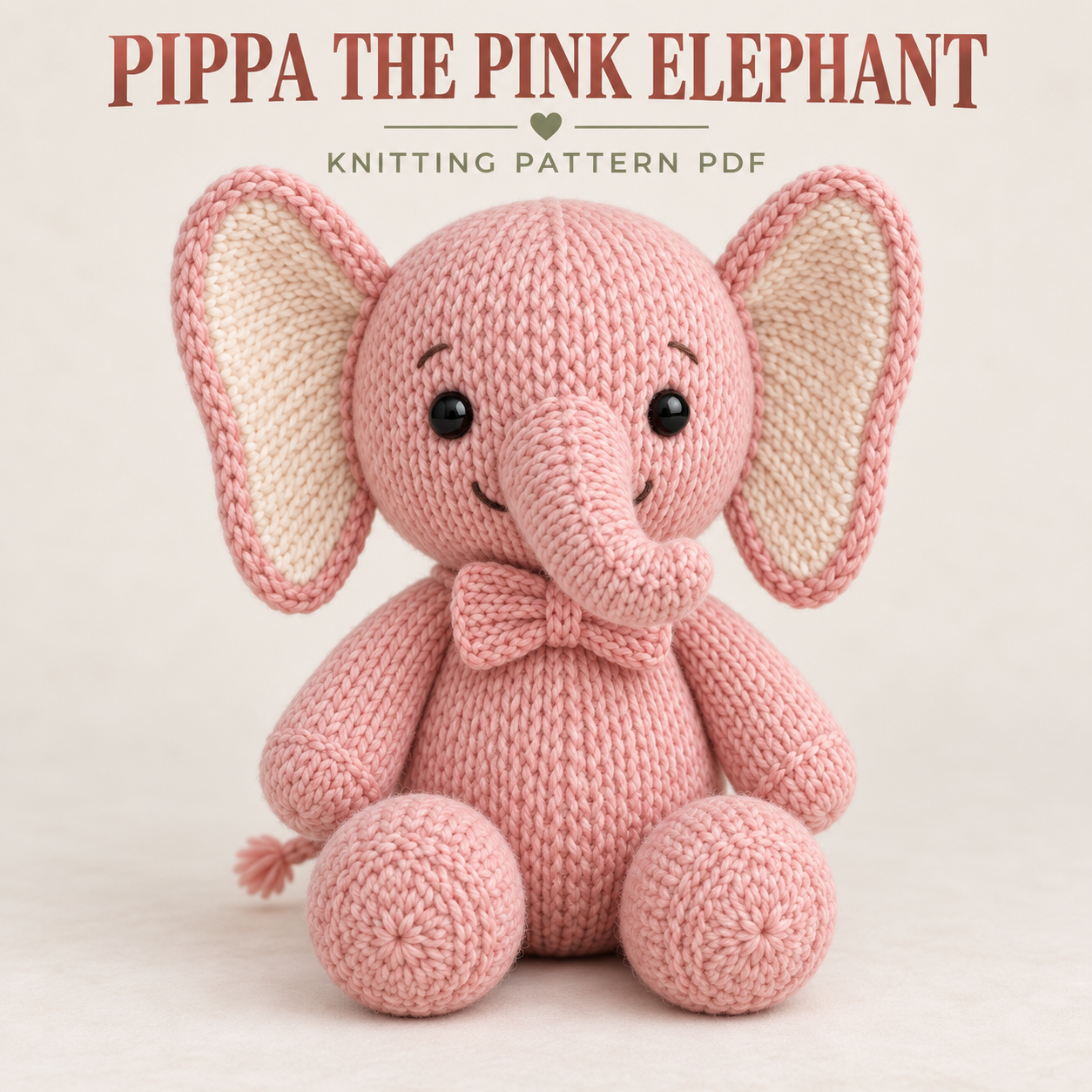
This pink elephant knitting pattern creates Pippa, a seated dusty-pink elephant with a dominant round head, tall ivory-lined ears, and a compact trunk that curls upward. A matching neck bow sits below the trunk, while rounded forward-facing feet support the seated silhouette. Small embroidered brows and smile segments give the face definition without an added muzzle patch. The PDF describes the skill level as confident beginner to intermediate, using both circular and flat knitting, shaping, seaming, and simple embroidery. This article explains the supplies, component construction, and placement checks that matter most before assembly. The complete instructions are available in the PDF download near the bottom.
About This Pink Elephant Knitting Pattern
Pippa’s proportions depend on the contrast between a large head and a slimmer pear-shaped torso. The ears are intended to read as tall and narrow, with an even pink border around each warm-ivory panel. Their upper and lower ends remain free to flare outward rather than being sewn flat against the head.
The main fabric, bow, feet, and little tufted tail are pink. There are no contrast foot pads or belly patch. The trunk has a firm base, a moderately filled middle, and a softer tip, allowing its sewn shaping tacks to create an upward curve without making the whole tube rigid.
Skills, Gauge, and approximate measurements
You need confidence with small rounds on DPNs or magic loop, flat stockinette with garter edges, increases and decreases, I-cord, and sewing stuffed pieces. Attaching the ears and shaping the trunk require more attention than the plain stockinette sections.
The pink elephant knitting pattern gives approximate dimensions of 23–25 cm seated height, 21–23 cm ear-to-ear width, and 14–16 cm depth. Each outer ear is about 6–6.5 cm wide and 10.5–11 cm tall; the trunk is about 6–6.5 cm long. These figures can vary with materials, tension, stuffing, and blocking.
Circular stockinette gauge is 22 stitches and 30 rounds per 10 cm before stuffing. Flat stockinette should have a similar stitch gauge so the ear layers remain proportional.
Yarn and Tools to Gather
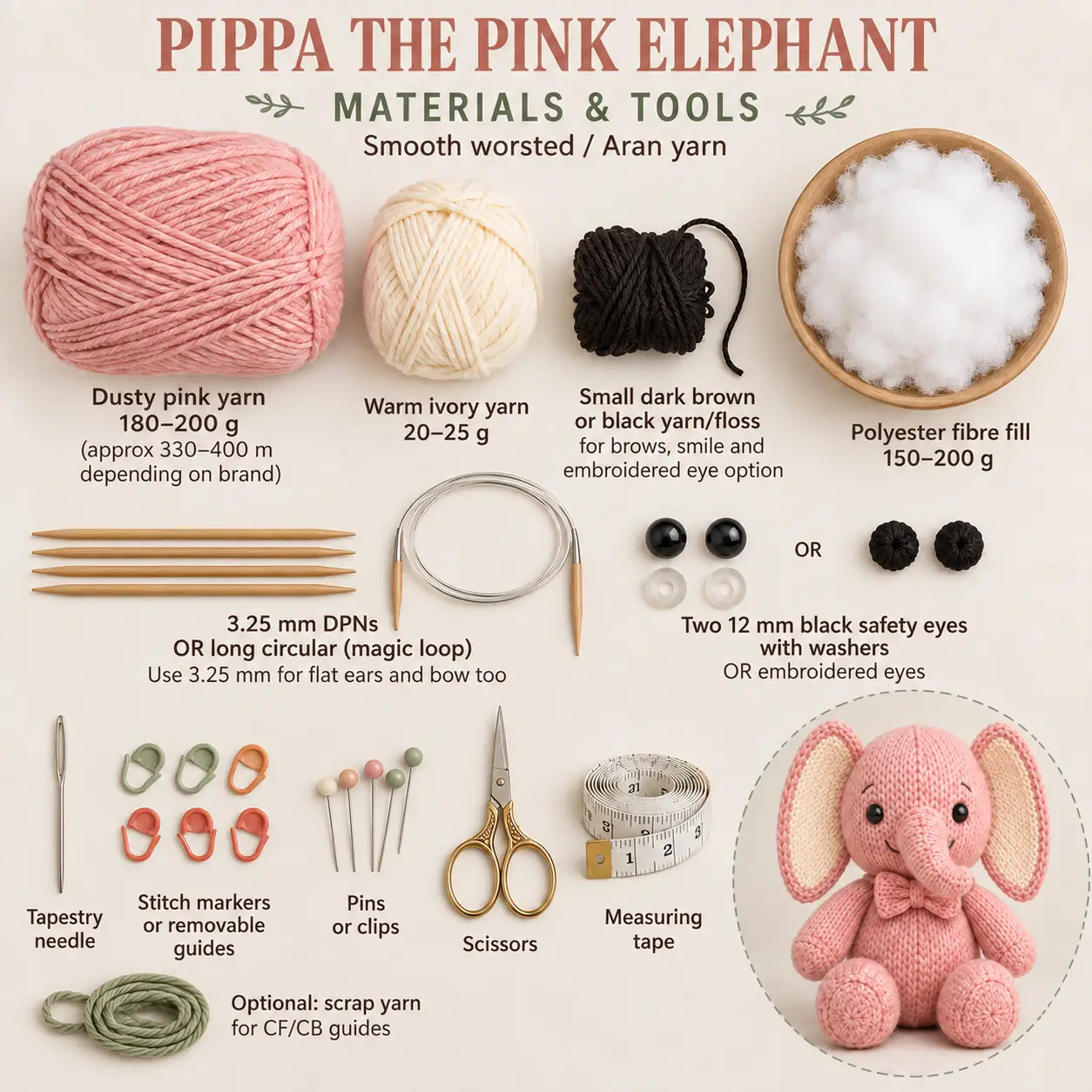
Use smooth worsted or Aran yarn: approximately 180–200 g dusty pink, corresponding to roughly 330–400 m depending on the brand, plus 20–25 g warm ivory of the same weight. A small amount of dark brown or black yarn or floss makes the face embroidery.
The needles are 3.25 mm DPNs or a long circular needle for magic loop; the same size can be used flat for the ears and bow. Allow approximately 150–200 g polyester fiberfill. Gather a tapestry needle, stitch markers, removable yarn guides, pins or clips, scissors, and measuring tape.
Eyes can be two 12 mm black safety eyes or embroidery. A little contrasting scrap yarn is optional for marking the front and back guides.
Techniques Behind the Shape
The head, body, trunk, arms, and legs are worked in the round. Knit-front-and-back increases widen the pieces, and knit-two-together decreases narrow them. Small starting centres are gathered securely closed before filling, while the trunk’s larger cast-on edge remains its attachment opening.
The pink elephant knitting pattern uses flat stockinette for the ears, with garter borders to define their edges. The inner panels are sewn shallowly onto the outer ears, keeping the backs neat. Both bow pieces use garter stitch, and the tail is a short four-stitch I-cord with a trimmed yarn tuft.
Simple underside tacks shape the trunk. Facial embroidery is added around the attached trunk, with two separate smile segments rather than a line hidden underneath it.
How Pippa Is Constructed
Start the pink elephant knitting pattern by preparing the layered ears and completing the head, fitting safety-eye washers before the final decrease section. Mark the eye positions at that stage if choosing embroidery. Stuff and close the head, then attach and shape the trunk and add the brows and smile.
The body is knitted separately into a slim seated form. Make and fill both arms and legs, leaving their attachment areas softer. Add the legs, arms, and tail to the body before joining the head. Front and back guides keep the larger head centred over the narrow torso.
Sew the ear attachment sections to matching head side lines, with the ivory panels facing forward. The bow goes on last, centred below the trunk and covering the front neck join.
Tips for Ears, Trunk, and Seated Balance
- Mark the physical side lines while the head is at its widest section. Extend them with removable guide yarn as shaping narrows.
- Sew only the central marked section of each ear’s inner long edge. Free upper and lower ends create the intended flare.
- Keep the ivory panels centred without stretching either layer. An even pink border makes mismatched placement easier to spot.
- Leave the trunk tip lightly filled. Its flexibility allows the underside tacks to lift it smoothly.
- Pin both feet while Pippa rests on a flat surface. Compare forward projection and contact height before sewing.
- Attach the bow through its centre band at several hidden points. This keeps it centred without crushing the lobes.
These checks help preserve the proportions described in the pink elephant knitting pattern.
Troubleshooting
Why does this pattern Trunk twist Sideways?
Release the shaping tack and rotate the soft tip back to centre front. Retack along the true underside rather than an off-centre line. If the trunk points downward, the source recommends adding or tightening an underside tack between the tip and middle. Adjust gradually so the curve remains soft instead of sharply pinched.
Why Does One Ear sit Higher?
Compare the central selvedge attachment sections and the head side guides. Remove only the necessary stitches, then distribute the marked edge evenly over the same head span as the opposite ear. Check both the top and bottom tips before resewing; matching one end alone can still leave the ear tilted.
Why Does Pippa Rock When Seated?
Massage the foot filling so both soles flatten and compare leg placement before changing the knitting. The PDF allows a small adjustment in attachment height if needed. Gently flatten the body underside as well, keeping its torso slim rather than adding filling until it becomes round.
Care and Secure Finishing
Follow the yarn and stuffing care instructions. Gentle spot-cleaning can help preserve the layered ears, bow, and tuft. If washing is suitable, avoid wringing, reshape the trunk and feet, and allow all filling to dry completely away from direct heat.
Check the tail tuft, seams, and face details before handling or gifting. The pink elephant knitting pattern recommends securely embroidered eyes for children under three and whenever detachable eye components are unsuitable. Follow the requirements appropriate to the intended use; embroidery does not remove the need for sound assembly.
Download Pippa’s Complete PDF
The complete pink elephant knitting pattern includes component instructions, stitch counts, approximate measurements, yarn quantities, gauge, placement maps, stuffing guidance, assembly steps, finishing checks, and troubleshooting. The source permits personal handmade creation and asks that the file and written instructions not be redistributed or resold. Use the full PDF for the shaping sequences and precise ear attachment marks.
DIGITAL DOWNLOAD ONLY — NO PHYSICAL ITEM WILL BE SHIPPED.
Leave a Reply