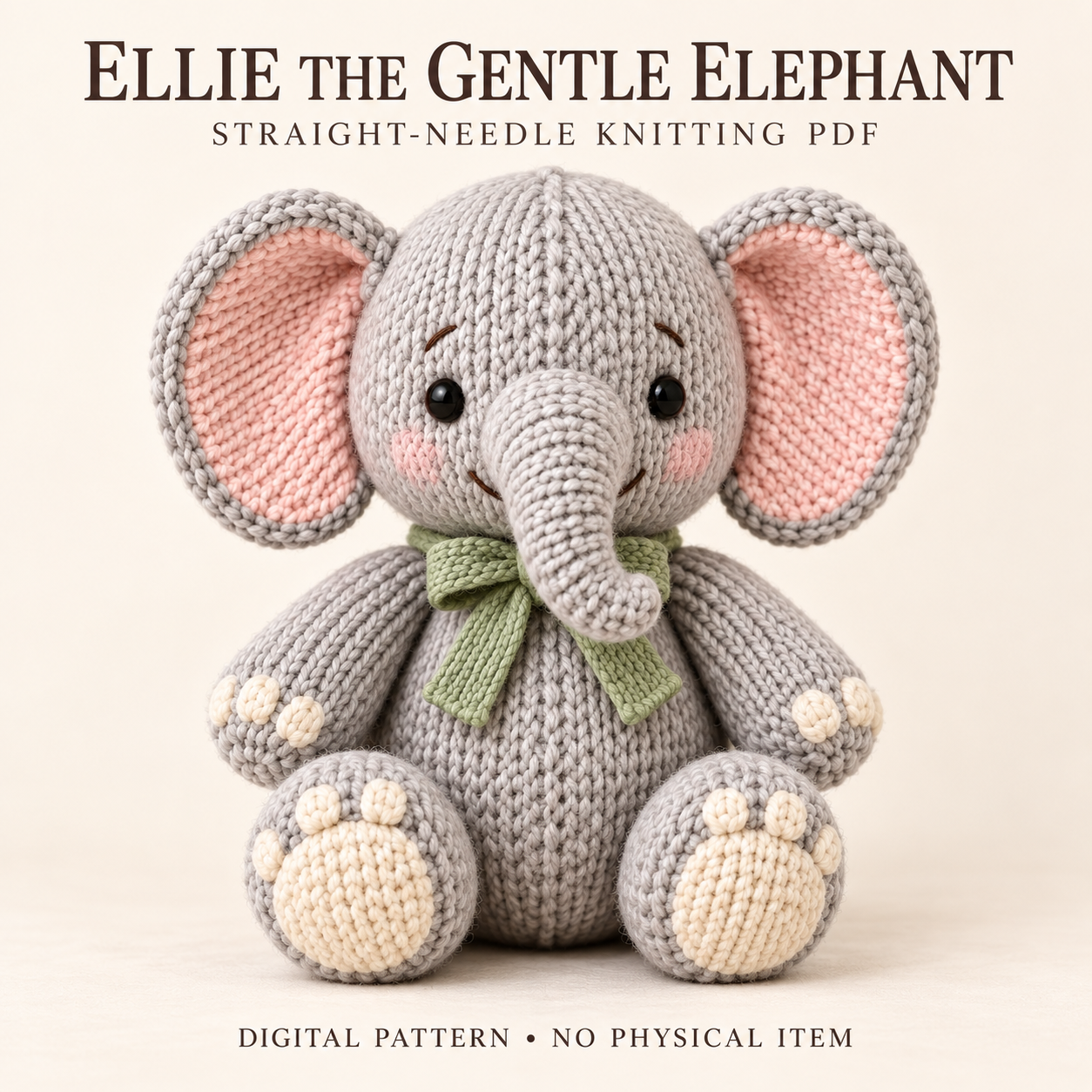
This elephant knitting pattern creates a seated grey plushie with broad pink-lined ears, a gently curled trunk, and a sage-green scarf. Cream sole and digit pads add contrast to the hands and feet, while embroidered brows, cheeks, and smile lines shape the expression. The pieces are knitted flat on straight needles, then seamed and stuffed. The PDF rates the design confident beginner to intermediate, with shaping on both right-side and wrong-side rows and a detailed assembly sequence. This overview explains the supplies, panel construction, and finishing choices before you begin. The complete knitting pattern PDF, including written row tables and placement maps, is introduced near the bottom.
About this elephant knitting pattern
Ellie’s head and body each use two side panels. Their joins form visible center-front and center-back seams, so those lines are useful construction landmarks rather than something to hide. The trunk is a separate tapered tube with light filling and a concealed thread that curls its lower section upward.
The ears consist of grey outer pieces and smaller pink inner panels, left unstuffed. Each foot has one large cream sole pad and three smaller digit pads; each hand has three small pads. The elephant knitting pattern finishes with a garter-stitch scarf and a braided or twisted grey tail with a tuft.
Skill level, finished measurements, and gauge
- Craft and type: flat-knitted stuffed elephant.
- Skill level: confident beginner/intermediate.
- approximate seated height: approximately 28–30 cm.
- approximate ear-to-ear width: approximately 29–32 cm.
- approximate seated depth: approximately 17–19 cm.
- Gauge: 20 stitches × 28 rows per 10 cm in relaxed stockinette.
The PDF gives design targets rather than verified physical measurements, and no completion-time estimate. The selvedge stitches are already included in every stated count: do not add extra seam stitches. In this elephant knitting pattern, correct panel orientation and access for internal yarn ends deserve as much care as the shaping itself.
Materials and tools for Ellie
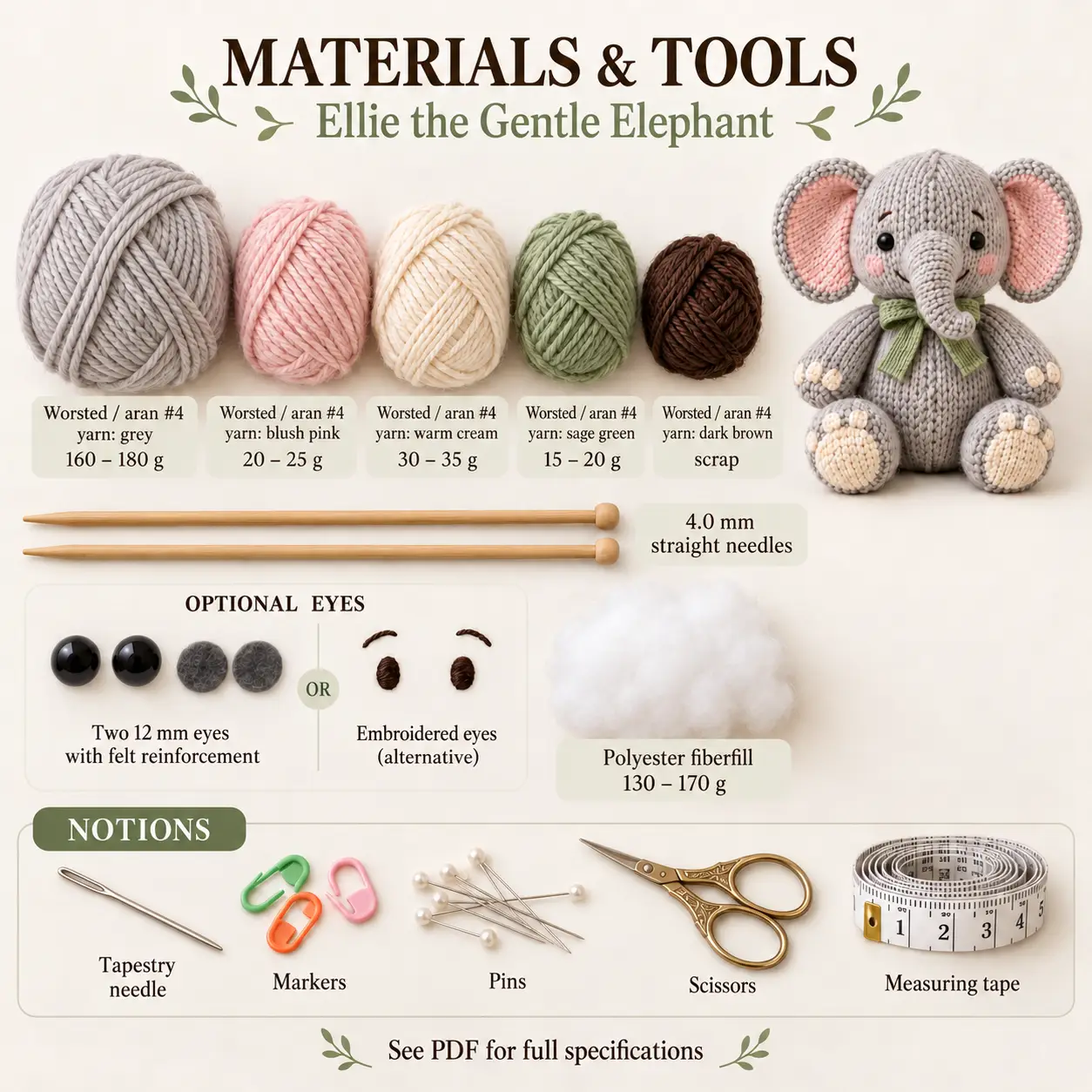
Use smooth plied worsted/aran #4 yarn. The allowances are approximately 160–180 g elephant grey, 20–25 g blush pink, 30–35 g warm cream, and 15–20 g sage green, plus a small dark-brown scrap for brows and smile lines. The listed meterages are 320–360 m grey, 40–50 m pink, 60–70 m cream, and 30–40 m sage.
You need 4.0 mm straight needles, approximately 130–170 g polyester fiberfill, a tapestry needle, removable markers or scrap yarn, pins, scissors, and measuring tape. The eye options are two 12 mm black safety eyes with felt reinforcement circles or embroidered eyes.
For the elephant knitting pattern, keep the fabric dense enough to contain filling, and use matching yarn weights so the ear layers and pads remain proportional.
Stitches, shaping, and seams
The main fabric is stockinette, with garter stitch for the scarf. Shaping includes knit-front-and-back and purl-front-and-back increases, plus right-side and wrong-side decreases such as knit-two-together, slip-slip-knit, and purl-two-together through the back loops where directed.
Mattress stitch joins the longer plush seams. Whipstitch is used for flat pads, ear layers, and the neck join. Facial details use embroidery or duplicate stitch as described in the PDF. Before starting the elephant knitting pattern, practice any unfamiliar wrong-side shaping on a small swatch; it is easier to see the direction there than in a partly completed panel.
How the side panels become an elephant
The written knitting sections begin with paired head panels, followed by body panels and separate features. Prepare the ear layers, then add the eyes and embroidery to the flat head halves while their wrong sides remain accessible.
Join the head’s front and back edges, leaving its neck opening available for stuffing and attachment tails. Add the prepared trunk and ears. The body panels form a separate shell with an open neck. Cream pads are attached while limb pieces are still flat, before those pieces are seamed and filled.
Attach arms, feet, and tail while the body neck remains open. The elephant knitting pattern joins head to body only after those internal ends are secured. The scarf is tied at the end, with temporary guide threads removed as the final seams are completed.
Tips for mirrored ears and a centered trunk
- Label the head and body halves before sewing. Count placements from the correct center-front edge on each half.
- Compare both eye heights before locking any safety-eye washers.
- Keep the pink ear inserts centered within an even grey border.
- Use light trunk filling so its shaping thread can create a gentle curve.
- Sew all twelve small digit pads before closing the limbs, checking three per hand and foot.
- Keep shoulders and ankles softer than the rounded limb ends so their attachment angles can settle naturally.
The elephant knitting pattern leaves the body neck open during limb and tail attachment for a reason: it provides access to secure the tails inside before the head join closes that route.
Troubleshooting the trunk, ears, and seated shape
Why does the trunk on my elephant knitting pattern project point sideways?
Check that its base is centered across the front seam. The shaping thread belongs underneath the trunk, not along one side. Rebalance the light filling and adjust the base before tightening additional attachment stitches. Pulling harder on an off-center shaping line can exaggerate the twist.
Why do the ears sit at different heights?
Compare each root with the placement map and measure from the center-front landmarks. Repin the affected attachment rather than stretching the ear fabric. Check both outward angles from the front so the pink inserts remain similarly visible.
Why does the elephant roll backward?
The PDF recommends adjusting the feet slightly forward and outward and adding a small amount of filling to the lower seat. Keep ankle areas softer so the feet can be positioned effectively. Check the body and both feet together on a level surface before finishing.
Care and small-component precautions
Follow the care labels for the yarn and filling; the PDF does not establish machine washability. Gentle spot-cleaning can address a local mark. If washing is permitted, avoid wringing, reshape the ears and trunk carefully, and allow the filling to dry completely away from direct heat.
Inspect the pads, trunk base, tail root, scarf, and eyes for loose threads or attachments. The PDF recommends embroidery for children under three or whenever detachable eye components are unsuitable. Felt reinforcement supports the hardware option but does not establish a safety-compliance claim. Follow applicable local requirements.
Download the complete Ellie PDF
The PDF contains yarn allowances, finished measurements, gauge, abbreviations, full written row tables, a component list, placement maps, face preparation, stuffing guidance, assembly order, and troubleshooting. It is supplied for personal handmade creation; permission to sell finished items depends on the seller’s terms. The digital file itself must not be copied, redistributed, resold, or shared.
DIGITAL DOWNLOAD ONLY — NO PHYSICAL ITEM WILL BE SHIPPED.
Leave a Reply