
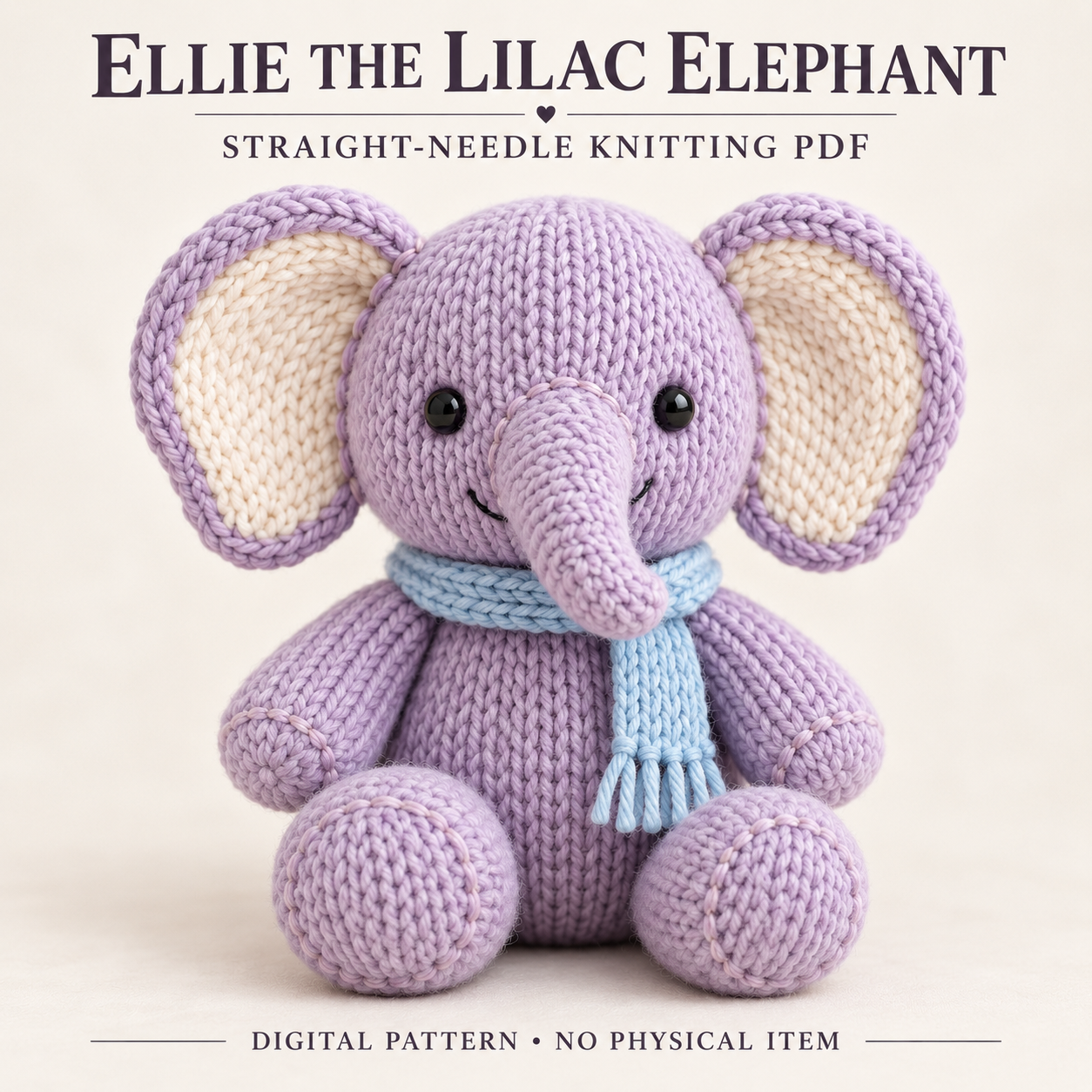
This lilac elephant knitting pattern introduces Ellie, a seated lavender elephant with broad cream-lined ears, a gently curved trunk, and a powder-blue fringed scarf. The rounded feet and soft arms frame a compact body, while the small facial details keep the expression simple. Every piece is knitted flat on straight needles, making the construction approachable for knitters who prefer seamed toy projects. The finished appearance depends on careful stuffing and thoughtful placement of the separate parts, especially the trunk and ears. This guide explains the yarn, skills, and assembly choices in the PDF so you can prepare your supplies before starting. Download the complete instructions for the shaping, stitch counts, and finishing sequence.
What makes this lilac elephant knitting pattern distinctive?
Ellie’s contrast comes from cream inner-ear panels and a blue scarf against the lavender body. The hands and feet remain lavender, without contrasting pads. A tasselled tail finishes the back, and the trunk curves gently downward rather than forming a sharply hooked tip.
The head and body each begin as a single shaped panel. Their edges join at the centre back, so accurate seam placement helps establish the front of the toy. The scarf is a stockinette tube with fringe, giving it a different finish from a flat garter-stitch strip.
Skill level, gauge, and finished measurements
The PDF describes a confident-beginner to intermediate project. You should be comfortable shaping flat knitting, seaming, gathering edges, and attaching stuffed pieces. Some trunk decreases occur on wrong-side rows, so read the abbreviations before casting on.
The lilac elephant knitting pattern specifies a firm flat gauge of 18 stitches and 26 rows per 10 cm. Its approximate target is approximately 24–26 cm seated height, with a similar ear-to-ear width and 15–17 cm depth. These are planning dimensions, not a guarantee for every yarn or tension. The trunk target is 8.5–9.5 cm measured along its curve; the scarf is approximately 3.2 cm wide and 36–38 cm long before fringe.
Yarn, needles, and notions to gather
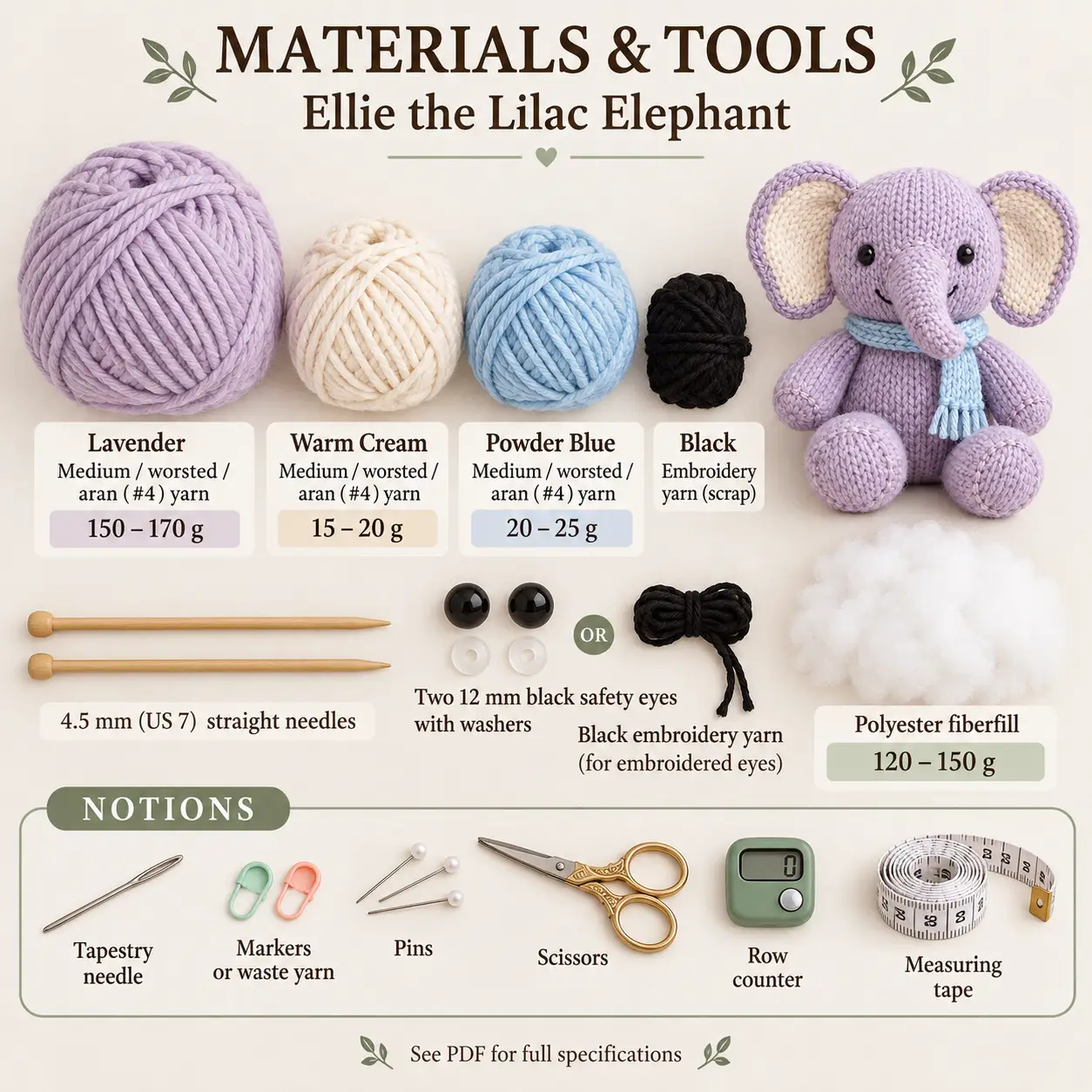
Use medium-weight, worsted or aran yarn in these quantities:
- Lavender: 150–170 g.
- Warm cream: 15–20 g.
- Powder blue: 20–25 g.
- A small amount of black yarn for embroidered details.
The supplies also include 4.5 mm straight needles, 120–150 g of polyester fiberfill, and either two 12 mm eyes with washers or embroidered eyes. Keep a tapestry needle, markers or waste yarn, pins, scissors, row counter, and measuring tape nearby.
Choose yarn that gives a firm fabric at the specified gauge. When preparing the lilac elephant knitting pattern, keep the three main colours clearly separated so the inner ears and scarf stay consistent across their pieces. Eye placement needs attention before the head is closed if you choose the fitted-eye option.
Flat-knitting techniques used in Ellie
The project combines stockinette, increases, shaped decreases, and several small seams. The trunk uses knit-side and purl-side decreases, including k2tog, ssk, p2tog, and ssp. Following the right-side and wrong-side labels keeps the tapered shape oriented correctly.
All stitch counts already include the edge stitches. Do not add extra selvedges to the lilac elephant knitting pattern, because doing so changes the panel width and seam alignment. The inner ears are sewn onto their outer panels without stuffing. The tail starts as a small flat strip that becomes an overcast cord, while the scarf’s long seam creates its tubular form.
Construction and assembly order
Make and identify the separate pieces before assembly. Finish the layered ears, position the eyes when applicable, then seam and fill the head. Shape the lightly filled trunk and attach it centrally; place the ears symmetrically around the head.
The body is knitted from its lower edge toward the neck. Join its centre-back seam and distribute the filling before gathering the neck. Align the head and body fronts before securing them together. Add the arms, feet, and tail, then complete the embroidered facial details and scarf.
Keep pins in place while assessing the silhouette from the front, side, and back. Temporary placement is particularly useful before securing the feet, since their position contributes to Ellie’s seated posture.
Stuffing, shaping, and finishing tips
Use firmer filling at the body’s seat and more moderate filling higher up. The arms need moderately filled hands with a lighter upper section, while the feet receive firmer filling toward the front. This distribution supports the intended shape without making every piece equally rigid.
For the lilac elephant knitting pattern, the hidden thread along the trunk’s underside is a shaping aid: shorten it gradually to produce the downward curve. The trunk itself needs only light stuffing. Its underside seam should stay discreet, and the curve should look smooth along its length.
The foot seams intentionally sit toward the upper front, slightly inward. Finish the scarf with its seam at the back so the visible front remains neat.
Troubleshooting assembly and proportions
Why is the trunk off-centre in my lilac elephant knitting pattern project?
Locate the head’s centre-back seam first. The centre front lies opposite it; use that reference when pinning the trunk. Reposition the attachment before sewing it permanently rather than compensating by twisting the whole head on the body.
Why does the trunk bend too sharply?
A tightly drawn underside thread can create a kink. Ease the tension and redistribute the light filling, then shorten the thread in small increments. Check the side profile each time so the bend remains gradual.
Why does the body seam look twisted?
Check that matching panel edges meet at the same level along the centre back. Uneven alignment can rotate the body and confuse the front reference. Correct the seam before attaching the head and limbs, while the pieces remain easier to handle.
Caring for the finished elephant
Follow the chosen yarn’s care label. Gentle surface cleaning may suit an assembled toy better than repeated soaking, especially when it includes fitted eyes, stuffing, and a scarf. Avoid wringing the body or stretching the trunk while damp.
Allow the elephant to dry thoroughly in its intended shape, away from direct heat. Check the ear, limb, tail, and scarf attachments periodically. The PDF offers an embroidered-eye alternative; select the finishing approach appropriate for the intended recipient rather than treating hardware as a universal choice.
Download the complete Ellie pattern PDF
The lilac elephant knitting pattern PDF contains the detailed shaping and assembly instructions needed to make the project. Use the complete document for row counts, stitch numbers, and the component finishing directions; this article is a preparation guide.
DIGITAL DOWNLOAD ONLY — NO PHYSICAL ITEM WILL BE SHIPPED.
Leave a Reply