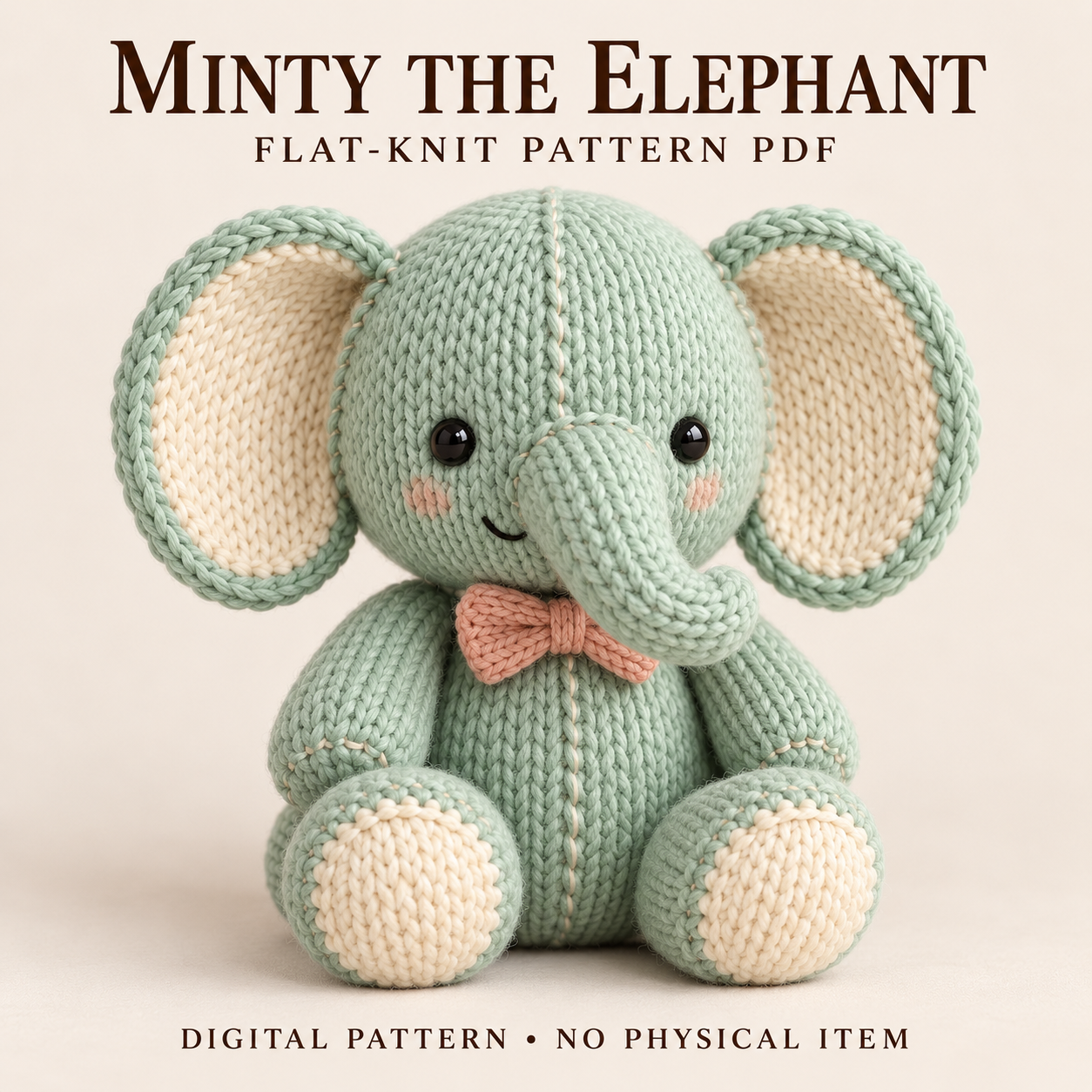
Minty’s mint elephant knitting pattern creates a seated plush elephant with a rounded head, wide ivory-lined ears, and a gently upturned trunk. The mint-sage body is paired with cream foot pads, a dusty-peach neck bow, and small peach cheeks. Loose ivory running stitches highlight selected seams and paw details. Most of the project is knitted flat, with a small crochet slip-stitch finish around the ears. The PDF describes confident-beginner to intermediate skills, including shaping, seaming, embroidery, and that narrow crochet trim. This overview explains the supplies and construction choices, especially the fixed front and back panel edges. Download the complete PDF near the bottom for the written instructions and detailed placement maps.
Features of the mint elephant knitting pattern
Large ears frame the face with cream centres and a raised mint border. They remain unstuffed; a small fold at each attachment edge creates a shallow cup without making the outer ear rigid. The trunk’s tip lifts with concealed underside tacks.
The body stays mint, without a separate cream belly patch. Flat cream pads sit on the front of the filled legs, and the peach bow is secured beneath the head, clear of the trunk. At the back, a compact knitted tail cord hangs down the centre seam and ends in a tiny mint tuft.
Skill level, gauge, and approximate size
The main stitch is flat stockinette: knit right-side rows and purl wrong-side rows. Increases and decreases shape the panels, while mattress and whip seams turn them into the rounded pieces. You will also use garter stitch, duplicate stitch, running-stitch embroidery, and crochet slip stitches.
The mint elephant knitting pattern specifies 19 stitches and 26 rows per 10 cm, measured relaxed and unstretched. approximate dimensions include 25–27 cm seated height, a 13–14 cm head width, and an ear span of 32–34 cm. Each ear is planned at approximately 10 × 9 cm. These are design targets that change with gauge, filling, and finishing.
Yarn colours and tools to prepare
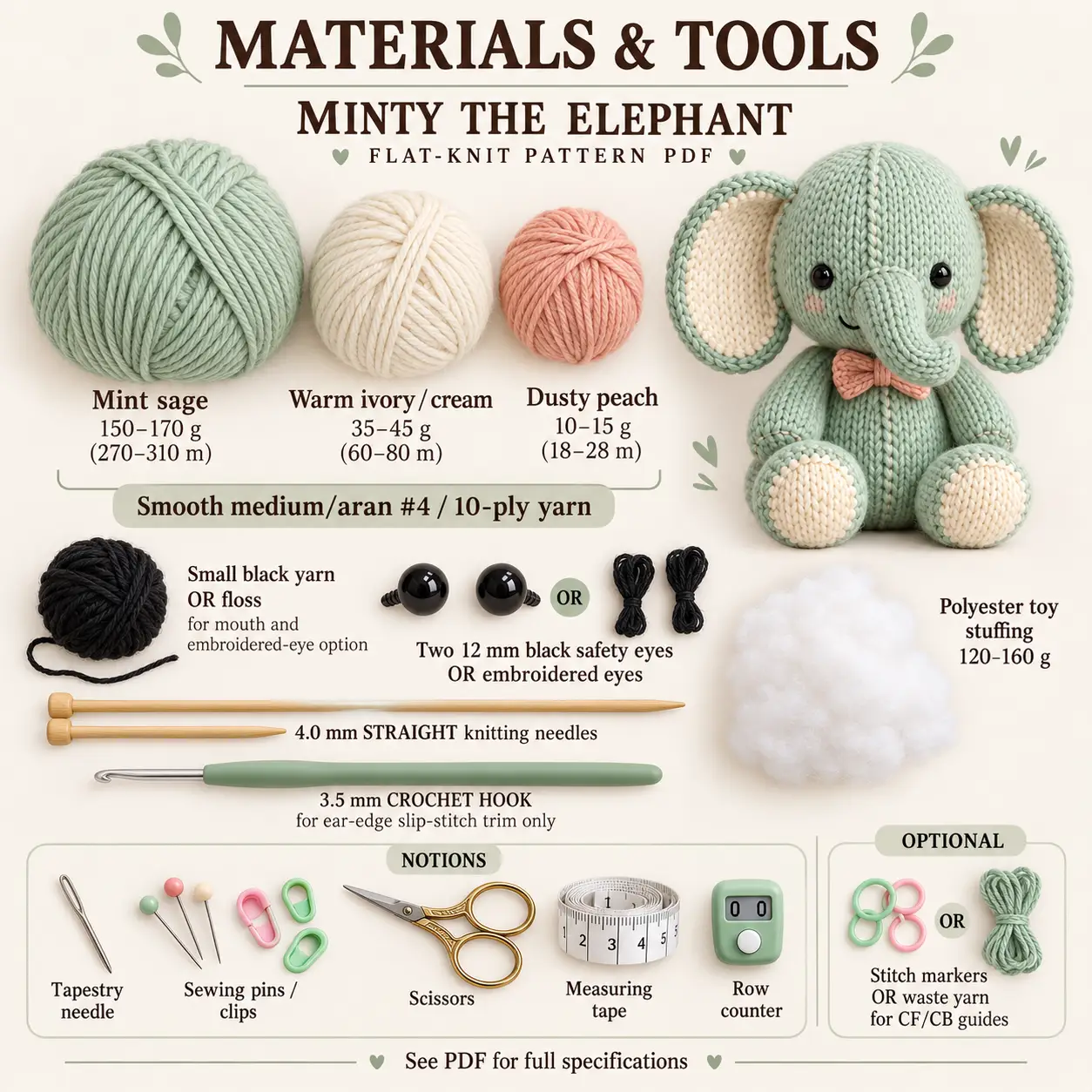
Choose smooth medium or aran yarn, weight number four or 10-ply. The PDF suggests cotton, cotton blends, or low-fuzz acrylic. Allow mint sage at 150–170 g or 270–310 m, warm ivory at 35–45 g or 60–80 m, and dusty peach at 10–15 g or 18–28 m.
The mint elephant knitting pattern uses 4 mm straight needles and a separate 3.5 mm crochet hook for the ear trim. Prepare a small amount of black yarn or floss for the mouth and embroidered-eye option, or two 12 mm eyes.
Stuffing is approximately 120–160 g of polyester fiberfill. Other tools are a tapestry needle, pins or clips, scissors, measuring tape, and row counter. Markers or waste yarn for the orientation edges are optional. Smooth yarn keeps the shaping and sewing bars visible.
Flat panels and fixed front-and-back edges
Two shaped panels form the head, and another pair forms the body. On each panel, one long edge is designated centre front and the other centre back. Joining the matching front edges establishes a permanent front seam; the matching back edges establish the rear seam.
The mint elephant knitting pattern includes its seaming edges within the stated stitch counts. Do not add extra selvedge stitches. Mark the chosen panel edges after knitting and retain those identities throughout finishing.
The head panels run from neck to crown, while the body panels run from the seated base toward the neck. The trunk, limbs, ear layers, foot pads, tail, and bow are separate flat pieces that are shaped or seamed as required.
Assembly and access for hidden ends
Install eye hardware on the unseamed head panels and add the cheek embroidery while the wrong sides remain accessible. Prepare each layered ear and its mint edging, then sew the head’s front, back, and crown seams, leaving the neck open.
Attach the ears and lightly filled trunk while you can still bury their ends through that opening. Fill the head afterward, complete embroidered eyes if chosen, and add the small mouth below the trunk.
Seam and fill the body, then prepare the legs with their cream pads. Attach the legs, arms, and centred tail before joining the aligned head and body openings. Add the bow and decorative ivory surface stitches after the structural joins are secure.
Tips for ears, trunk shaping, and seated feet
Keep the crochet edging relaxed. Its purpose is a slightly raised border, so tightening every slip stitch can pull the ear away from its intended flat oval. Compare both ears before attachment and preserve an even mint border around their ivory panels.
For the mint elephant knitting pattern, fill the trunk moderately at the base and lightly toward the tip. Keep its long seam underneath, where the concealed tacks can lift the end without an obvious dent on the visible surface.
Pin both legs while the body rests on a flat surface. Match the cream pads’ height and direction before tightening either hip seam. Keep shoulder filling soft enough for the arms to angle down and forward. Use loose surface embroidery so the ivory accents do not compress the filled pieces.
Troubleshooting seams and placement
Why does the trunk hang straight in my mint elephant knitting pattern project?
Check the underside shaping tacks and tighten them slightly, assessing the curve after each adjustment. Avoid pulling so hard that the tip folds sharply. Light filling toward the end makes a gradual upward curve easier to establish.
Why does the head-to-body join twist?
Reopen the affected neck section and align the front seams with each other, followed by the back seams. Distribute the two matching openings evenly before resewing. Correct the structural alignment before adding the bow, which can otherwise conceal the shifted front reference.
Why does one ear sit higher?
Compare the attachment midpoints and the amount folded back at each inner edge. Repin the higher ear using the same landmarks as its partner. Assess both cream panels from the front before completing the replacement seam.
Care and eye-finishing choices
After making the mint elephant knitting pattern, follow the chosen yarn’s care label for the assembled plushie. Gentle surface cleaning may suit the filled shape. Avoid wringing the trunk or pulling the broad ears and small tail tuft, and allow the filling to dry thoroughly after cleaning.
The PDF advises securely embroidered eyes instead of detachable eye components for items intended for children under three, alongside local requirements. Check ear attachments, trunk tacks, neck sewing, and bow joins during finishing. Decorative running stitches sit on the surface; they supplement the appearance rather than replacing the structural seams.
Download Minty’s complete pattern PDF
The mint elephant knitting pattern PDF includes the written components, ear-edge finish, placement maps, filling guidance, and assembly sequence. Use the complete file for exact row counts and the front-and-back edge system.
DIGITAL DOWNLOAD ONLY — NO PHYSICAL ITEM WILL BE SHIPPED.
Leave a Reply