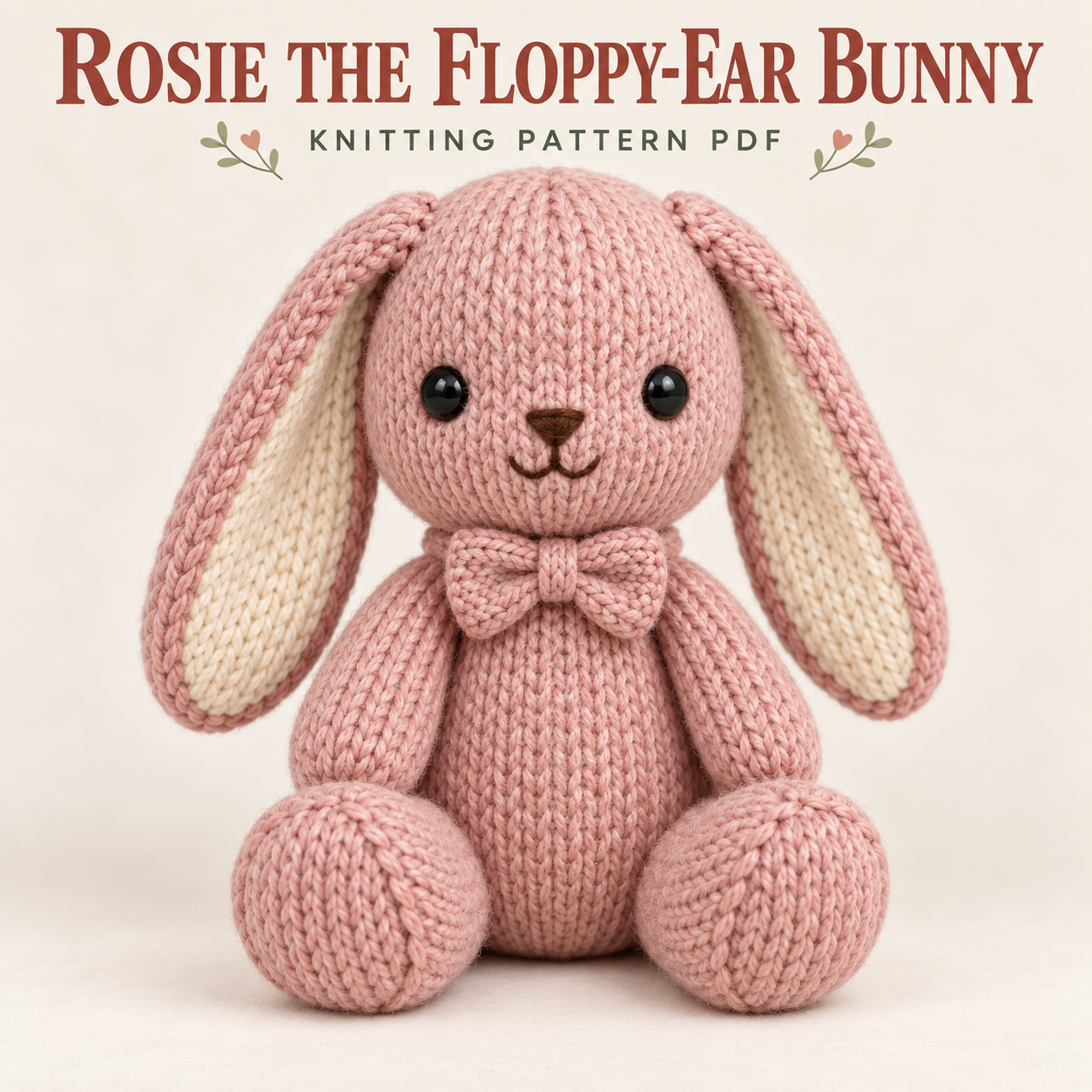
This pink bunny knitting pattern makes Rosie, a seated dusty-blush rabbit with a round head, long floppy ears, broad feet, and a matching neck bow. Warm cream fills the ear panels and the small knitted tail, while the nose and split smile are embroidered directly onto the pink face. There is no separate muzzle patch. The PDF describes the difficulty as advanced beginner to intermediate, combining small pieces in the round with flat stockinette ears and bow components. This article explains the DK-yarn supplies, component orientation, and assembly checks that help the bunny sit evenly. The complete instructions are available in the PDF download near the bottom.
About This Pink Bunny Knitting Pattern
The ears are unstuffed, with smaller cream panels sewn onto pink outer pieces. Their narrow attachment bases and a few hidden anchors control the drape. The rounded tips should hang beside the face rather than stand straight out from the head.
Rosie’s plain pink pear-shaped body has long arms and broad, gently flattened feet. A smooth-centred bow with narrow garter borders covers the front head-to-body join. The cream tail is a knitted stuffed ball, not a loose yarn pom-pom. These distinctions keep the materials and finishing methods consistent with the downloadable pattern.
Skills, Gauge, and Approximate Size
The pink bunny knitting pattern requires knit-and-purl fabric, knit-front-and-back increases, decreases, small-circumference knitting, sewing, and simple embroidery. Ear panels use paired shaping to maintain balanced edges, while the circular pieces are shaped into closed stuffed forms.
approximate dimensions include 22–24.5 cm seated height from the feet to the crown, 17–19 cm width across the feet, and 17–19 cm depth. Ears are about 15.5–16 cm long and 5.5–6.5 cm wide. Each foot is about 8–8.5 cm long; the cream tail is around 3–3.5 cm across. Results vary with tension and finishing.
Both circular and flat stockinette gauges are 22 stitches and 30 rounds or rows per 10 cm. Measure without heavily stretching the fabric.
Materials and Tools
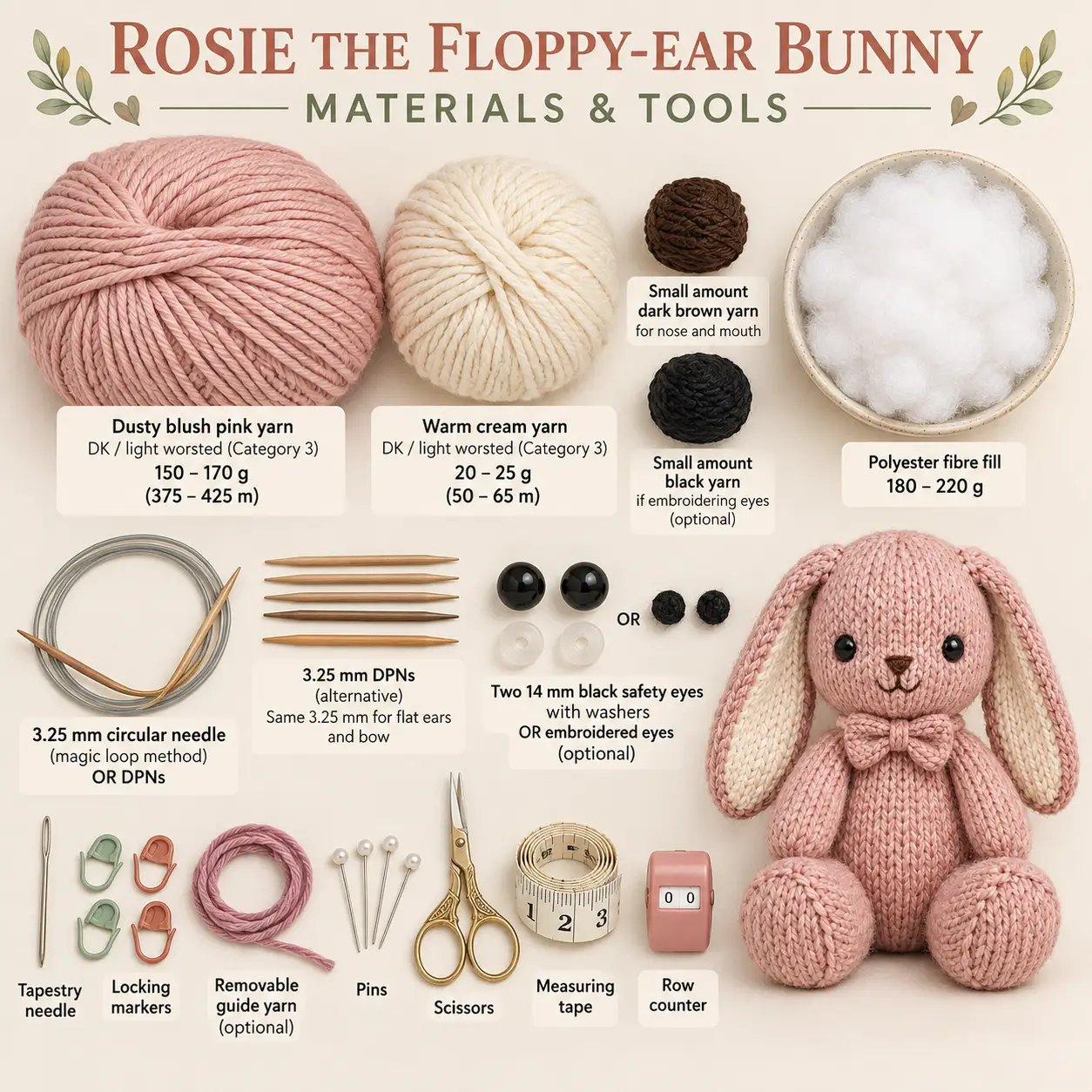
Use DK or light worsted category 3 yarn. Approximate amounts are dusty blush pink 150–170 g/375–425 m and warm cream 20–25 g/50–65 m. A small amount of dark brown makes the nose and mouth; black yarn is needed if embroidering the eyes.
The specified needles are 3.25 mm circular needles for magic loop or DPNs, with the same size for flat knitting. Allow approximately 180–220 g polyester fiberfill. Gather a tapestry needle, locking markers, removable yarn guides, pins, scissors, measuring tape, and row counter.
Eye options are two 14 mm black safety eyes or embroidery. Keep the main and contrast yarns at compatible gauge so the cream panels fit the pink ears without stretching.
Circular Pieces and Flat Panels
The head is worked from the crown toward its lower closure. Install safety-eye washers while the head remains accessible, before the decrease section; embroidered-eye locations are marked then and stitched after filling. The body starts at its neck pole and is fully closed before assembly.
The pink bunny knitting pattern also closes the arms, feet, and cream tail as individual pieces. Their attachment seams therefore join finished stuffed forms rather than serving as filling openings.
The outer ears and cream insets are knitted flat and sewn together without stuffing. The bow rectangle uses stockinette with garter edges, then accordion folds and a separate garter band define its centre. Circular stockinette means knitting every plain round; the flat panels alternate knit and purl sides.
Assembly and Closed-Piece Access
Check filling before joining the completed head and body. If either feels hollow, reopen that piece’s gathered closure, adjust its filling, and secure it again. The corrected PDF specifically says not to place loose stuffing between the two closed pieces.
Align their physical front and back landmarks and sew around the pinned contact area. Attach the assembled ears next, then arms, feet, tail, face embroidery, and bow. Pin both sides of every pair before sewing permanently.
The feet attach by their heel contact areas, with toes pointing forward and slightly outward. The tail sits at centre back, high enough to remain visible from the rear without lifting the bunny off its sitting surface.
Tips for Ears and Feature Alignment
- Keep centre front and centre back as physical guide lines. The beginning-of-round marker is a construction reference and should not move the face through knitting drift.
- Place each cream ear panel above the pink attachment edge. Leave an even pink border around its sides and rounded tip.
- Sew the insets shallowly without pulling tight. They should lie flat without making the outer ears cup or ripple.
- Mirror the shallow diagonal ear-base angle before adding hidden anchors. Matching anchors help both ears drape similarly.
- Stuff toes firmly and heels moderately, then flatten the feet gently. Ball-shaped feet can reduce the stable contact area.
- Centre the bow just below the chin. Keep its lobes dimensional and clear of the mouth.
These steps preserve the face and seated proportions described in the pink bunny knitting pattern.
Troubleshooting
Why Does One Pink Bunny Knitting Pattern Ear Hang Differently?
Check that both bases use the same cast-on attachment edge and mirror the same diagonal placement. Compare the cream panels too; tight inset seams can stiffen one ear. The PDF suggests a tiny hidden upper-edge anchor on the looser ear when needed. Adjust the attachment before trying to reshape the whole ear.
Why Does the Head-to-Body Join twist?
Repin using both centre-front and centre-back landmarks. Establish four anchor points at front, back, and both sides before filling the gaps with sewing. If additional filling is needed, adjust it through the affected piece’s closure first; opening the attachment seam does not give access inside a closed head or body.
Why Are the Feet Uneven?
Set the bunny on a flat surface and compare both heel attachment heights before completing the second sewing pass. Redistribute filling to make the toes sit level. Keep their small outward angle mirrored so one foot does not project farther or roll onto an edge.
Care and Eye Options
Follow the care instructions for both yarns and the selected filling. Gentle spot-cleaning can help retain the ear drape and folded bow. If washing is suitable, avoid wringing, reshape the ears and feet, and let all filling dry completely.
Inspect the tail, seams, and facial embroidery before gifting or handling. The pink bunny knitting pattern notes that detached safety eyes can be a choking hazard and are not recommended for children under three. Embroidered features provide an option without detachable eye hardware; secure assembly and appropriate local requirements still apply.
Download Rosie’s Complete Bunny PDF
The complete pink bunny knitting pattern includes component tables, gauge, approximate measurements, supplies, eye-access checkpoints, placement maps, stuffing notes, corrected assembly, final checks, and troubleshooting. The source describes personal handmade use unless separate seller licensing grants otherwise, and asks that the file not be shared or resold. Use the full instructions for the ear shaping and all circular component counts.
DIGITAL DOWNLOAD ONLY — NO PHYSICAL ITEM WILL BE SHIPPED.
Leave a Reply