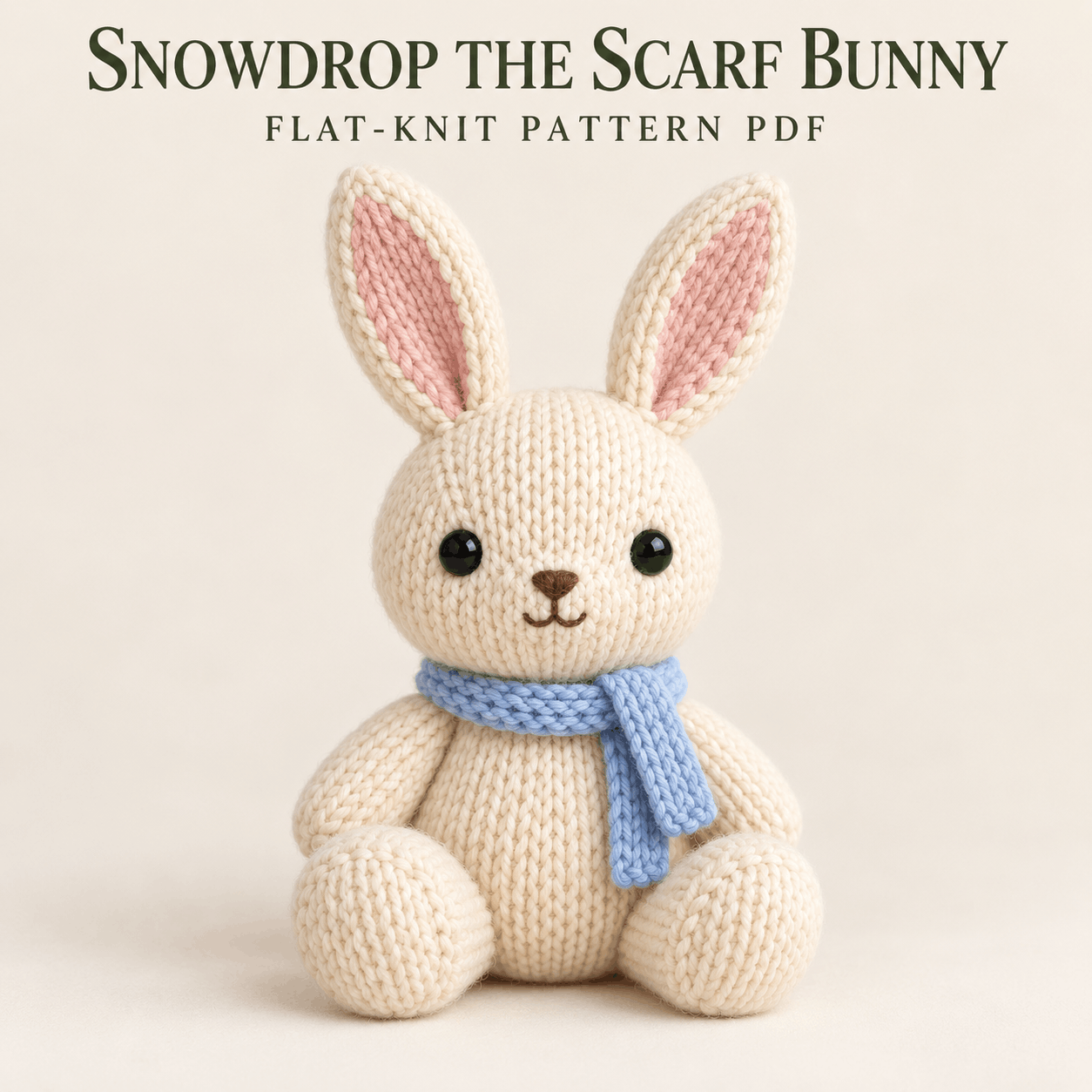
The scarf bunny knitting pattern makes Snowdrop, a seated cream rabbit with long upright ears, blush-pink inner panels, and a powder-blue scarf. A small brown nose and two curved mouth lines are embroidered directly onto the face. Rounded feet and relaxed arms balance the larger head, while a compact knitted tail sits at the back. The PDF describes advanced beginner to intermediate difficulty and uses flat knitting with seamed components. Careful closure timing matters: the eyes, face embroidery, and stuffing need access before the head is finished. This article covers supplies, construction, and project-specific alignment checks. The complete written instructions are available in the PDF download near the bottom.
About This Scarf Bunny Knitting Pattern
Snowdrop’s cream colour continues across the head, torso, limbs, outer ears, and tail. Pink appears only inside the ears, while the blue scarf wraps once around the neck. Its plain ends cross toward the bunny’s own left-front side rather than hanging centrally.
The ears have narrow bases and long tapered tips. Each uses two cream outer panels and a smaller pink inset. They stay mostly flat, with matching outward lean. A separate muzzle patch is not part of the component list; the embroidered brown features sit on the stuffed head. The tail is a knitted ball, rather than a loose pompom.
Skills, Gauge, and approximate Size
The scarf bunny knitting pattern uses flat stockinette, increases and decreases, garter edging, mattress stitch, gathering, short attachment seams, and embroidery. Some tables begin with a wrong-side purl row, so follow the stated row orientation rather than assuming the first row is always a knit row.
approximate dimensions are approximately 30–32 cm seated height to the ear tips and 19–21 cm from base to crown. Front-to-back depth is about 12–14 cm. Each ear is 12–13 cm long, the head 10–11 cm wide, and the tail about 4–4.5 cm across. The scarf target is 30–33 cm long and about 4 cm wide. Gauge and filling can change these dimensions.
Flat stockinette gauge is 17 stitches and 24 rows per 10 cm on 4.0 mm needles. Aim for firm fabric that contains the stuffing without stretching open.
Materials and Tools
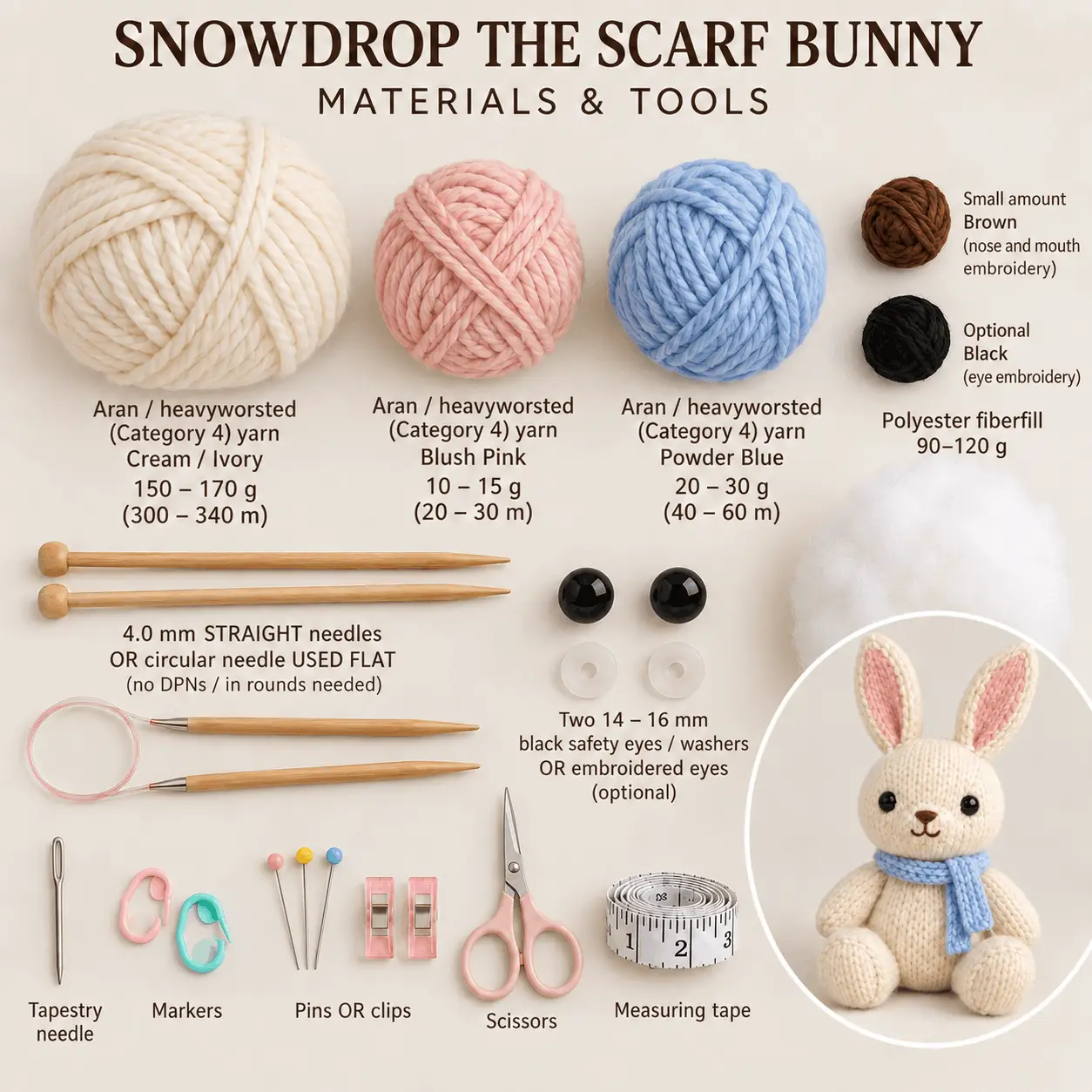
Use Aran or heavy-worsted category 4 yarn: approximately 150–170 g/300–340 m cream or ivory, 10–15 g/20–30 m blush pink, and 20–30 g/40–60 m powder blue. A small amount of brown makes the nose and mouth. Black yarn is needed if embroidering the eyes.
The source specifies 4.0 mm straight needles, or a circular needle used flat. Eye hardware is a pair of 14–16 mm black safety eyes with washers; embroidery is the alternative. Allow approximately 90–120 g polyester fiberfill.
Other tools are a tapestry needle, stitch markers, pins or clips, scissors, and measuring tape. Keep the yarn colours at the same general weight so the ear layers and scarf remain proportional to the cream pieces.
Flat Knitting, Gathered Ends, and Scarf Edges
The scarf bunny knitting pattern turns flat stockinette into rounded shapes by sewing the long edges and gathering selected ends. The head and body seams become centre back. Centre front is directly opposite, providing a reliable reference for the face and paired limbs.
The scarf has a smooth stockinette centre with one knit edge stitch on either side. These narrow borders help stabilize the strip. It has plain ends; fringe is not included.
Ear construction is layered rather than tubular. Sew each pink panel onto a cream front, then pair it with a plain back. Matching stitches and even cream borders keep the pink insets visually balanced.
Construction and Assembly Order
Prepare the ears, then knit the head and install optional safety eyes while the fabric is still flat. Seam from the crown downward, keeping the lower opening accessible. Stuff and embroider the nose and mouth before closing the remaining seam and gathering the neck edge.
The body top is gathered before filling through the lower opening. Close the base after shaping the seated footprint. Arms, legs, and tail are also stuffed and gathered before attachment; their finished ends form closed surfaces rather than open neck rims.
For the scarf bunny knitting pattern, join the gathered head base to the gathered body top with front and back landmarks aligned. Attach ears, arms, hind legs, and tail, checking the pose before securing each join. Wrap the blue scarf last and tack it discreetly only if needed to keep its position.
Tips for Upright Ears and a Stable Seat
- Mark centre front opposite the back seam while shaping the head. Use that guide for the nose and mouth before final closure.
- Keep the pink ear bases above the cream attachment edges, with equal borders on both sides.
- Compare ear-tip height while both bases are pinned. Their outward angles should mirror one another.
- Fill the paws more than the shoulders, allowing the arms to rest naturally against the body.
- Check both feet on a table before sewing the legs. Match their fullness and forward direction.
- Position the tail just above the seated base so it does not lift or push the bunny forward.
- Cross the scarf ends at the left-front without tightening the wrap enough to compress the neck.
Troubleshooting
Why does this project Tip to One Side?
Redistribute filling toward the lower body and feet, then recheck the leg positions on a flat surface. Compare the attachment row ranges on both sides. Check tail clearance too, since a tail resting underneath the body can change its seated balance.
Why Is a Pink Ear Inset Uneven?
Review the inset placement before joining the front and back layers. The pink panel should sit centrally with an even cream border. Keep filling minimal so it does not bulge underneath the inset. If an ear leans too far, the PDF suggests small support stitches at the back of its base.
Why Does the Head Seam Twist?
Reopen the affected section enough to align the stockinette column edges, then resew with mattress stitch. Keep centre front opposite centre back as you redistribute filling. Pull seam stitches evenly; tightening them excessively can create visible holes or draw the fabric off balance.
Care and Eye Choices
Follow the yarn and stuffing care labels. Gentle spot-cleaning can help retain the ear layers and scarf shape. If washing is suitable, avoid twisting or wringing, reshape while damp, and let the stuffing dry completely away from direct heat.
Inspect attached parts and embroidery before use. The scarf bunny knitting pattern recommends embroidered eyes instead of detachable safety-eye components for recipients under three. Secure all yarn ends and follow the relevant local requirements; no formal safety-testing claim is made.
Download Snowdrop’s Complete PDF
The complete scarf bunny knitting pattern includes shaping tables, stitch counts, supplies, gauge, approximate $1, face and body maps, ear layering, stuffing access, assembly, and troubleshooting. Use the PDF for precise row positions and closure instructions. It describes personal handmade creation unless the seller states otherwise and asks that the file itself not be redistributed.
DIGITAL DOWNLOAD ONLY — NO PHYSICAL ITEM WILL BE SHIPPED.
Related Flat-Knit Plush Projects
- Sagebow Bunny Knitting Pattern
- Lilac Floppy-Ear Bunny Straight-Needle Knitting Pattern
- Mocha Floppy-Ear Bunny Knitting Pattern
- Mallow the Scarf Cat Knitting Pattern
Leave a Reply