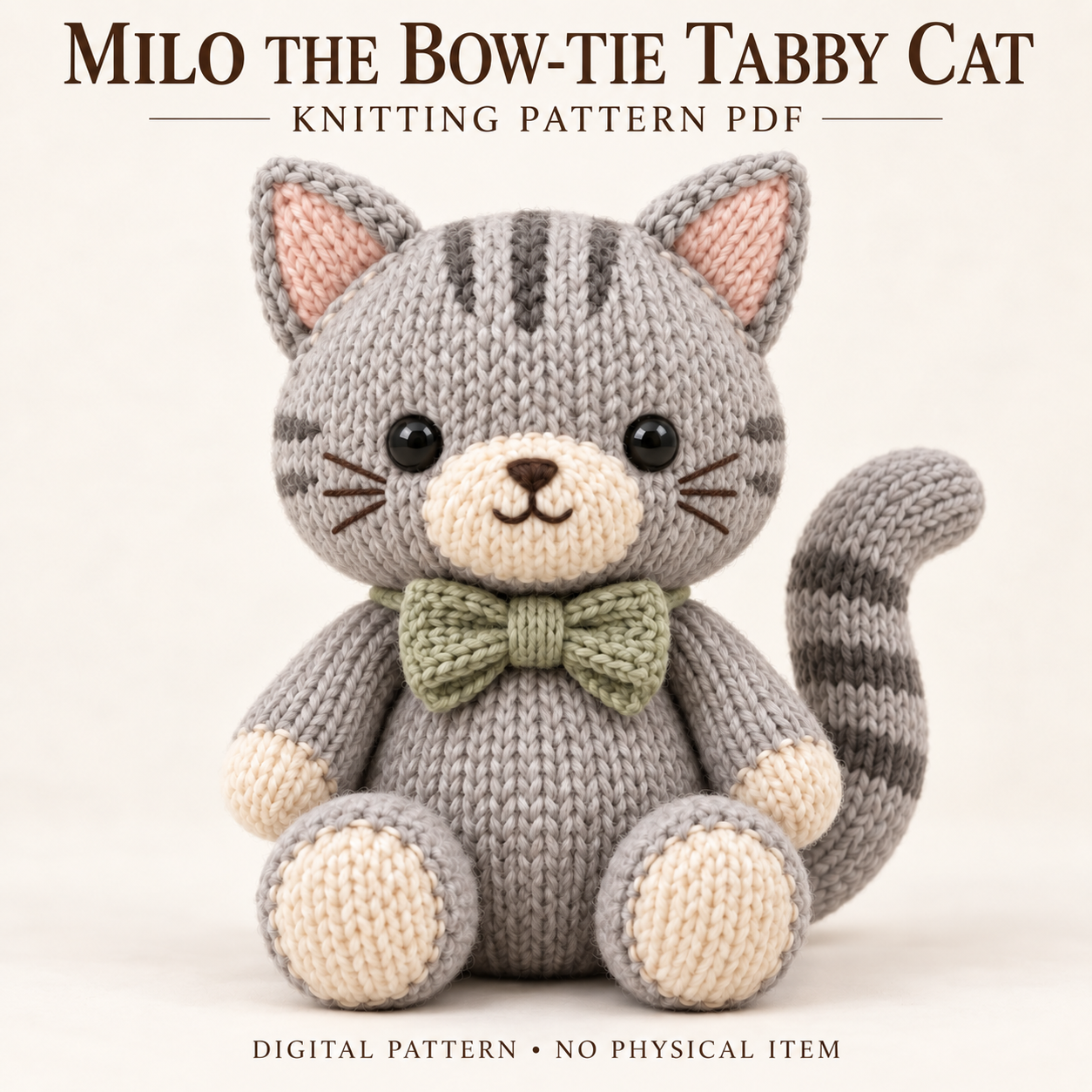
Milo’s bow tie tabby cat knitting pattern combines a large rounded head, cream paws, and an upward-curving striped tail with a sage-green collar and bow. Dark grey forehead markings, blush-pink inner ears, and a cream oval muzzle establish the tabby face. Most of the plushie’s filled pieces are knitted in the round, while the decorative panels and neck accessories use flat knitting. The PDF places the project at confident-beginner to intermediate level, with shaping, colour changes, duplicate stitch, embroidery, and assembly. This overview explains the materials and the placement choices that keep the cat balanced and facing forward. The complete downloadable PDF near the bottom supplies the component instructions, stripe positions, and assembly maps.
Features of the bow tie tabby cat knitting pattern
The main grey colour continues over the belly, without a separate cream tummy patch. Cream appears on the muzzle, arm ends, and front foot pads. Three vertical dark grey forehead stripes and two small side bars on each cheek create the tabby markings. Three dark brown or charcoal whiskers extend from each side of the muzzle.
The sage collar is a separate garter strip. The broad bow also uses garter stitch, with a stockinette centre band. A lightly shaped tail has three dark grey bands and curves upward behind the seated body.
Skill level, gauge, and approximate proportions
The bow tie tabby cat knitting pattern uses standard knitting terminology. You will need to manage small circular pieces, knit and purl flat sections, increase and decrease, and sew shaped components together. The placement work deserves as much attention as the stitch counts.
Gauge is 22 stitches and 30 rounds per 10 cm in circular stockinette, with approximately the same stitch and row counts for flat stockinette. The PDF’s approximate dimensions include 28–30 cm seated height with ears, a 14–15 cm head width, and a 12–13 cm tail before curving. The bow is planned at approximately 9–10 × 4 cm. Yarn, tension, and filling affect the finished proportions.
DK yarn colours and knitting tools
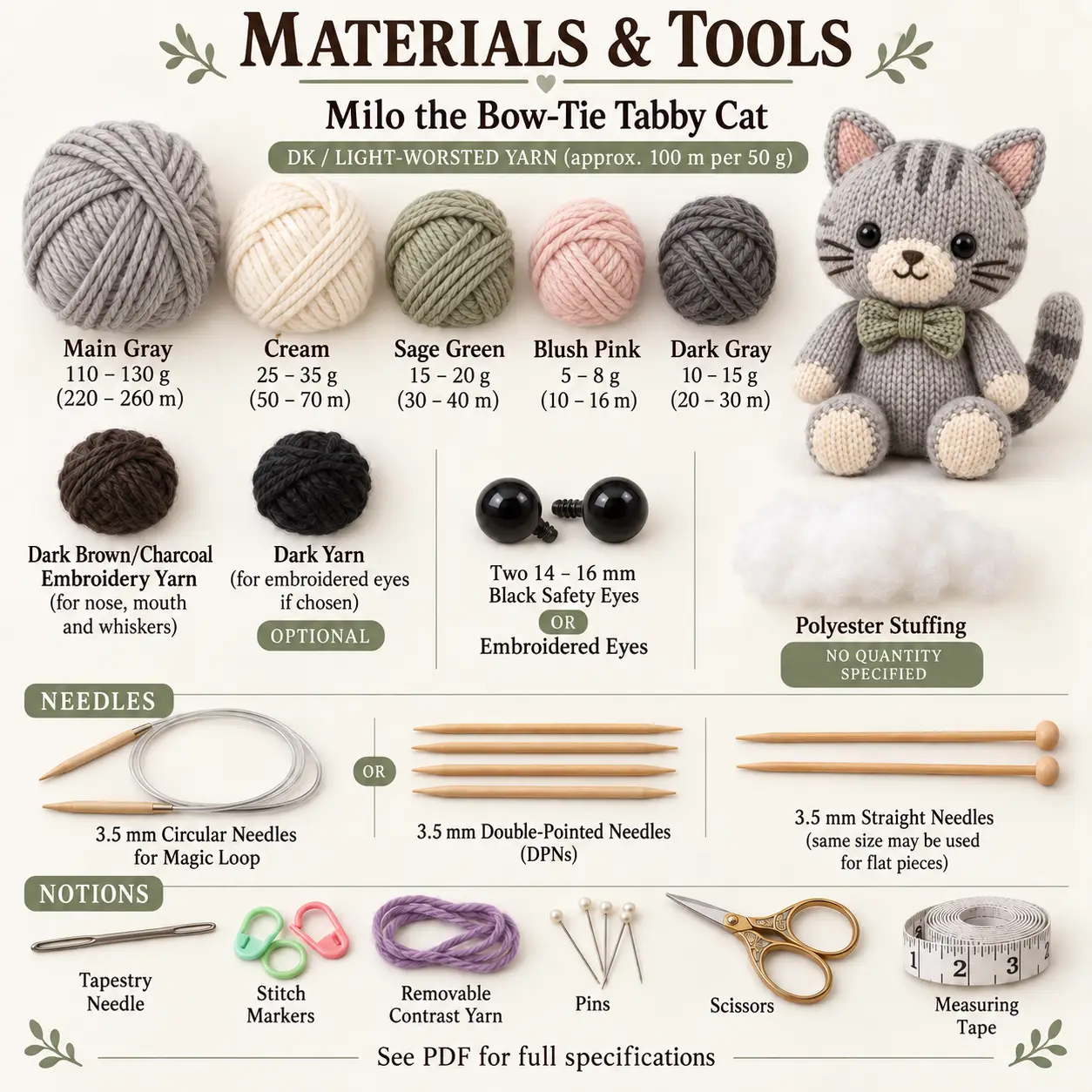
Choose DK or light-worsted yarn, approximately 100 m per 50 g. Main grey requires 110–130 g or 220–260 m; cream, 25–35 g or 50–70 m; sage green, 15–20 g or 30–40 m; blush pink, 5–8 g or 10–16 m; and dark grey, 10–15 g or 20–30 m.
The bow tie tabby cat knitting pattern also uses a small amount of dark brown or charcoal yarn for the nose, mouth, and whiskers. Keep that embroidery yarn distinct from the dark grey used for the tabby stripes.
Prepare 3.5 mm DPNs or circular needles for magic loop and same-size needles for flat pieces. Choose two 14–16 mm eyes or embroidered eyes. Other supplies are polyester stuffing, a tapestry needle, markers, removable contrast yarn, pins, scissors, and measuring tape. The PDF gives no numeric stuffing allowance.
Circular shaping and flat decorative pieces
The head starts at the crown and narrows to an open neck. The body starts at the base and also finishes with an open neck. Those matching openings are sewn together during assembly, after the face and internal eye or embroidery ends are secured.
In the bow tie tabby cat knitting pattern, the beginning of a round is a knitting reference rather than an automatic front or back landmark. Mark a physical centre-front column and an opposite centre-back guide independently. Continue those guides through shaping so the head does not rotate at the neck.
Arms and tail combine circular knitting with colour changes. The cream foot pads, muzzle, ear panels, collar, bow body, and centre band are separate flat pieces.
Face preparation and assembly order
Position the eyes while the head opening remains accessible. Add the forehead and cheek markings with duplicate stitch, then embroider the whiskers and complete the cream muzzle’s facial details. Hide and secure the ends before filling the head and joining it to the body.
Attach the cream foot pads while each foot still has its finishing opening, so the sewing tails can be secured inside. Stuff the feet and complete their closures afterward.
Join the aligned head and body, followed by the mirrored ears, feet, arms, and tail. Apply the tail’s supporting tacks without flattening its curve. Fit the collar with its seam at centre back and secure the bow at centre front. Remove the guides after checking the complete silhouette.
Tips for the neck, feet, and accessories
Use quarter-point pins around the neck before sewing, comparing both front and back guides. This distributes the join and helps prevent the head from turning as the seam progresses.
The bow tie tabby cat knitting pattern benefits from firm, even head filling and a supported lower body, with a softer chest and neck area. Keep the arms’ upper sections lightly filled so their seams lie against the body. Fill the feet moderately firmly, then flatten their contact areas by hand.
Leave the ears, collar, and bow unfilled. Match the inner-ear panels before closing the outer layers. Keep the curved tail lightly to moderately filled and assess it from the side before adding its final tacks. Small changes in attachment angle can alter the seated pose without changing the knitted shape.
Troubleshooting alignment and curved pieces
Why does this project have a twisted neck?
Check the physical front and back guides rather than aligning only the round-start markers. Unpick the neck join as needed, line up those guides, and pin the seam in quarters. Recheck the face direction after the first few sewing stitches.
Why does the cat tip on its feet?
Adjust the foot attachment angle before adding more stuffing. The PDF suggests releasing the upper portion of the seam and rotating the foot slightly outward and downward. Compare both contact areas on a flat surface, then resew without pulling one side higher.
Why does the tail have a sharp kink?
Remove the supporting tacks and smooth the filling along the curve. Replace the tacks farther apart so they support the tail without creating an abrupt bend. Avoid tightening a single tack until it indents the striped fabric.
Care and finishing the facial features
After making the bow tie tabby cat knitting pattern, follow the selected yarn’s care label. Gentle surface cleaning may suit the stuffed project. Avoid wringing, pulling the tail, or stretching the collar and bow while damp. Reshape the seated form and allow it to dry thoroughly.
The PDF recommends securely embroidered eyes instead of detachable eye components for items intended for children under three, alongside applicable local requirements. Check the whiskers, muzzle edge, neck join, and limb seams for loose ends. The thin decorative panels should remain flatter than the filled head and feet.
Download the complete Milo pattern PDF
The bow tie tabby cat knitting pattern PDF contains the full written instructions, face and stripe positions, component shaping, and assembly guidance. Use the complete file for exact counts and the independent front-and-back orientation system.
DIGITAL DOWNLOAD ONLY — NO PHYSICAL ITEM WILL BE SHIPPED.
Leave a Reply