
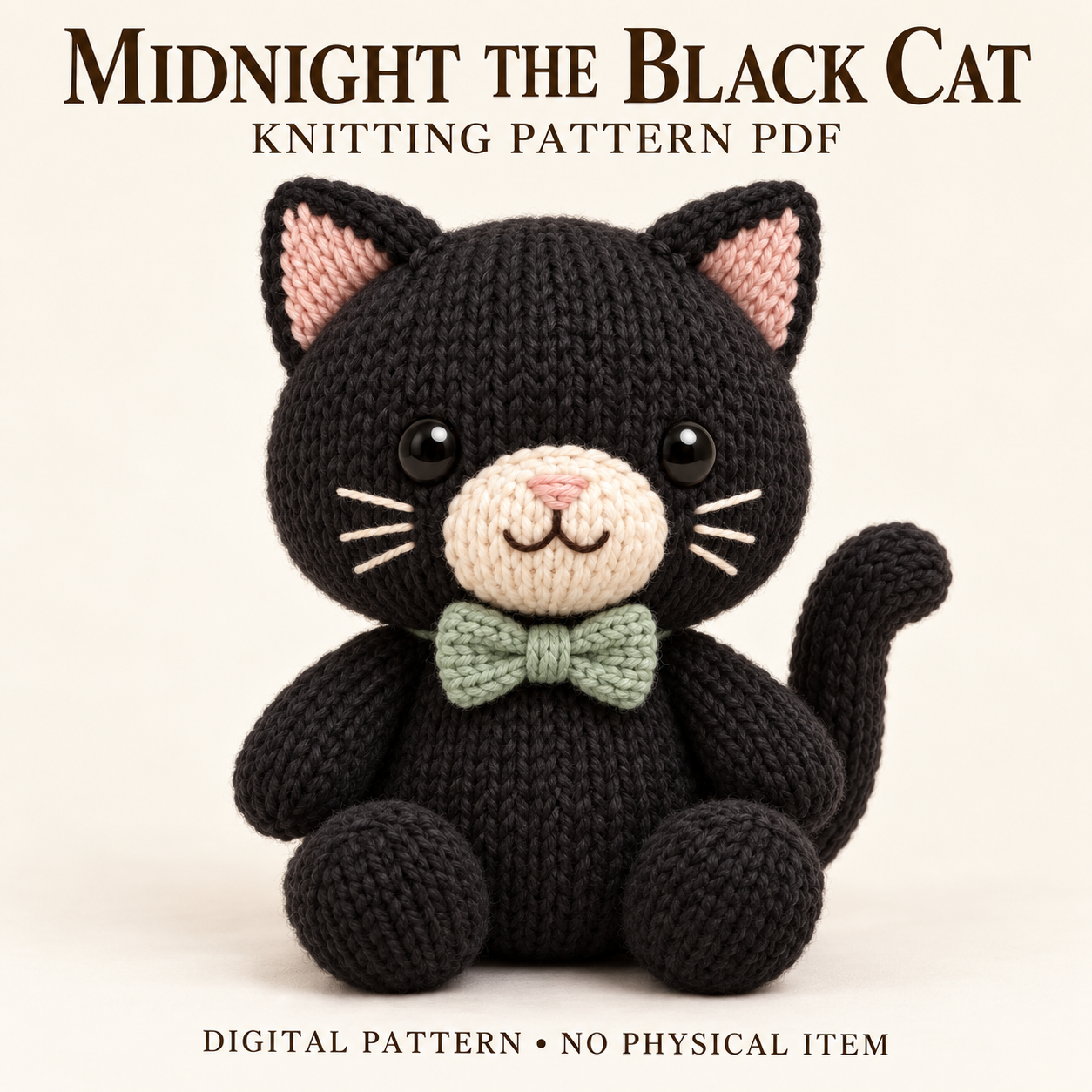
Midnight’s black cat knitting pattern pairs an oversized rounded head with a compact seated body, large oval feet, and a gently curved rear tail. The black yarn is contrasted by a cream muzzle, blush-pink inner ears and nose, six pale whiskers, and a sage-green bow tie. Most pieces are worked in the round, with flat knitting for the ear layers, muzzle, and bow. The PDF describes confident-beginner to intermediate skills, including shaping, stuffing, seaming, and embroidery. This guide explains the materials and construction choices, with particular attention to front and back references and the direction of the feet. Download the complete instructions near the bottom for the written pattern and detailed placement maps.
Details in the black cat knitting pattern
The cream muzzle is a horizontal oval, wider than it is tall, with a small pink triangular nose above a dark curved mouth. Three cream whiskers fan from each cheek. The feet, arms, and belly stay black, without separate coloured paw pads or a tummy patch.
The bow has a seed-stitch body and a smooth stockinette centre band. A lightly filled tail rises behind the cat in an upward hook. The restrained palette makes balanced placement noticeable: the muzzle needs equal black cheek space on either side, and the two bow loops should sit evenly beneath it.
Skill level, gauge, and approximate size
The main techniques include circular stockinette, increases, decreases, small flat pieces, seaming, and facial embroidery. Dark yarn makes careful stitch counting and clear removable guides useful during placement work.
The black cat knitting pattern specifies 17 stitches and 24 rounds per 10 cm in circular stockinette, with 17 stitches and 24 rows for flat stockinette after light relaxation. approximate dimensions include 30–32 cm seated height, a 16–17 cm head width, and a tail about 16–18 cm long. The planned bow is approximately 9.5 × 4 cm. Gauge and filling affect the result, so treat these figures as design targets rather than fixed finished measurements.
Yarn quantities and knitting supplies
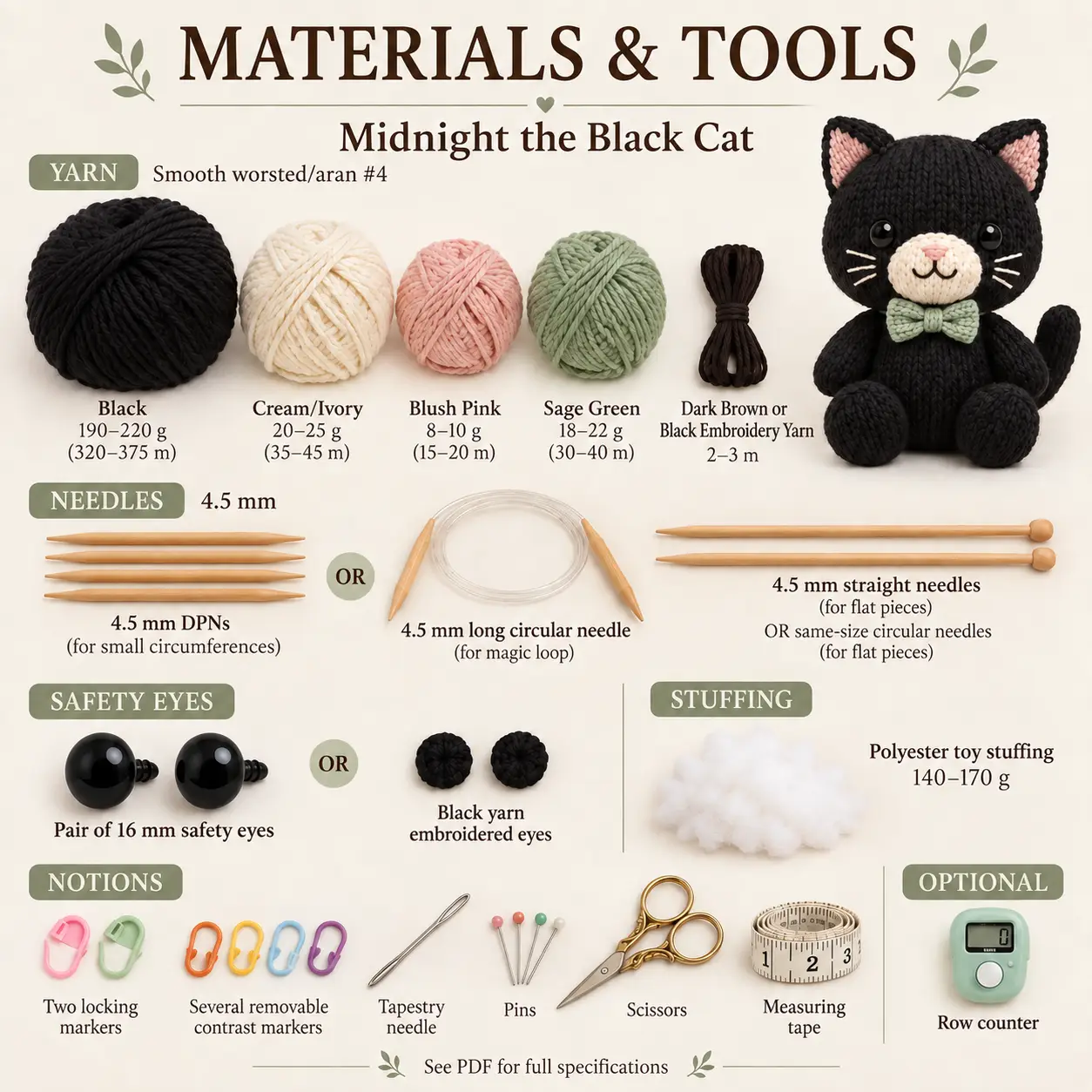
Choose smooth worsted or aran yarn. The PDF lists black at 190–220 g or 320–375 m, cream or ivory at 20–25 g or 35–45 m, blush pink at 8–10 g or 15–20 m, and sage green at 18–22 g or 30–40 m. Dark brown or black embroidery yarn requires about 2–3 m.
The black cat knitting pattern uses 4.5 mm DPNs or a long circular needle for magic loop, with same-size needles suitable for the flat pieces. Prepare a pair of 16 mm eyes or black embroidery yarn and approximately 140–170 g of toy stuffing.
Other tools are a tapestry needle, scissors, pins, measuring tape, two locking markers, and several removable contrast markers. A row counter is optional. The fabric should stay dense enough to contain the filling.
Component construction and orientation guides
The head and body begin at small circular cast-ons, widen, and then narrow toward their opposite ends. Arms, feet, and tail are also circular pieces. Each ear uses two black outer panels with a smaller pink panel sewn onto the front.
The black cat knitting pattern designates the round-start position as physical centre back for the head and body. Separate front guides remain opposite those back references. Carry the removable guides through shaping and keep them until assembly is complete.
The feet start at their toes and close at their backs. The tail starts at its tip and remains open at the base for sewing. Label those ends before stuffing so the attachment direction stays clear.
Assembly from completed face to neck bow
Complete eye installation or embroidered-eye anchoring before the head closes. Fill the head gradually, then add the horizontally placed muzzle and its light padding. Finish the pink nose, dark mouth, and whiskers with hidden ends before completing the muzzle edge.
Pin and attach the ears as a mirrored pair. Prepare the stuffed body, add the tail at the back, and position the feet on the lower front. Attach the arms with lighter, flattened upper sections.
Align the head and body’s front references before sewing their contact ring. Assess the full silhouette from the front, sides, and back. Centre the completed bow over the front neck seam, then remove the guides and bury the remaining tails.
Stuffing and placing the feet and tail
Use firmer filling through the body’s lower half and more moderate filling at the shoulders. Fill the foot toes firmly and their backs more moderately, gently flattening the sole area. The arms need light to moderate filling below their unstuffed upper sections.
The black cat knitting pattern places each foot’s long axis forward from the body, with only a slight outward toe angle. Laying that axis sideways across the front changes the seated proportions. Pin both feet before sewing and compare their contact with a flat surface.
The tail needs noticeably less filling than the feet. A shaping strand runs along one side and returns to the open base; shorten it only enough to establish the hook without puckering the visible fabric.
Troubleshooting balance and placement
Why does this project roll backward?
Flatten and redistribute the lower-body filling, then bring the feet slightly farther forward before resewing. Recheck the orientation of each foot’s toe-to-back axis. Compare the body from the side rather than assessing the feet only from the front.
Why does the tail twist at its base?
Unpick the base seam and align the tail’s curve upward at the centre-back guide. Pin its base in four places before sewing around it again. Keep the shaping knot enclosed without rotating the entire tail to hide it.
Why is the muzzle uneven beneath the eyes?
Align the nose with the front guide and pin the muzzle at its upper, lower, and widest side points. Unpick only the affected seam section if needed. Correcting the oval’s position gives more control than trying to compensate with extra filling on one cheek.
Care and eye-finishing choices
After completing the black cat knitting pattern, follow the chosen yarn’s care label. Gentle surface cleaning may be suitable for the assembled form. Avoid wringing the filled parts or pulling the whiskers and bow while damp, and allow the cat to dry thoroughly in shape.
The PDF advises embroidered eyes where detachable eye components are inappropriate, particularly for children under three, alongside applicable local requirements. Check the muzzle, ear, limb, tail, and bow attachments periodically. The ears need no filling or only a very thin wisp, so preserve their flatter shape instead of treating them like the firmly filled feet.
Download Midnight’s complete pattern PDF
The black cat knitting pattern PDF includes all component instructions, face preparation, guide placement, tail shaping, and assembly directions. Use the complete file for exact counts and the sequence of access steps.
DIGITAL DOWNLOAD ONLY — NO PHYSICAL ITEM WILL BE SHIPPED.
Leave a Reply