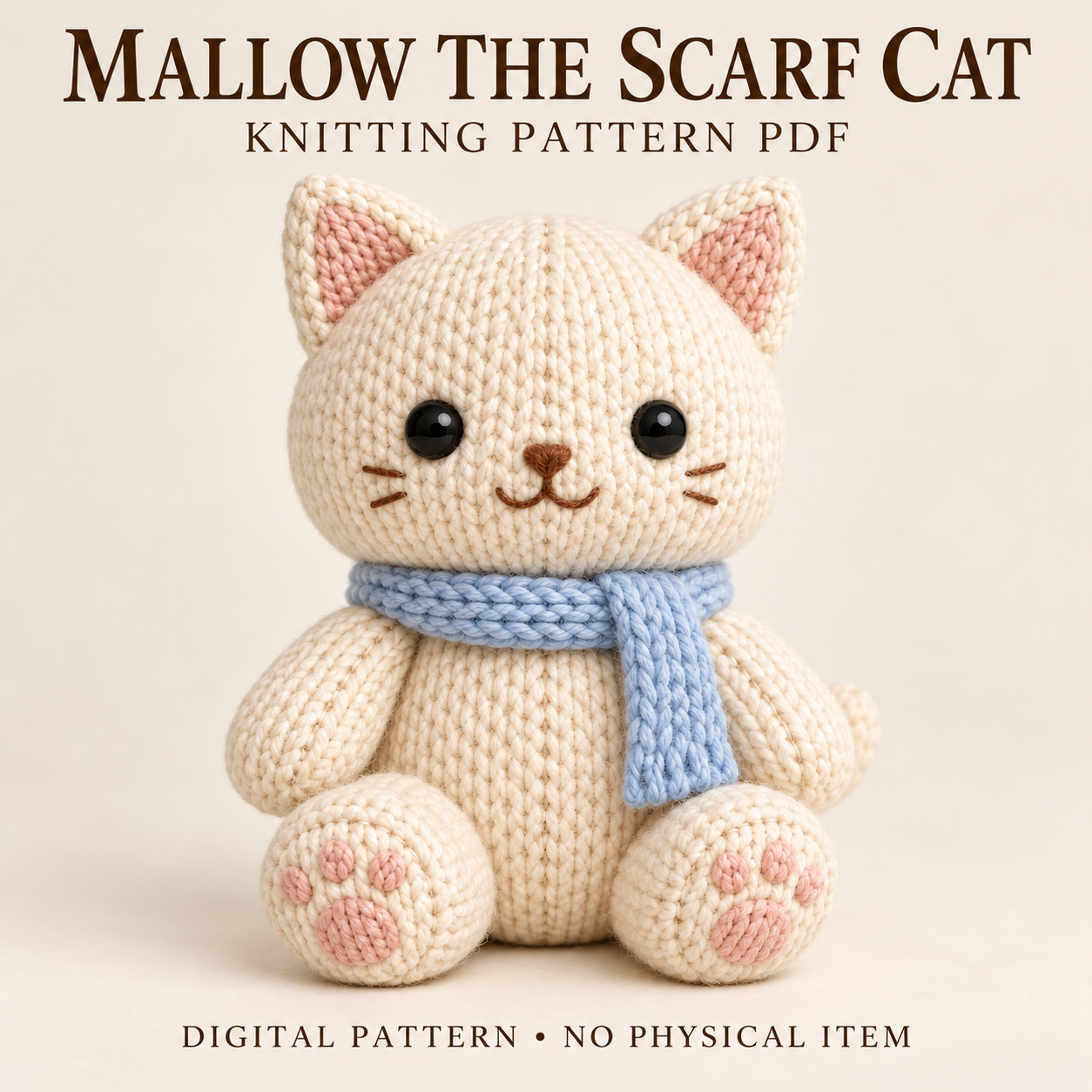
Mallow’s scarf cat knitting pattern makes a cream seated kitten with a broad round head, pink inner ears, and front-facing feet decorated with pink pads. A powder-blue scarf wraps around the neck, crossing toward the cat’s own left with one end hanging down. Warm brown stitches form the nose, mouth, and short whiskers, while a small cream bobtail completes the back. The PDF describes a confident-beginner to intermediate project that combines circular knitting with flat ears and scarf. This guide explains the supplies, component construction, and finishing choices, including access for eye washers and embroidery tails. Download the complete pattern near the bottom for the written rounds and placement maps.
Features of the scarf cat knitting pattern
The design uses cream for the head, body, arms, feet, and tail, with pink confined to the inner ears and paw embroidery. Each foot has one larger oval pad and three small toe beans. Those details remain visible because the completed feet are angled slightly upward and forward.
The triangular ears are double-layered and unstuffed. Their pink centres are worked in duplicate stitch onto one panel of each pair, rather than added as purchased inserts. Two short whiskers on each cheek balance the embroidered face. The scarf is a flat stockinette strip with plain ends, not a fringed tube.
Skills, gauge, and finished measurements
You should be comfortable knitting in the round, shaping with increases and decreases, handling small circumferences, sewing pieces, and working simple embroidery or duplicate stitch. The flat details require the usual distinction between right-side knit rows and wrong-side purl rows.
The scarf cat knitting pattern specifies 12 stitches and 18 rounds per 10 cm in unstretched circular stockinette. Its flat stockinette gauge is approximately the same. approximate dimensions include 27–29 cm height to the ear tips, a 13–14 cm head width, and an approximately 40 cm head circumference at the widest round. The scarf target is about 42 × 4 cm. Gauge and filling affect the final size, so use these figures as design targets.
Bulky yarn, needles, and supplies
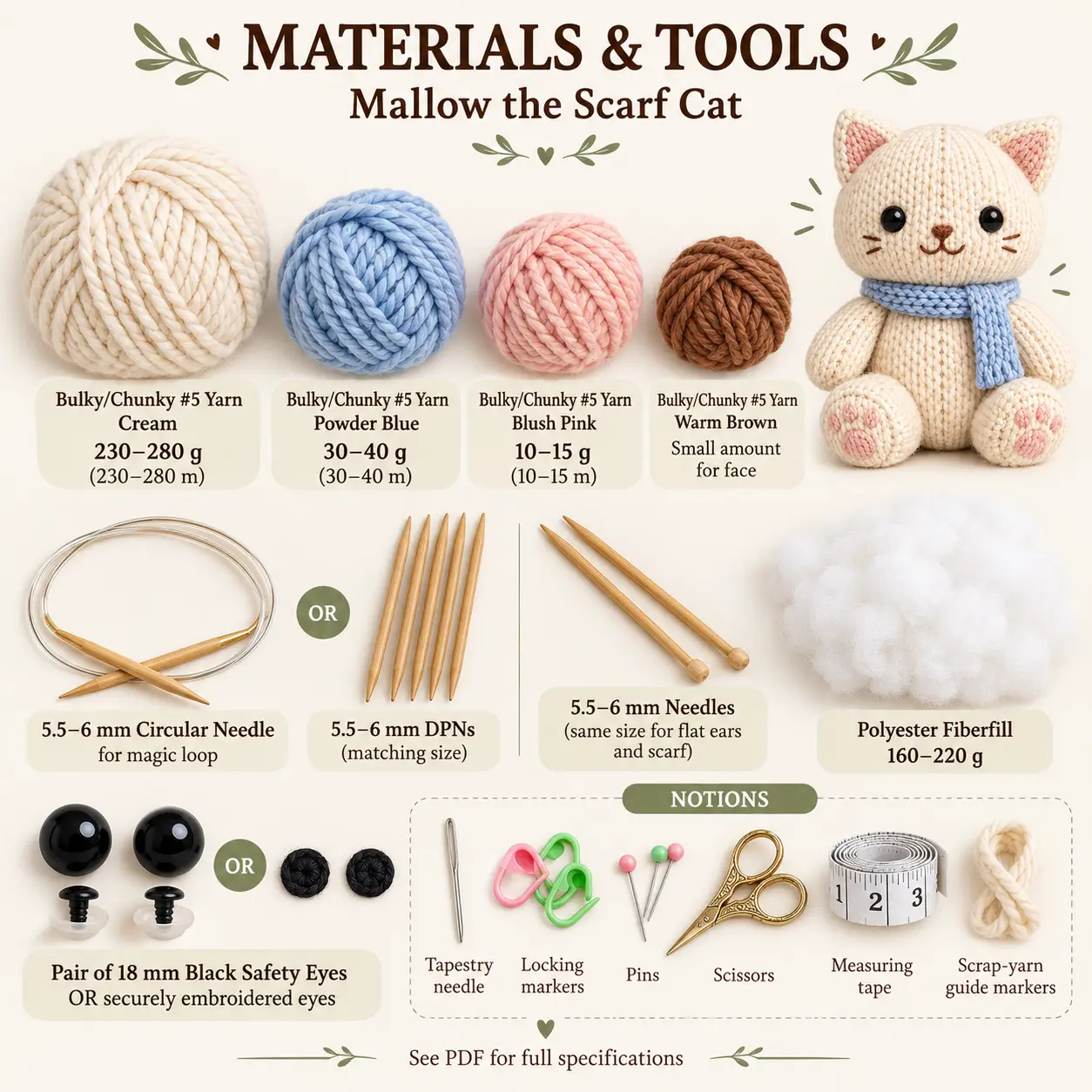
Use bulky or chunky yarn in cream, approximately 230–280 g or 230–280 m; powder blue, approximately 30–40 g or 30–40 m; and blush pink, approximately 10–15 g or 10–15 m. Warm brown is needed in a small amount for the face. Black yarn is needed only if choosing embroidered eyes.
For the scarf cat knitting pattern, prepare a 5.5–6 mm circular needle suitable for magic loop or matching DPNs. The ears and scarf use same-size needles suitable for flat knitting. Choose the size that produces the dense fabric required by the gauge.
Other supplies are approximately 160–220 g of polyester filling, two 18 mm black eyes or embroidered eyes, a tapestry needle, locking markers, pins, scissors, measuring tape, and scrap yarn for temporary guides.
Circular construction and embroidery techniques
The head begins at its neck opening and closes at the crown. The body grows from its lower centre toward the neck. Arms, feet, and bobtail are also circular pieces; the scarf and four outer-ear triangles are knitted flat.
The scarf cat knitting pattern uses duplicate stitch for the pink ear centres and duplicate stitch or compact satin-style embroidery for the paw pads. Two triangles form each ear, giving it enough structure without filling.
Mark front and back references on the head and body. Each foot also has a separate front guide opposite its underside round-start marker. That guide centres the large pad and toe beans, so carry it upward until the embroidery and foot attachment are complete.
Finishing the head and joining the body
Keep the head’s neck opening accessible while installing eye washers, attaching ears, and completing the brown facial embroidery. Light pre-stuffing helps establish the rounded face for embroidery; secure the tails inside through the open neck before completing the filling.
Fill the body with a firmer lower section and a softer upper neck area. Join the matching head and body neck edges one to one, aligning centre front and centre back before sewing. Check the quarter points so the face stays upright.
Prepare the foot embroidery before final filling and permanent attachment. Add the feet, arms, and low bobtail using the PDF’s landmarks. Remove the guides only when the placement-dependent work is finished, then wrap and arrange the scarf last.
Paw placement, stuffing, and scarf tips
Give the head even, moderate-firm filling without excessive pressure around the eyes. The arms have fuller paw ends and lighter shoulders. Fill both feet evenly, keeping their ankle edges flexible enough to sit against the body.
The scarf cat knitting pattern asks you to assess the paw-pad face before completing the ankle seams. If the feet point straight down, the embroidery may become hidden. A slight upward and outward rotation makes the pads visible while preserving the seated arrangement.
Keep the tail softly rounded and directed back and down. Wrap the blue scarf once around the neck without compressing it, crossing the ends toward the cat’s own left. A small hidden tack is optional if you want that position fixed.
Troubleshooting paws, joins, and facial balance
Why are the pads hidden in my scarf cat knitting pattern project?
Re-pin the foot so its embroidered face turns slightly upward and outward before permanently sewing the ankle edge. Compare both feet from the front. The aim is matching visible pads and a balanced seated pose, rather than maximising the rotation on one side.
Why does the neck join twist?
Align centre front to centre front and centre back to centre back first. Mark both neck edges at their quarter points, then join the corresponding stitches. If the face rotates during sewing, correct the alignment before covering the seam with the scarf.
Why do the ears lean at different angles?
Check their base positions against the same head round and equal attachment arcs. Re-pin the pieces with mirrored tilt, viewing the head from the front and back. The ears are unstuffed, so attachment differences can be more noticeable than small variations in their knitted panels.
Care and secure finishing
After completing the scarf cat knitting pattern, follow the yarn’s care label. Gentle surface cleaning can reduce unnecessary soaking of the filled parts and embroidered details. Avoid wringing the body or pulling the scarf, whiskers, and ear seams while damp. Allow the toy to dry thoroughly in shape, away from direct heat.
The PDF offers securely embroidered eyes instead of detachable eye components for items intended for children under three and advises following applicable local requirements. Check sewn attachments periodically. During final finishing, remove all pins and guides and confirm that embroidery tails are secured. The design needs no internal wire or rigid insert, so shaping comes from the fabric, filling, and placement.
Download Mallow’s complete pattern PDF
The scarf cat knitting pattern PDF contains the full head and body rounds, separate components, paw-pad map, facial details, and assembly sequence. Use the complete document for the exact counts and access reminders.
DIGITAL DOWNLOAD ONLY — NO PHYSICAL ITEM WILL BE SHIPPED.
Leave a Reply