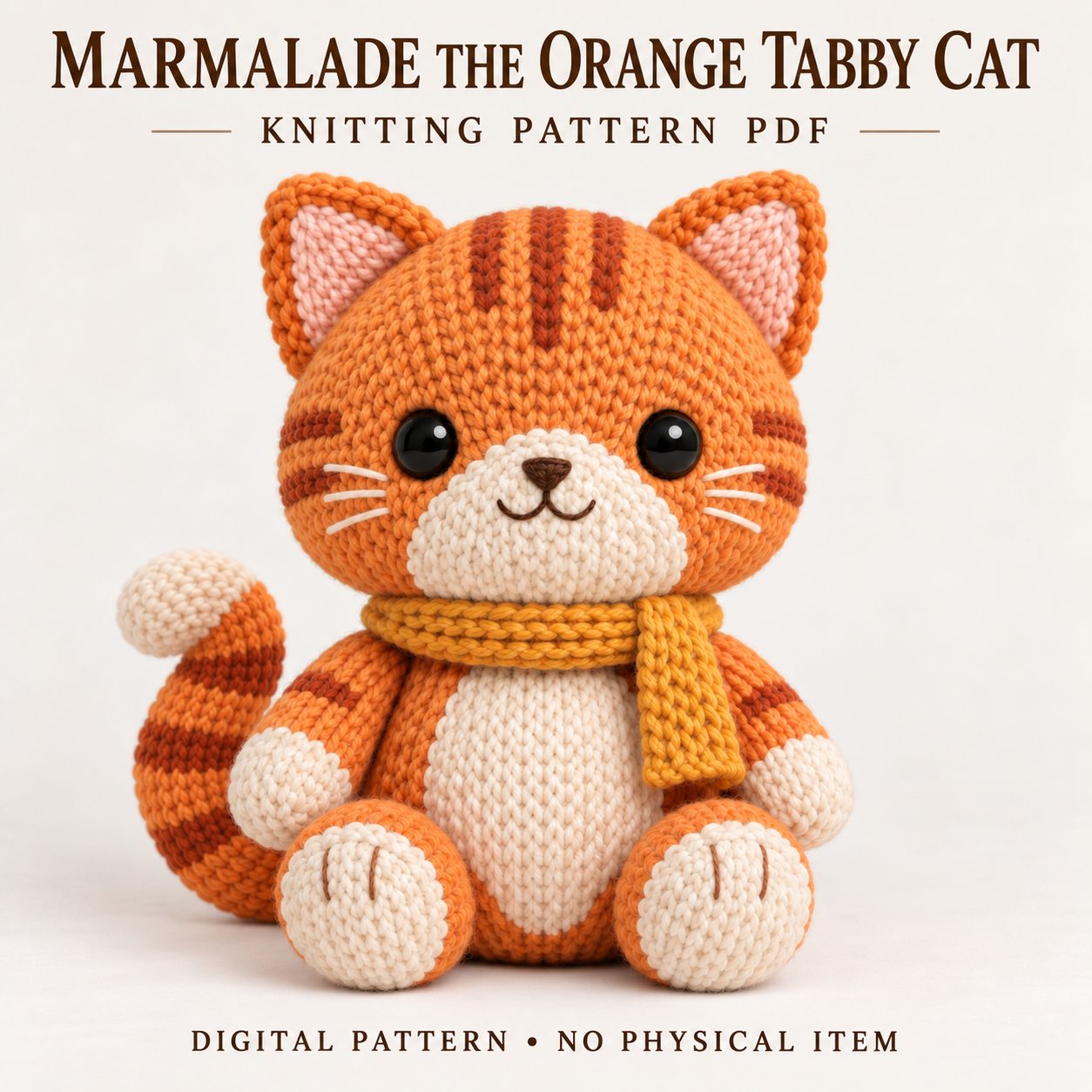
Marmalade’s orange tabby cat knitting pattern creates a seated cat with a large rounded head, compact body, and cream details against warm orange yarn. Darker tabby bars decorate the forehead, cheeks, back, and arms, while knitted bands circle the curved tail. Pale-pink inner ears and a mustard scarf complete the palette. The PDF describes a confident-beginner to intermediate project, combining circular main pieces with flat patches and accessories. Duplicate stitch adds most of the markings after knitting, so finishing has a clear role in the final character. This guide explains the supplies, construction, and placement decisions before you begin. Download the complete PDF near the bottom for the written rows, rounds, and assembly maps.
Features of the orange tabby cat knitting pattern
The cream muzzle, tummy patch, hand ends, and sole panels give the design its contrast. The tummy stays flat, while a little filling beneath the muzzle creates a shallow dome. Each cream sole receives two dark-brown toe lines.
Three forehead bars and three cheek bars per side frame the face. The tail has three darker bands and a cream tip, curving toward the cat’s own right and back. The scarf crosses at the opposite front side. These directional details are worth identifying before sewing, especially when comparing the cat’s right and left with your view from the front.
Skills, gauge, and approximate proportions
The main skills are small-circumference knitting, increases, decreases, flat stockinette, garter stitch, duplicate stitch, and toy assembly. Colour changes form the tail bands; embroidery supplies the facial details and toe lines.
The orange tabby cat knitting pattern specifies 20 stitches and 28 rounds per 10 cm in circular stockinette, with 20 stitches and 28 rows for flat stockinette on 4 mm needles. approximate dimensions include 22–24 cm seated height to the ears and a head about 13–14 cm wide. The scarf target is approximately 42–45 cm long and 3.5–4 cm wide. Gauge and filling change the finished dimensions, so these are planning figures rather than guaranteed measurements.
Yarn colours and essential tools
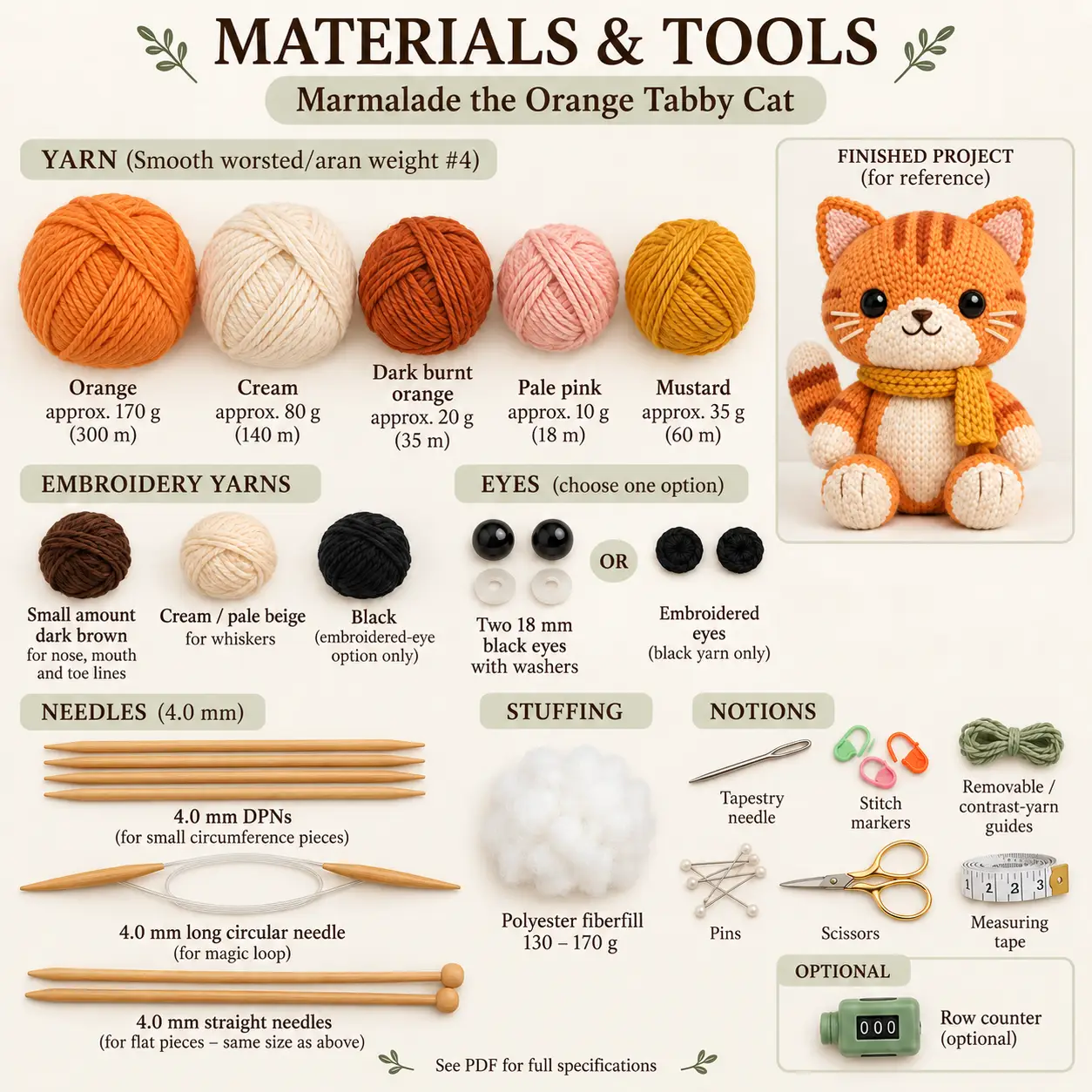
Use smooth worsted or aran yarn. The PDF lists orange at approximately 170 g or 300 m, cream at 80 g or 140 m, dark burnt orange at 20 g or 35 m, pale pink at 10 g or 18 m, and mustard at 35 g or 60 m.
Prepare small amounts of dark brown for the nose, mouth, and toe lines, plus cream or pale beige for whiskers. Needles are 4 mm DPNs or a long circular for magic loop, with suitable same-size needles for flat pieces. Other supplies include two 18 mm eyes with washers or embroidered eyes and approximately 130–170 g of fiberfill.
For the orange tabby cat knitting pattern, keep a tapestry needle, markers, contrast-yarn guides, pins, scissors, and measuring tape nearby. A row counter is optional.
Circular knitting, flat patches, and tabby markings
The head begins at the crown and closes at its lower end. The body begins at its open neck and grows downward. Arms, feet, and tail are circular pieces, while the ears, muzzle, belly patch, sole panels, and scarf are worked flat.
The orange tabby cat knitting pattern adds head, body, and arm bars with duplicate stitch. Tail bands are knitted colour changes, so they need a different approach. Keep short carried strands relaxed to avoid narrowing the tail.
The ears have two orange outer panels and one smaller pink panel each. Their paired placement creates the mirrored appearance. The muzzle’s bound-off edge faces the eyes; its cast-on edge faces the neck. Keep that orientation clear when pinning the patch.
Construction and assembly sequence
Install fitted eyes before the head decreases restrict access, and insert filling before the lower opening closes. Retain the head’s front and back guides while adding stripes, muzzle, whiskers, and ears.
Stuff the body through its open neck, then complete its back markings and flat belly patch. Finish the cream soles and toe lines on the feet. Add the arm stripes before attaching the arms, and check both feet on a flat surface before permanent sewing.
Attach the curved tail while keeping the back guide accessible. The body’s open neckline is then sewn around the designated ring on the closed lower head, with front and back aligned. Wrap and tack the scarf last, removing the guides only after the placement-dependent work is complete.
Stuffing, tail shaping, and symmetry tips
Fill the head evenly to preserve broad cheeks, and support the body’s lower base without making the upper chest rigid. Use fuller cream paws with lighter orange upper arms. Flatten each foot’s sole-facing side gently before adding its cream panel.
The orange tabby cat knitting pattern keeps the tail lightly to moderately filled so it can curve. Hidden ladder stitches along its underside shorten that side gradually. Adjust their tension while checking the visible upper surface for puckering.
Pin both ears and limbs before completing either side. On shaped rounds, follow the same physical placement line rather than carrying an unchanged numerical stitch position into a smaller circumference. The PDF provides those changing landmarks for the seated feet.
Troubleshooting orientation and finishing
Why is the tail straight in my orange tabby cat knitting pattern project?
Too much mid-tail filling can resist the curve. Remove a little where accessible and tighten the hidden underside stitches gradually. Check that the cream tip rises and the curve turns toward the intended right-back position before securing the base.
Why does the muzzle look off-centre?
Find the front guide first and pin the muzzle’s upper and lower centre points to it. Then compare the side edges beneath both eyes. Correct the pinning before finishing the perimeter rather than using an off-centre nose to disguise the patch position.
Why do the tail bands slant?
Keep colour changes at the tail’s round-start landmark and avoid pulling the first stitch of a new colour tightly. Check the inside carries as well; excessive tension can distort a band even when its round count is correct.
Care and secure finishing
After completing the orange tabby cat knitting pattern, follow your yarn’s care label. Gentle surface cleaning may suit the filled form and numerous embroidered details. Avoid wringing the tail or pulling whiskers, ears, and scarf while damp. Dry the cat thoroughly in shape, away from direct heat.
The PDF provides embroidered eyes instead of detachable eye components for items intended for children under three and advises following applicable local requirements. Check attachments during ordinary handling and repair loose sewing before further use. Keep the muzzle softly padded, the tummy flat, and the scarf loose enough to cover the neck without compressing it.
Download Marmalade’s complete pattern PDF
The orange tabby cat knitting pattern PDF contains the full component instructions, marking positions, placement maps, and assembly sequence. Use it for exact stitch counts and the access checkpoints before closing openings.
DIGITAL DOWNLOAD ONLY — NO PHYSICAL ITEM WILL BE SHIPPED.
Leave a Reply