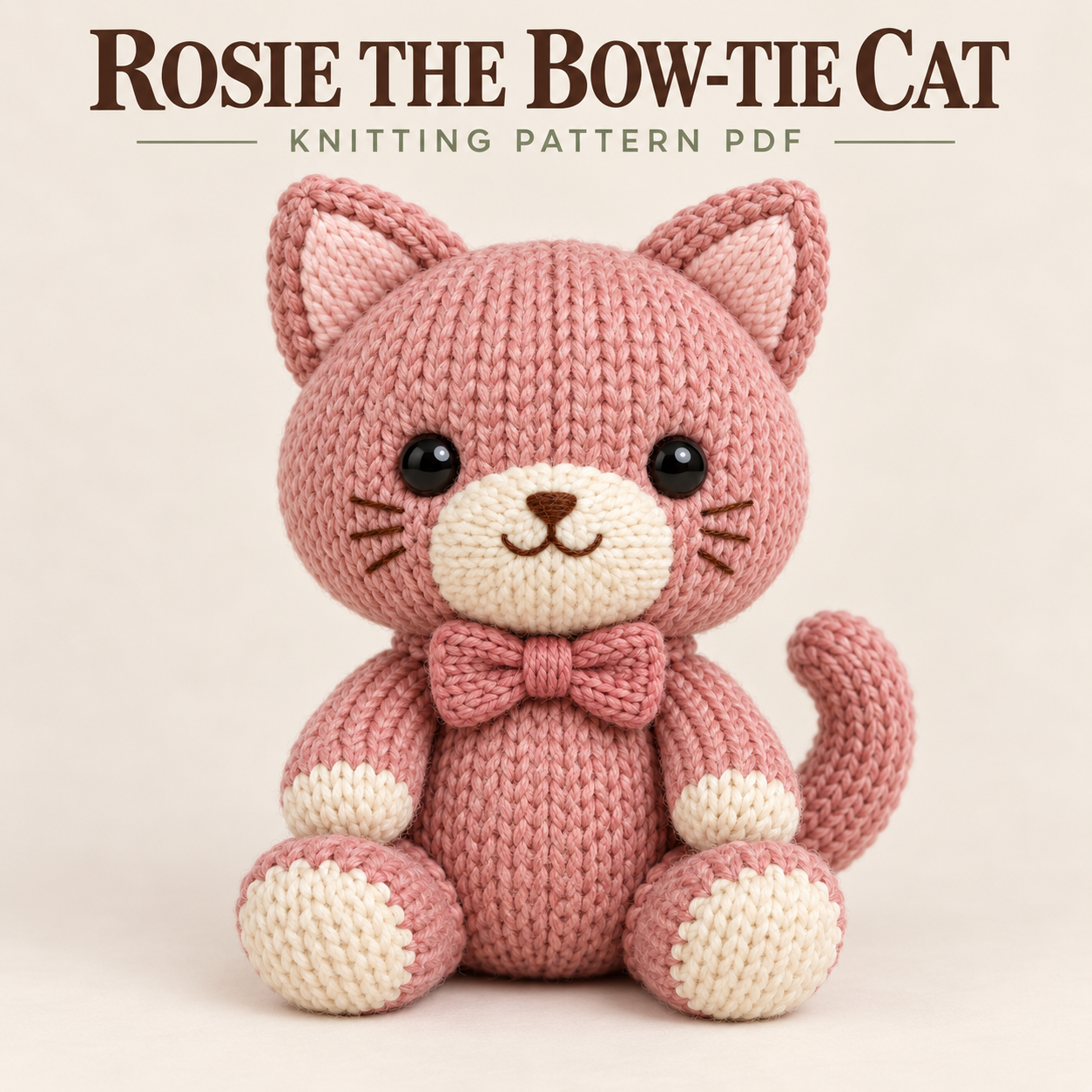
This bow tie cat knitting pattern makes Rosie, a seated dusty-rose cat with a large round head, cream muzzle and paws, pale-blush inner ears, and a matching neck bow. Three brown whiskers on each cheek frame the small embroidered nose and split smile. A lightly stuffed tail curls upward behind the compact body, giving the silhouette detail from the back as well as the front. The PDF describes the skill level as confident beginner to intermediate, using small-circumference knitting, flat panels, shaping, and careful sewing. This article explains the supplies, component construction, and positioning checks before you download the complete pattern PDF near the bottom for all instructions.
About This Bow Tie Cat Knitting Pattern
Rosie’s head is noticeably wider than the torso, with triangular ears angled gently outward. The cream muzzle is a separate flat-knit oval, embroidered before attachment so its thread ends remain hidden. The pale inner-ear panels are a third yarn colour, distinct from both the dusty-rose outer ears and cream paws.
The cream hand and toe sections are knitted into their limb pieces, rather than added as purchased pads. The bow begins as a stockinette loop flattened and pinched into two lobes. Its garter centre band and hidden tacks hold it level below the face. The tail uses sewn shaping without wire.
Skills, Gauge, and approximate measurements
The bow tie cat knitting pattern combines circular stockinette for the stuffed pieces with flat stockinette for ears, muzzle, and bow. You need familiar increases and decreases, neat colour changes, embroidery, and sewing through small attachment edges.
approximate dimensions are 22–23.5 cm seated height to the ear tips, 15–16.5 cm across the feet, and 15–17 cm front-to-back depth including the tail curl. Head width is about 13–14 cm. The tail is about 10.5–11 cm before curling, while the bow is about 6–6.5 cm wide. Gauge and filling affect the finished result.
Gauge is 20 stitches and 28 rounds per 10 cm in circular stockinette. Flat stockinette should be approximately 20 stitches and 28 rows over the same area.
Yarn, Needles, and Notions
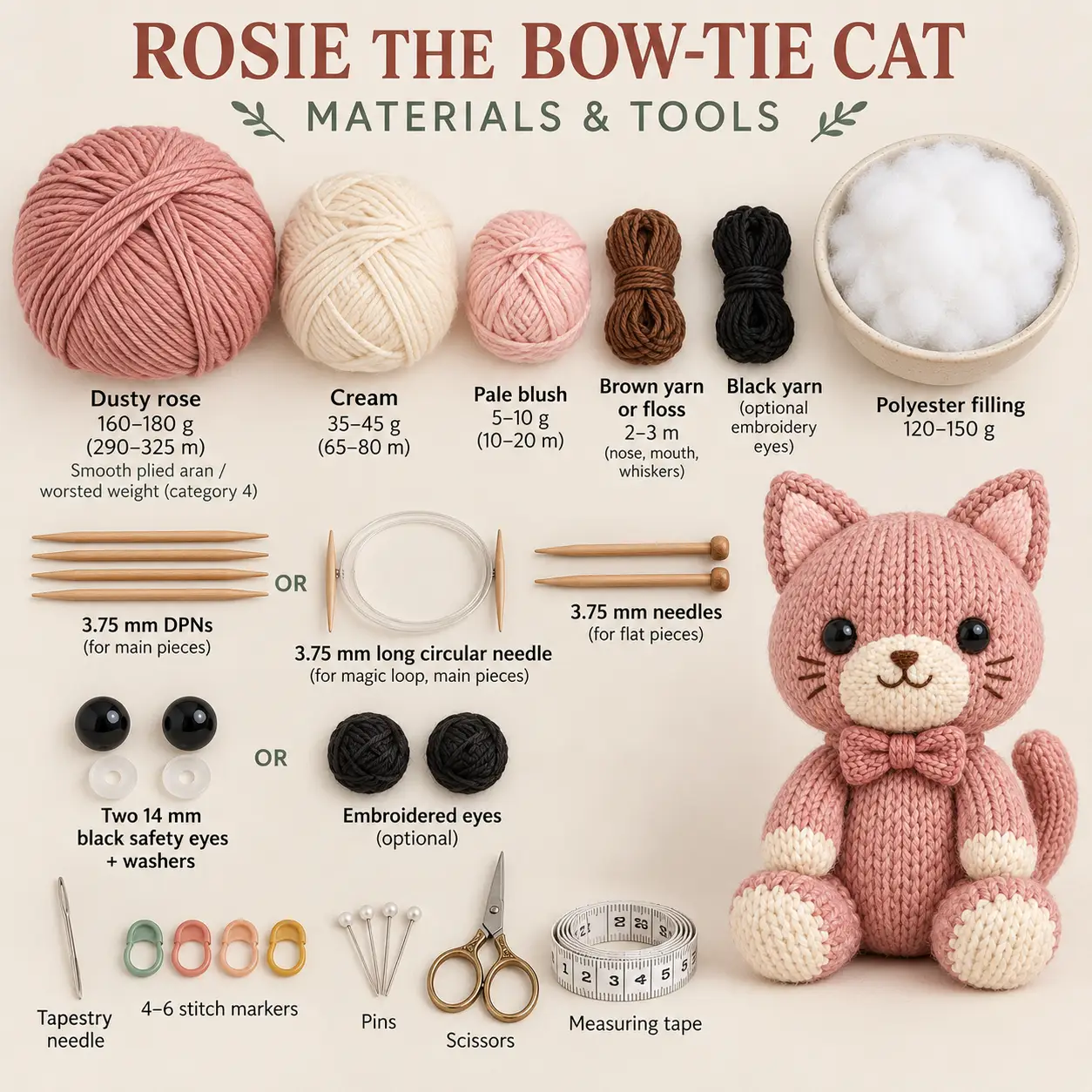
Use smooth plied Aran or worsted category 4 yarn. Approximate amounts are dusty rose 160–180 g/290–325 m, cream 35–45 g/65–80 m, and pale blush 5–10 g/10–20 m. Allow 2–3 m of brown yarn or floss for the nose, mouth, and whiskers, plus black yarn if using embroidered eyes.
The needles are 3.75 mm DPNs or a long circular needle for magic loop, with the same size used for flat pieces. Polyester toy filling is approximately 120–150 g. Gather a tapestry needle, four to six stitch markers, pins, scissors, and measuring tape.
The eye choice is two 14 mm black safety eyes with washers or embroidery. Select that method before the head decreases reduce access.
Techniques and Colour Placement
Knit-front-and-back increases widen the circular pieces, and decreases shape their narrower ends. The flat ears taper into triangular tips; smaller pale panels are sewn onto their fronts with an even dusty-rose border.
In the bow tie cat knitting pattern, the arms begin at cream paw tips and the feet at cream toes, then change to rose farther along. Their starting centres are closed securely before filling. Keeping both colour changes at matching stages helps the pair look balanced.
The tail remains rose throughout and lightly filled. A hidden shaping strand shortens its inner curve after attachment. The bow uses a sewn fabric loop rather than two separately stuffed wings, so its construction depends on folding and pinching rather than filling.
Construction and Open-Neck Access
The head and body are knitted separately and retain matching sixteen-stitch neck openings. Install safety eyes before the head’s decrease section, then fill through the remaining neck opening. Complete all internal adjustments before joining it to the body.
Prepare the bow tie cat knitting pattern’s layered ears and embroidered cream muzzle. Attach those pieces to the head and add the whiskers while the face guides remain visible. Fill the body firmly low down and more moderately near the neck, then align both front and back landmarks when sewing the two neck edges together.
Attach the legs, arms, and tail to the body. Form the tail curl with its hidden strand, then centre the finished bow below the neck join. Remove guides and bury all ends after the final symmetry check.
Tips for a Balanced Face and Tail
- Mark centre front opposite the beginning-of-round guide. Use it for the muzzle and nose rather than guessing from one eye.
- Pin both ear bases before sewing. Their small outward tip angles should mirror each other from the front and back.
- Embroider the muzzle while its reverse is accessible. This hides the knots beneath the completed applique.
- Keep three whiskers on each side with mirrored slopes. Unequal angles can make a centred face look tilted.
- Fill cream toes firmly but leave upper rose limb sections more yielding. The attachment rings then settle against the body.
- Keep the tail bendable and gather its inner curve gradually. A hard-filled tube tends to spring straight.
These checks keep the bow tie cat knitting pattern’s contrasting features clear without distorting the round head.
Troubleshooting
Why Will My Bow Tie Cat Knitting Pattern Tail Not Hold Its Curl?
The source recommends reducing tail filling and retightening the hidden inner-curve strand. Use only enough tension to create the compact upward curl; the outside should remain smooth rather than puckered. Confirm the base is centred low at the back before shaping, so a tilted attachment does not pull the whole curve sideways.
Why Does the Head twist at the Neck?
Release a short section of the join, realign centre front and centre back, and repin the head level. Check both sides before resewing. The matching neck edges should distribute evenly around the opening rather than gathering toward one front or back point.
Why Is the Muzzle or One Ear Uneven?
For a shifted muzzle, release the affected side and realign its full oval to centre front before sewing again. For an ear that leans differently, adjust a tiny lower-edge anchor and compare both tips. Tightening the ear tip itself can distort the triangular shape without correcting its base angle.
Care and Secure Eye Choices
Follow the care instructions for every yarn and the chosen filling. Gentle spot-cleaning can help preserve the curled tail and dimensional bow. If washing is suitable, avoid twisting or wringing, reshape the feet and tail, and allow the filling to dry completely.
Inspect the small panels, embroidery, and limb joins before gifting or handling. The bow tie cat knitting pattern specifies embroidered eyes when safety-eye components are unsuitable, including for children under three. Use securely attached features and follow the requirements appropriate to the recipient; the pattern does not establish a safety certification.
Download Rosie’s Complete Cat PDF
The complete bow tie cat knitting pattern includes written component instructions, yarn quantities, gauge, approximate measurements, eye-access timing, placement maps, stuffing notes, wire-free tail shaping, assembly, finishing checks, and troubleshooting. The source describes personal handmade use unless separate seller licensing provides otherwise, and asks that the digital file and instructions not be copied or resold. Follow the PDF for all shaping counts and colour-change positions.
DIGITAL DOWNLOAD ONLY — NO PHYSICAL ITEM WILL BE SHIPPED.
Leave a Reply