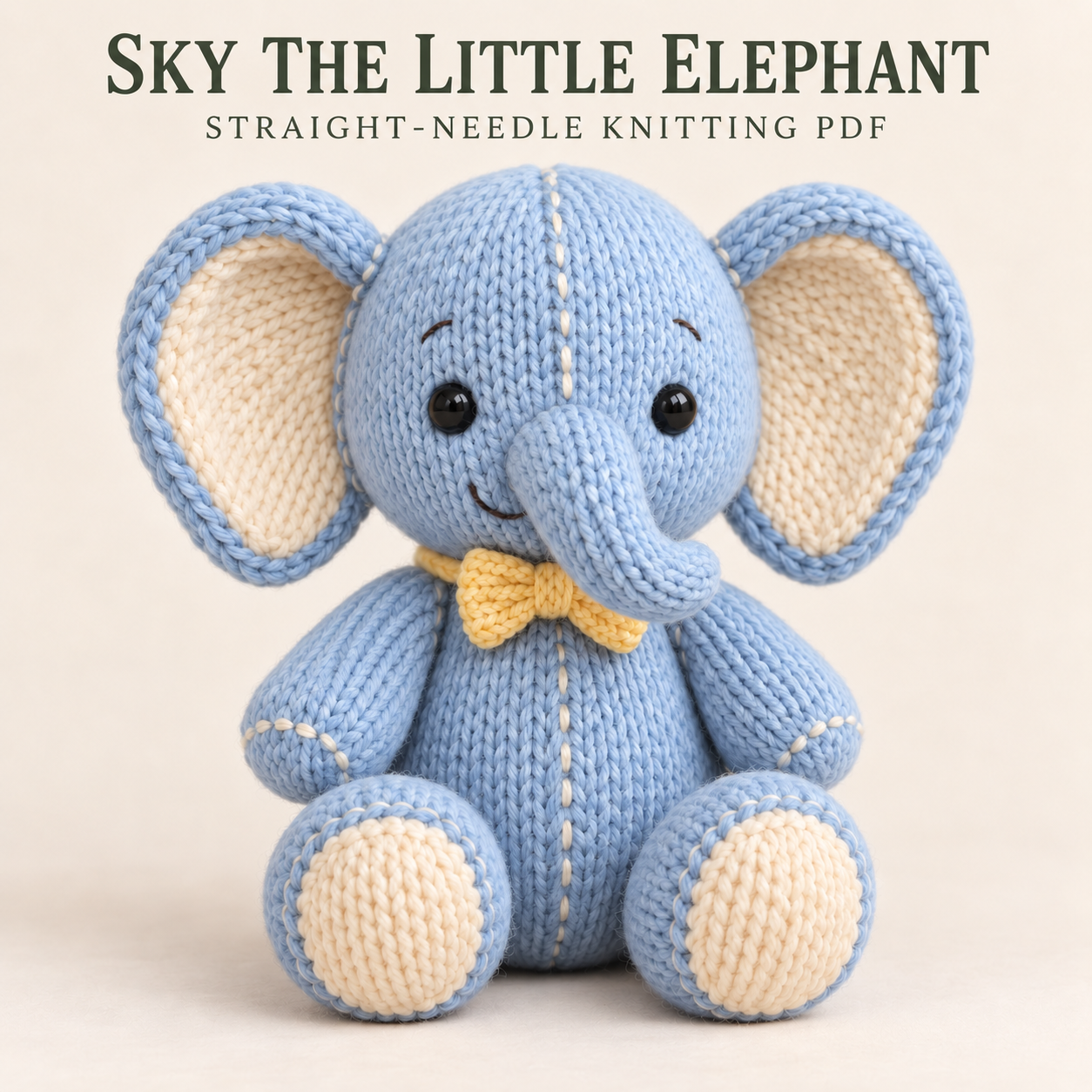
This blue elephant knitting pattern introduces Sky, a seated plushie with broad cream-lined ears, rounded cream foot pads, and a soft yellow collar and bow. Its trunk projects forward, curves downward, then turns gently upward at the tip. Small embroidered brows and a shallow smile complete the face, while cream running stitches highlight selected seams. The PDF is written for flat knitting on straight needles and lists confident beginner to intermediate difficulty. Its separate panels require careful orientation, especially around the face and ears. This article explains the supplies, construction, stuffing access, and alignment checks. The complete instructions are available in the PDF download near the bottom.
About This Blue Elephant Knitting Pattern
Sky’s rounded head sits over a pear-shaped body, with both feet projecting forward. The ears are double-layered and unstuffed. Their cream panels face slightly forward, and mirrored base folds give each ear a shallow cup behind the eye.
The yellow accessory has a narrow garter collar and a bow built from two shaped lobes with a separate centre band. A slim blue tail ends in a small blue tassel at the back. Cream running stitches follow the head and body front and back seams; three short stitches decorate the lower outside of each arm. These surface details are added after the structural sewing.
Skills, Gauge, and Approximate Size
The blue elephant knitting pattern uses knit, purl, increases, decreases, garter stitch, mattress or oversewing joins, whipstitch, and basic embroidery. Keeping the mirrored centre-front edges marked is more consequential than adding extra complexity to the knitting itself.
approximate measurements are approximately 23–25 cm seated height, 27–30 cm ear span, and 16–18 cm depth including the forward feet. Each ear is about 12–13 cm high and 9–10 cm wide. The finished trunk curve is about 6–7 cm long, and the bow approximately 7–8 cm across. Results vary with materials and filling.
Flat stockinette gauge is 20 stitches and 28 rows per 10 cm. Garter gauge is approximately 20 stitches and 36 rows; the collar is worked to its specified relaxed length. All counts include the edge stitches, and no extra selvedges are added.
Materials and Tools
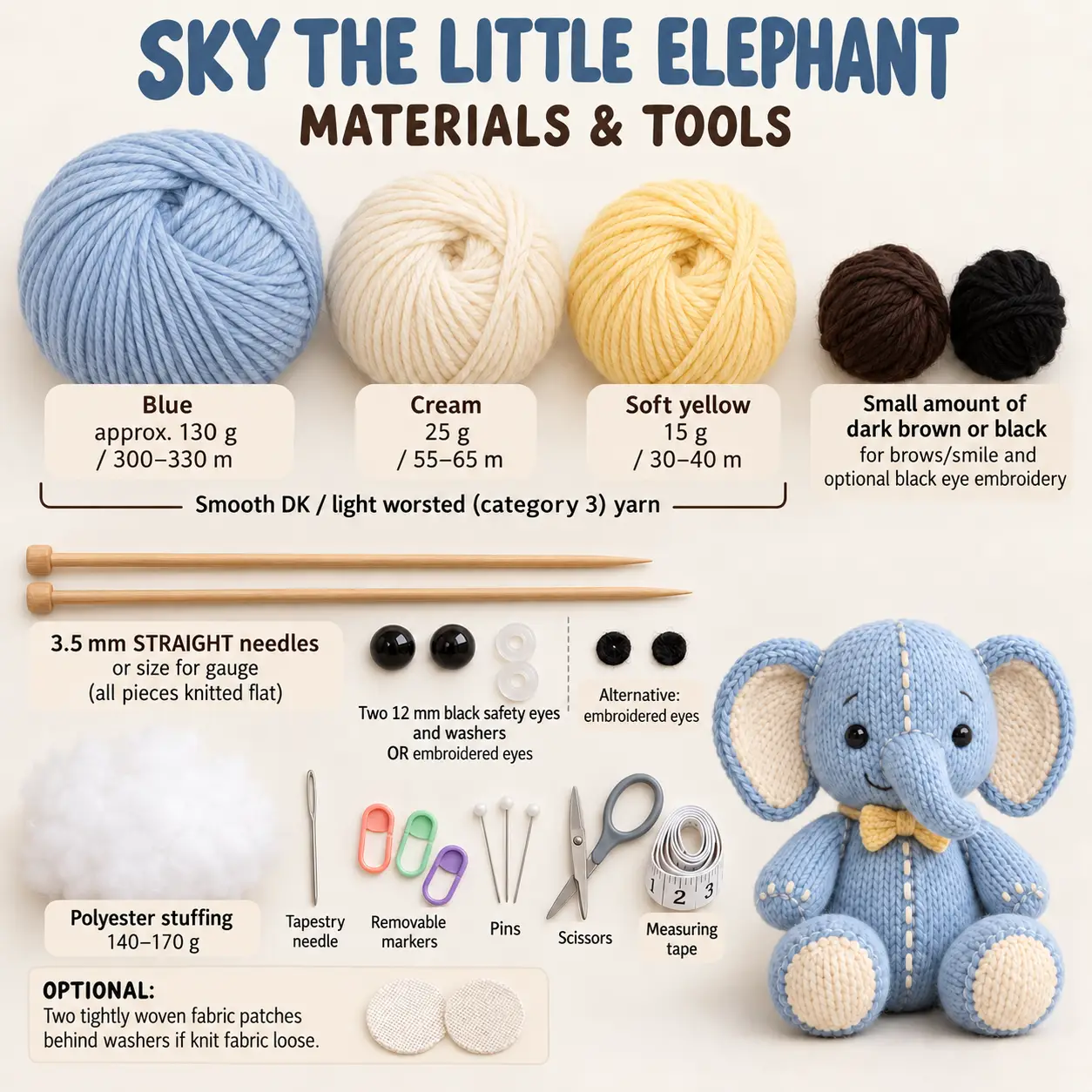
Use smooth DK or light-worsted category 3 yarn: approximately 130 g/300–330 m blue, 25 g/55–65 m cream, and 15 g/30–40 m soft yellow. A small amount of dark brown or black is needed for brows and smile, with black yarn for optional embroidered eyes.
The pattern specifies 3.5 mm straight needles or the size needed for gauge. Allow approximately 140–170 g polyester stuffing. Eye choices are two 12 mm black safety eyes with washers or yarn embroidery.
Gather a tapestry needle, removable markers, pins, scissors, and measuring tape. Two small tightly woven fabric patches are optional behind eye washers if the knitted fabric is loose. Firm fabric helps contain filling while keeping the blue stitch columns visible around the cream details.
Mirrored Panels and Surface Embroidery
The blue elephant knitting pattern builds the head from two shaped side panels and the body from another pair. Mark their front and back long edges as mirror images before installing eyes. This prevents both panels from being treated as the same side during assembly.
The trunk and limbs become soft tubes by folding and seaming flat pieces. Cream foot pads are separate knitted panels sewn to the legs. The collar and bow use garter stitch rather than a purchased accessory.
Cream running stitches are decorative, with loose spacing that avoids puckering. They follow centre front and centre back on the head and torso, stopping at the specified feature boundaries. The arm decorations sit across the lower outside surfaces rather than forming long contrast arm seams.
Construction and Assembly Order
Make and label the head panels first. Install optional safety eyes while the pieces remain accessible. Sew the head perimeter, leaving a lower-back filling opening; stuff and close that opening before attaching the separate features.
Prepare ears and trunk, then sew and fill the body through its top opening. Close the body top. Build the limbs, sewing cream pads onto the legs before stuffing. Their flattened upper openings remain soft for the seated joins.
In the blue elephant knitting pattern, the closed head joins the closed body across a contact circle. Align the front seams before sewing. Attach ears, trunk, legs, arms, and tail, then add the yellow collar and bow. Embroider the face and cream accents after the structural assembly is complete.
Tips for Ears, Trunk, and Foot Pads
- Keep the cream ear border even before joining each front and back panel. The two base folds must mirror one another.
- Pin each ear using all three head landmarks. Its midpoint controls how the cream panel faces forward.
- Keep the trunk seam underneath and reduce filling toward the tip. Gentle hidden tacks hold the down-then-up curve without wire.
- Sew each foot pad before stuffing, opposite the leg seam, with its lower edge wrapping slightly around the toe.
- Leave the upper arm and leg attachment areas soft. This allows the flattened joins to sit against the body without pulling it inward.
- Measure the collar relaxed to approximately 17.8 cm. Its overlap belongs at centre back, with the bow centred below the trunk.
Troubleshooting
Why does this pattern Trunk Spring Straight?
Remove a little filling from the tip and retake the hidden inner-curve tacks. Tighten only enough to retain the arc. The source describes a soft bend, so a sharp folded crease would indicate overly tight shaping stitches.
Why Do the Ears Face Different Directions?
Check the mirrored base folds and all three attachment anchors. Reposition the midpoint first, then adjust the upper and lower anchors. Both cream panels should face slightly forward, with the ears behind the eyes rather than covering them.
Why Does One Limb sit Higher?
Release only the upper attachment stitches and repin using the same body-row range on both sides. Check the feet on a flat surface before resewing. Compare arm angles separately so a misplaced arm is not disguised by uneven filling.
Care and Eye Alternatives
Follow the care labels for the yarn, stuffing, and any eye hardware. Spot-cleaning is a gentle starting point for the shaped trunk and flat ears. If washing is suitable, avoid twisting, reshape the pads and collar, and allow the filling to dry fully away from direct heat.
The blue elephant knitting pattern recommends embroidered eyes for recipients under three or anyone likely to mouth the toy. Inspect the tail tassel, seams, and embroidery as well. Follow applicable requirements for the intended recipient without assuming any eye choice guarantees compliance.
Download Sky’s Complete PDF
The complete blue elephant knitting pattern includes panel tables, counts, supplies, gauge, approximate measurements, feature maps, mirrored orientation guidance, filling notes, assembly, seam accents, and troubleshooting. Use it for the shaping sequence and exact placement coordinates. The source describes personal handmade creation unless separate rights are granted and asks that the file or pages not be redistributed.
DIGITAL DOWNLOAD ONLY — NO PHYSICAL ITEM WILL BE SHIPPED.
Leave a Reply