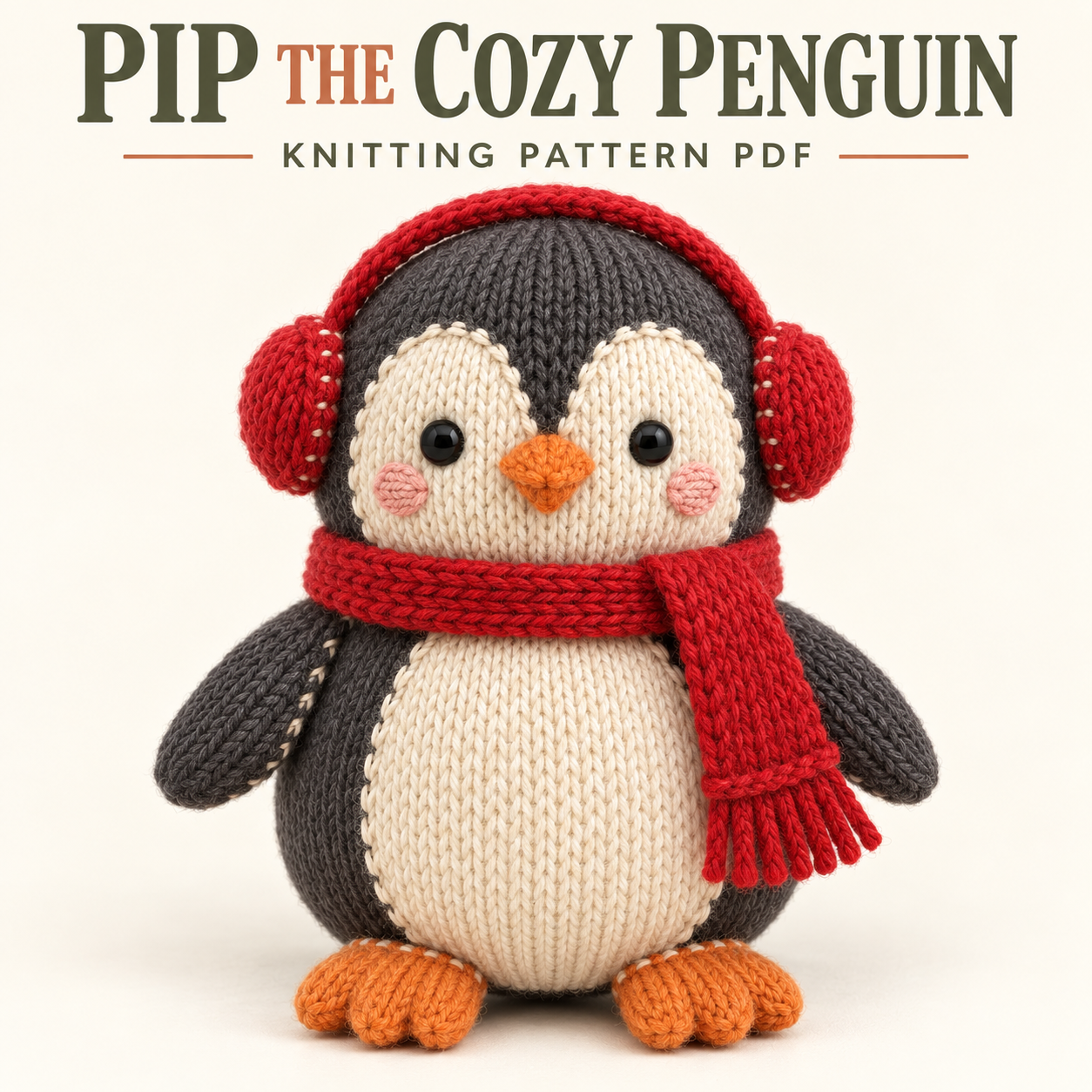
This penguin plushie knitting pattern makes Pip, a rounded charcoal penguin wearing red earmuffs and a matching fringed scarf. Two cream face ovals frame the eyes and leave a small dark V at the forehead; a separate cream belly panel brightens the body. Orange feet have three distinct toe lobes each, while pink cheeks and a small projecting beak complete the face. The PDF calls the project adventurous beginner to intermediate, using circular knitting, flat stockinette, simple shaping, seaming, and I-cord. This overview explains the materials and construction, especially the eye-access sequence that must happen before crown closure. The complete pattern PDF is available near the bottom for the full instructions.
About This Penguin Plushie Knitting Pattern
Pip’s body and head form one continuous charcoal shell, gently narrowing at the neck before widening into the head. The cream areas are flat-knit appliques attached to that shell, rather than colourwork sections within it.
Visible cream sewing is part of the design. Small pale stitches outline the face and belly boundaries, with running-stitch accents at the flipper joins and around the earmuff pads. The red scarf has a smooth centre, narrow garter borders, and fringe. Its hanging end falls on Pip’s own left, shown on the viewer’s right. Together, those features give the simple rounded body a defined winter character.
Skills, Gauge, and approximate Size
You should be comfortable knitting small tubes with DPNs or magic loop, using shaped increases and decreases, and sewing appliques without puckering them. The two face panels are identical pieces; their mirrored appearance comes from placement.
approximate design targets are about 25–27 cm overall height including the feet, 17–19 cm width including earmuffs and flippers, and 13–14 cm body depth. Each earmuff pad is approximately 4.5–5 cm across, lightly flattened. The scarf target is about 4.5 cm wide and 50–55 cm long before fringe. These dimensions vary with tension and finishing.
The penguin plushie knitting pattern uses 22 stitches and 30 rounds or flat rows per 10 cm on 3.5 mm needles. Aim for firm fabric that contains stuffing.
Yarn and Equipment
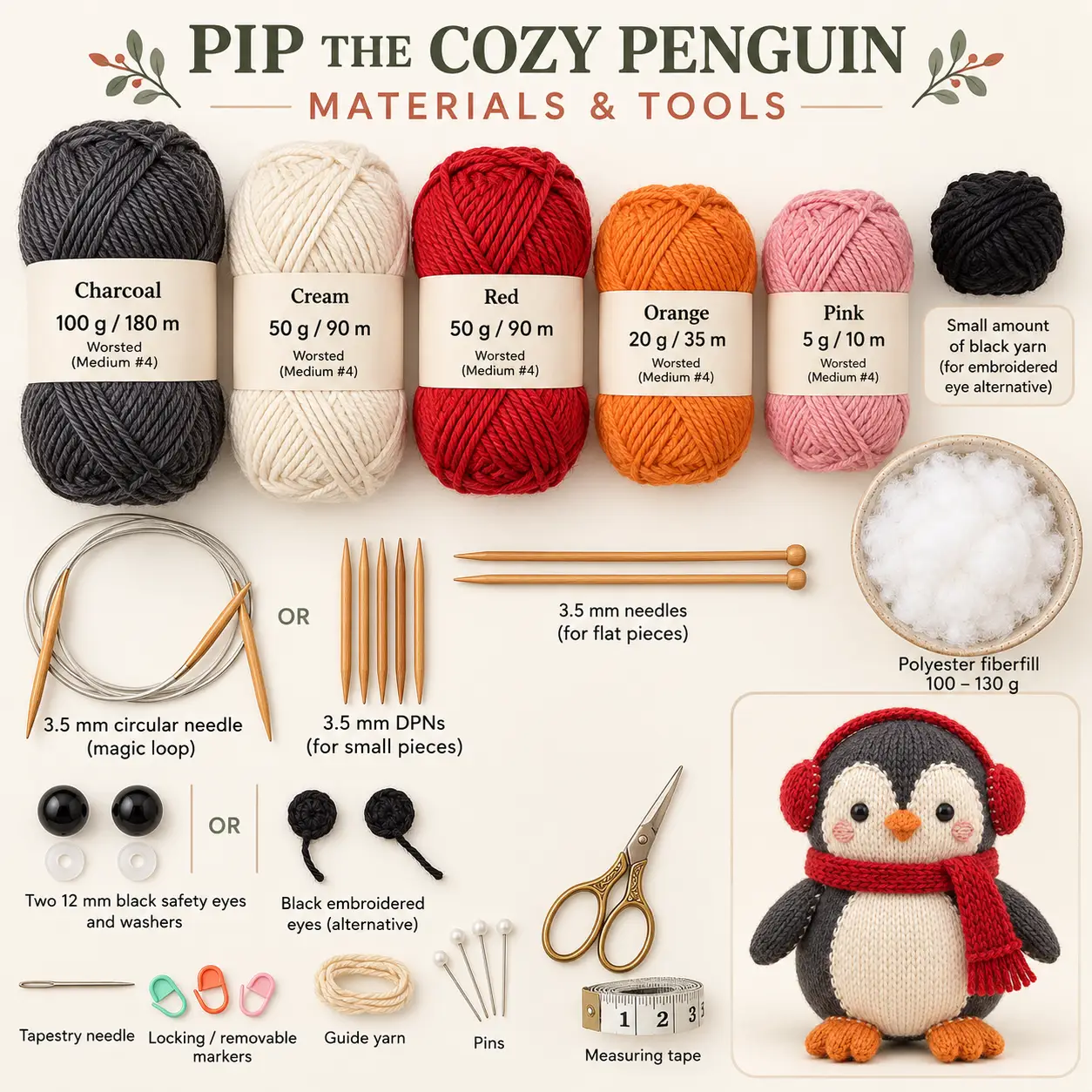
The yarn is worsted/medium category 4. Approximate requirements are charcoal 100 g/180 m, cream 50 g/90 m, red 50 g/90 m, orange 20 g/35 m, and pink 5 g/10 m. Keep a small amount of black yarn if choosing embroidered eyes.
Use 3.5 mm circular needles for magic loop or DPNs, plus the same size for flat pieces. Allow about 100–130 g polyester fiberfill. Other tools are a tapestry needle, locking and removable markers, pins, scissors, and a measuring tape.
The standard rigid-eye option is two 12 mm black safety eyes with washers. The alternate method uses black embroidered round eyes. Decide before closing the shell because the hardware needs inside access.
Stitches and Finishing Methods
The main shell, flippers, toe lobes, cheek discs, and earmuff pads are knitted in the round. Knit-front-and-back increases and decreases shape the tubes and rounded ends. Flat stockinette forms the belly, face panels, and two triangular beak halves; paired increases and decreases control those outlines.
A four-stitch I-cord makes the slender earmuff band. Its measured fit across the crown is more useful than a fixed row count. Garter edges help define the scarf around its stockinette centre.
The penguin plushie knitting pattern uses counted body rounds and centre landmarks to place the cream panels, eyes, flippers, and accessories. Keep those references visible until all features are pinned.
Construction and the Crown-Access Step
Knit the charcoal shell upward from its lower opening, which is gathered closed early. Keep the crown accessible through the specified pause after round 72. At that point, sew on the cream belly and both face ovals before stuffing the head.
If using safety eyes, their posts pass through the cream panel and charcoal shell. Reach inside the open crown to secure the washers, then add stuffing and complete the final decreases. Embroidered eyes are added after the shell is stuffed and closed.
The remaining pieces include two beak halves, two cheeks, two flippers, six toe lobes, two earmuff pads, the headband, and scarf. Build each foot from one centre toe and two side toes, mirroring the clusters. Attach the headband before its ends are covered by the earmuff pads.
Tips for a Clear Face and Balanced Feet
- Preserve the centre-back marker and mark centre front opposite it. The cream belly and face should follow the same vertical guide.
- Pin both face ovals before sewing either. Leave the small charcoal V visible above their inner edges.
- Check eye spacing through both fabric layers before fastening washers. Later adjustment is much more limited.
- Keep the face stuffing slightly softer than the lower body. Overfilling can stretch the eye spacing and distort the appliques.
- Arrange each foot as a mirrored three-toe cluster before attachment. The centre toe faces forward and the outer toes flare away from centre front.
- Flatten earmuff pads into soft pucks. They should rest near the head rather than look like balls.
These checks support the proportions and accessory placement in the penguin plushie knitting pattern.
Troubleshooting
Why Is My Penguin Plushie Knitting Pattern Face Off Centre?
Use the shell centre-front line as the anchor. Pin the top, bottom, and inner edge of each cream oval first, then ease the outer edge. Compare the two panels from straight ahead and both three-quarter views. If a section puckers, release that section and resew with smaller, relaxed bites rather than pulling the whole panel tighter.
Why Does the Earmuff Band Slide?
Confirm the band is centred front to back over the crown and that its ends sit beneath the pads. After checking alignment, the PDF suggests invisible tacks at the crown and under both pads. Adjusting those tacks is more useful than shortening the band enough to dent the head.
Why Do the Feet or Flippers Look Uneven?
Compare matching attachment spans from the same landmarks and rounds. Redistribute toe filling so all lobes contact the resting surface, and shape the lower body slightly flatter for sitting. Flipper tips should angle down and back equally, with light stuffing that allows them to flatten.
Care and Eye Safety
Follow each yarn’s care label and check the suitability of the stuffing and eye components. Gentle spot-cleaning can help preserve the appliques and fringe. If washing is appropriate, avoid wringing, reshape the accessories, and let the filling dry completely.
Inspect small attachments and seams regularly. The penguin plushie knitting pattern notes that detachable eye parts may be unsuitable for children under three and provides embroidery as an alternative. Secure stitching and appropriate material choices still matter; the PDF does not claim verified safety testing.
Download Pip’s Complete PDF
The complete penguin plushie knitting pattern contains stitch-count tables, yarn quantities, gauge, finished measurements, placement guides, eye-installation instructions, stuffing notes, assembly steps, troubleshooting, and a piece inventory. Follow the access sequence in that file before closing the crown. The source describes personal handmade use unless the seller’s listing explicitly grants additional permissions.
DIGITAL DOWNLOAD ONLY — NO PHYSICAL ITEM WILL BE SHIPPED.
Leave a Reply