
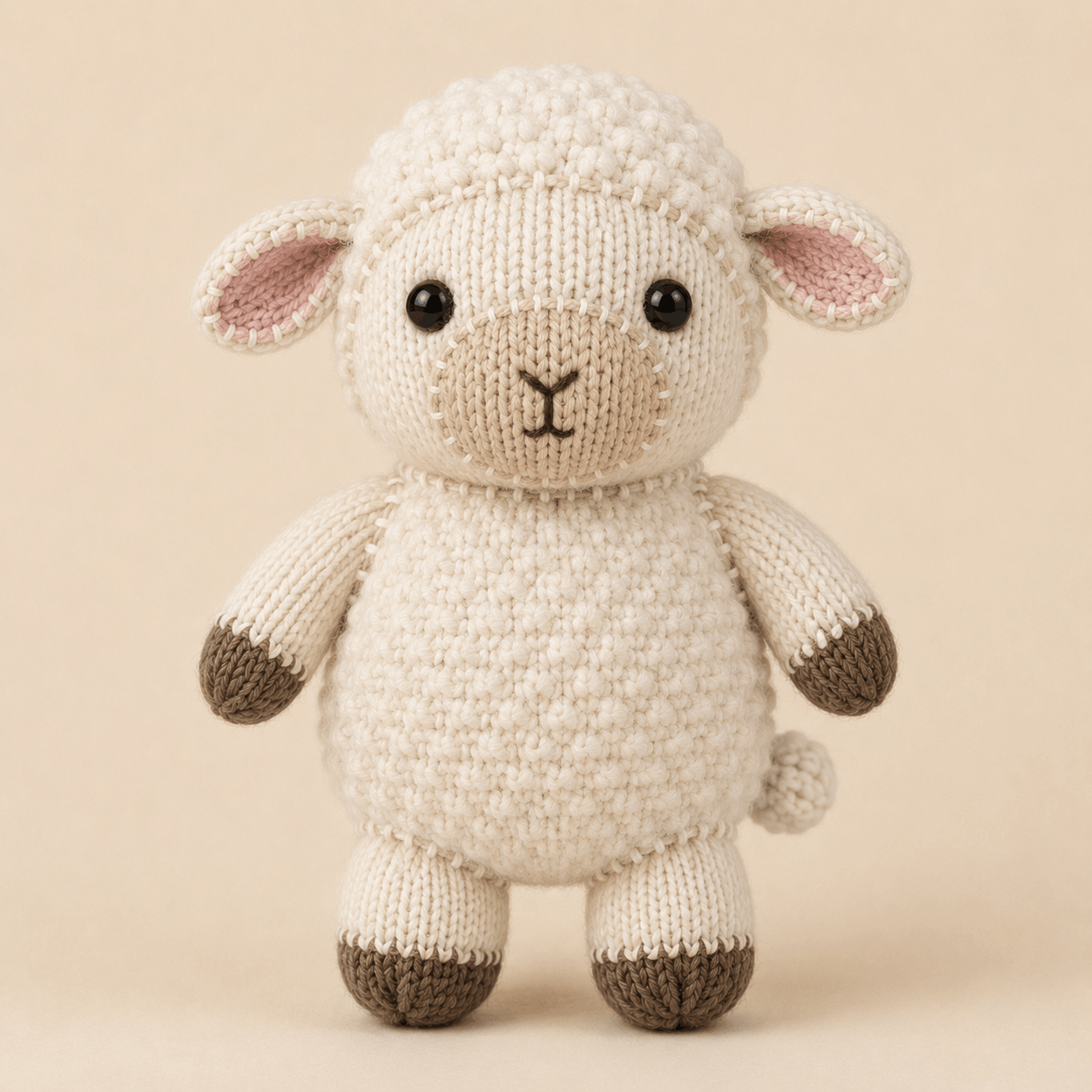
Maisie is a standing lamb plush with a smooth stockinette face and limbs, a textured cream body, rounded brown hooves, pink-lined floppy ears, a light beige muzzle, and a separate bobbled wool cap. This lamb knitting pattern is designed for intermediate knitters who are comfortable with small-circumference knitting, shaping, seaming, and embroidery. Below, you’ll find the main materials, construction method, techniques, measurements, practical tips, and project-specific troubleshooting. The complete row-by-row and round-by-round instructions are kept in the downloadable PDF near the bottom.
About This Lamb Knitting Pattern
Maisie combines several textures without using a complicated colour palette. The head is smooth stockinette, the pear-shaped torso uses a two-round knit-and-purl pebble texture, and the wool cap adds raised mini bobbles.
Cream forms most of the lamb, with warm brown hooves, a light beige muzzle, and dusty-pink inner ears. The finished views show the intended front, side, and back proportions, including outward-angled ears, downward-hanging arms, forward-facing hooves, a centered tail, and the cap fitted over the rear of the head.
Skill Level, Making Time and Finished Size
Craft: Knitting
Project type: Stuffed lamb plushie
Skill level: Intermediate
Construction: Mostly worked in the round; ears and muzzle are worked flat, and the cap finishes with a flat rear flap
Terminology: Standard knitting terminology
Finished height: Approximately 25–27 cm / 9.8–10.6 in
Finished width: Approximately 21–23 cm / 8.3–9.1 in from ear tip to ear tip
Estimated making time: Not stated in the pattern
The head is approximately 10–11 cm wide, while the body is about 10.5–11.5 cm wide. The most attention is needed for small-circumference shaping, the bobbled cap, and the final placement of the muzzle, ears, limbs, and cap.
Materials and Tools You Will Need
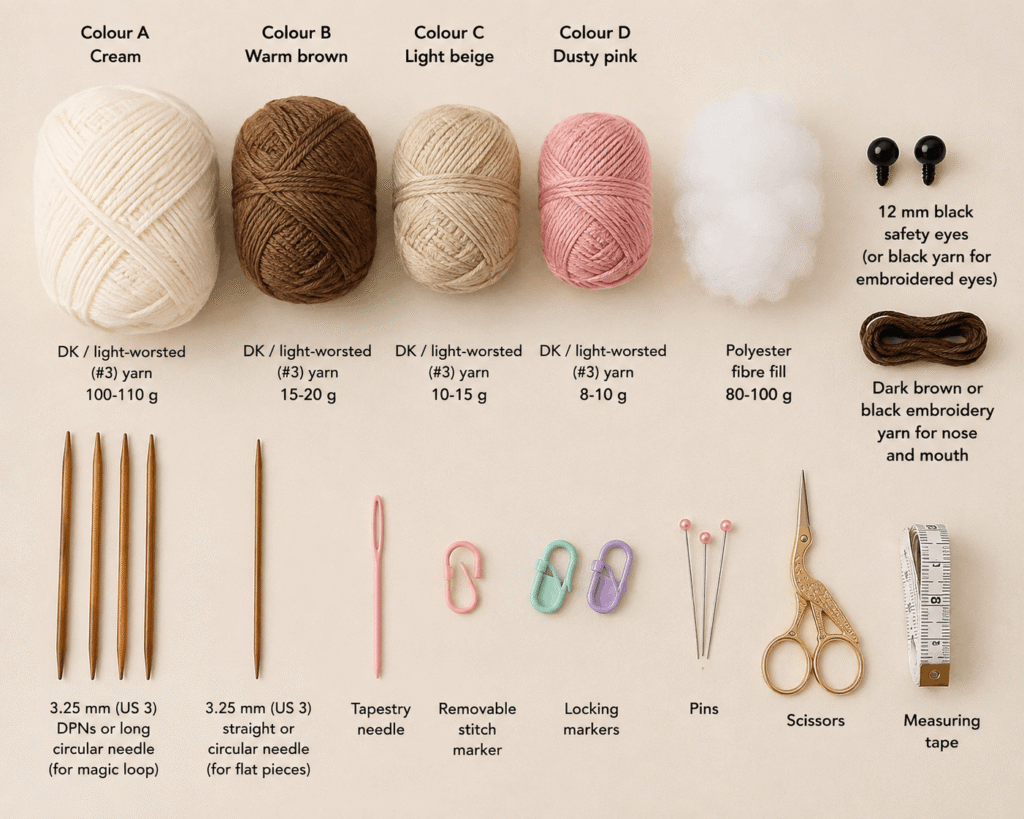
The lamb knitting pattern uses DK / light-worsted (#3) yarn. The PDF recommends a smooth plied wool or wool-acrylic blend and gives approximate quantities of 100–110 g cream, 15–20 g warm brown, 10–15 g light beige, and 8–10 g dusty pink.
You will need 3.25 mm (US 3) DPNs or a long circular needle for magic loop, plus a 3.25 mm straight or circular needle for flat pieces. Other supplies include polyester fibre fill, two 12 mm black safety eyes or black yarn for embroidered eyes, dark embroidery yarn, a tapestry needle, stitch markers, pins, scissors, and measuring tape.
Firm toy-knitting tension matters because loose fabric can reveal the stuffing. The PDF advises moving down a needle size if the smooth stockinette is too open.
Stitches and Techniques Used
You should be comfortable casting on, knitting and purling, binding off, working in the round, and working flat. Shaping uses kfb, k2tog, and ssk. The body alternates knit and purl stitches to create its pebble texture.
The cap introduces a mini bobble, while the arms and legs are closed with a three-needle bind-off. Assembly also uses whip-style sewing, mattress-style ladder stitches at the neck, stuffing, and simple facial embroidery.
For this lamb knitting pattern, no single technique is unusually complex, but keeping the textured rounds, shaping, and placement landmarks organized requires care.
How Maisie the Little Lamb Is Constructed
The head is worked from crown to neck and stuffed to hold a rounded shape. The body begins at the neck and is worked downward, increasing into a fuller pear shape before decreasing to a gathered base.
The arms and legs are made separately from the brown hoof ends upward. Two cream outer ears and two dusty-pink inner panels are knitted flat and layered together. The light beige muzzle is also worked flat and lightly stuffed during attachment.
The bobbled wool cap starts in the round, then divides so a tapered rear flap can be worked flat. The small tail is worked separately in pebble texture. Assembly proceeds through the face, ears, cap, head-to-body seam, limbs, and tail, followed by final shaping.
Helpful Tips for Making This Project
Keep the beginning-of-round marker easy to identify on the head and body because center-back and center-front placement depend on it.
Check both gauges before committing to the full lamb knitting pattern. Smooth stockinette is 22 stitches × 30 rounds per 10 cm, while pebble texture is 22 stitches × 32 rounds. If your purl tension is much tighter, the body may become smaller than intended.
Use the long sewing tails where the pattern provides them, and pin paired features before sewing. Compare the ears from the front and top, check that the arms begin at matching heights, and stand the body upright before fixing the legs.
Add stuffing gradually. The head should stay round without stretching the stitches, the muzzle needs only light filling, and the lower body should remain broad enough to stand steadily.
Troubleshooting Common Problems
Why Does My Lamb Knitting Pattern Look Too Large or Too Small?
Measure both structural gauges. A different needle size changes the overall scale, while a mismatch between stockinette and pebble texture can make the head and body look disproportionate. If stuffing shows, use a smaller needle or remove a little filling rather than stretching the fabric further.
Why Does the Finished Lamb Not Stand Evenly?
The design depends on a broad gathered base and horizontal leg attachments. If the body rocks, redistribute a little stuffing toward the lower side walls. If one foot sits higher, re-check the leg seam and shift the attachment by one body stitch before securing it.
Why Do the Face or Ears Look Uneven?
Use the PDF’s center-front and side-axis landmarks before tightening seams. The muzzle is centered on head CF, the eyes are symmetrical, and the ear bases sit at matching side axes. Re-pinning is more effective than trying to correct height by tightening one seam.
Why Is the Bobbled Cap Pulling the Head Out of Shape?
The cap should rest on the head rather than compress it. If the forehead pulls inward, loosen the sewing tension. If the edge ripples, re-pin the front center, side corners, and lower back before resewing with relaxed stitches.
Care Instructions for the Finished Project
The PDF does not specify a laundering method, so follow the care instructions for the yarn you use. Spot-clean when practical, avoid twisting or wringing, reshape gently while damp, and allow the plush to air-dry completely away from direct heat.
Inspect seams and attached features occasionally. The pattern notes that safety eyes and other small rigid components may not be suitable for children under three years old; embroidered eyes are offered as an alternative.
Leave a Reply