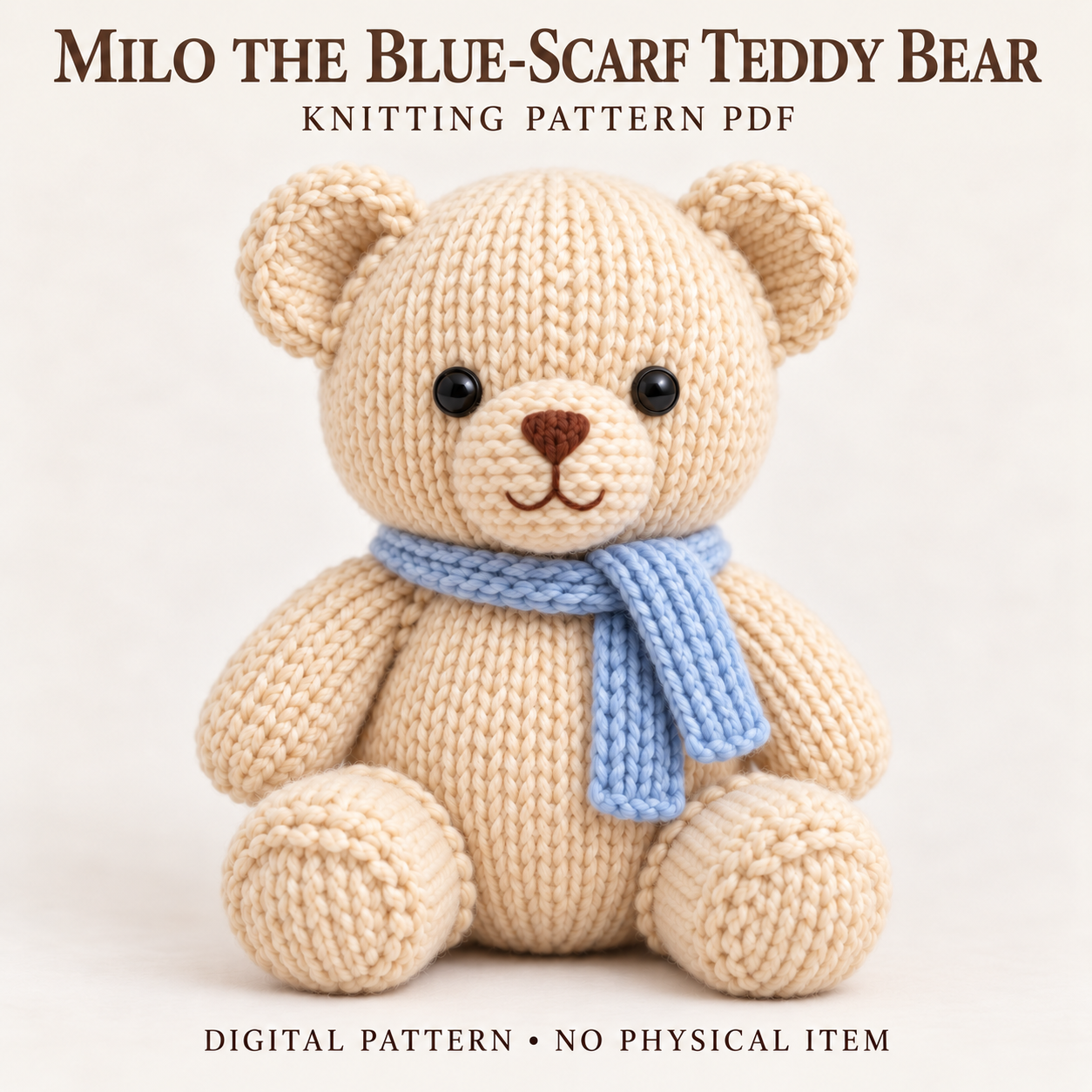
Milo’s blue scarf teddy bear knitting pattern creates a seated cream bear with a broad round head, a pear-shaped belly, and oversized forward-facing feet. A pale powder-blue scarf adds colour around the neck, while dark brown nose and mouth embroidery defines the face. The muzzle uses the bumpy reverse side of stockinette, and folded garter-stitch ears introduce another quiet texture. This is a knitting project for confident beginners to intermediate makers who can work small circular pieces, shape fabric, and sew components together. The overview below explains the supplies, filling choices, and placement references that establish the seated shape. The complete PDF near the bottom contains the written instructions, placement maps, and detailed assembly sequence.
Texture in the blue scarf teddy bear knitting pattern
The bear stays warm cream from head to toes, including its muzzle, arms, feet, and small rear tail. There are no contrasting paw pads. The muzzle’s reverse-stockinette surface distinguishes it from the smoother head and gives the embroidered face a clearly defined setting.
Each ear begins as a circular garter disc that is folded and sewn into a rounded shape. The scarf is worked flat in one-by-one rib, with plain ends and a loose knot on the bear’s own left, which appears on the viewer’s right. It has neither fringe nor a separate bow.
Skills, gauge, and approximate size
Expect knit and purl stitches, circular stockinette, increases, decreases, binding off, seaming, and facial embroidery. The main challenge is controlling the relationship between filled pieces rather than learning an elaborate stitch pattern.
The blue scarf teddy bear knitting pattern gives a main gauge of 15 stitches and 22 rounds per 10 cm, measured after relaxation and before stuffing. approximate size targets are 28–30 cm seated height, 19–21 cm across the feet, and 17–19 cm front to back. The head is planned at 15–16 cm wide.
The scarf is approximately 5 × 42 cm. Its length is measured directly, so an exact scarf row gauge is less important than maintaining even rib columns.
Bulky yarn and tools to prepare
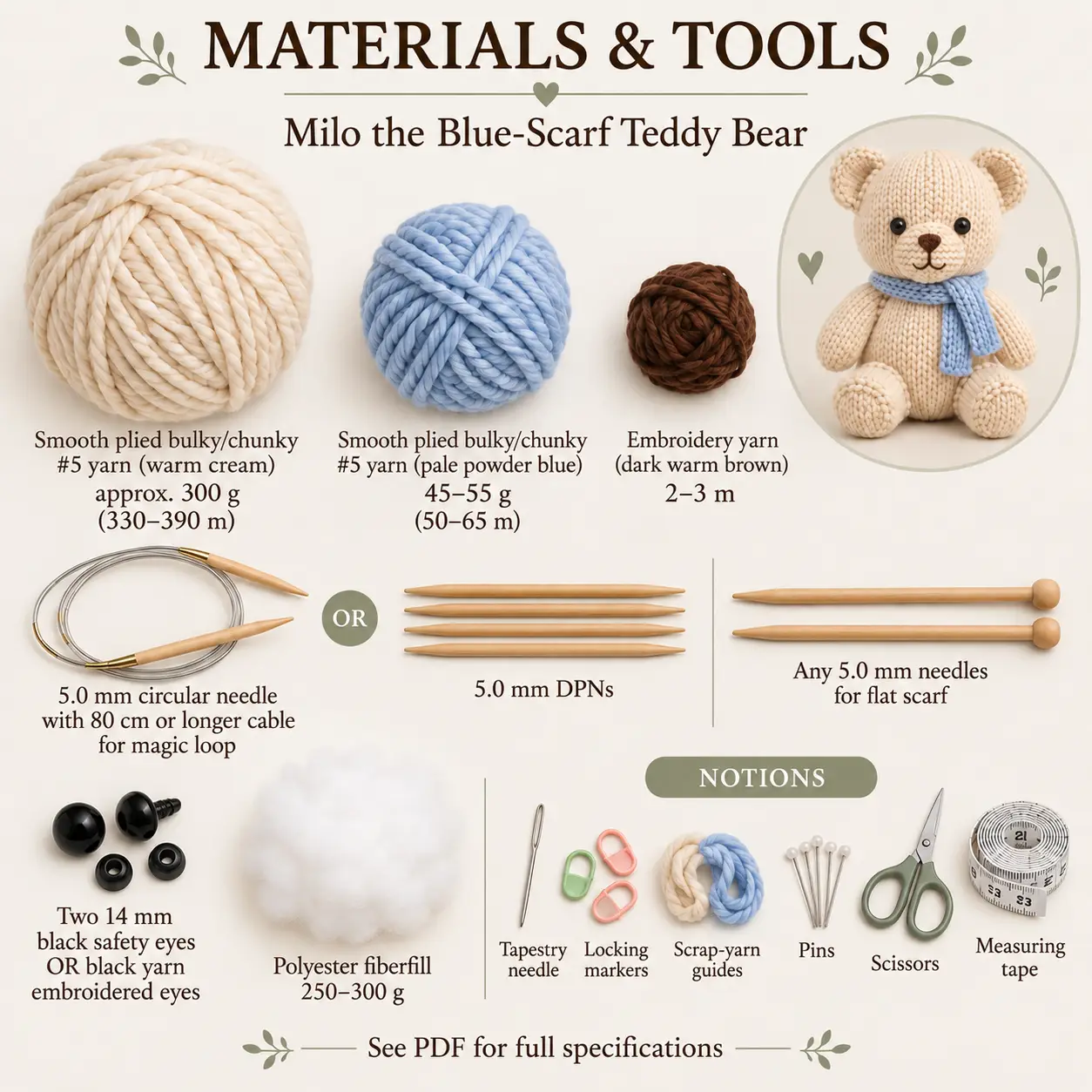
Use smooth plied bulky or chunky yarn, weight number five. The warm cream allowance is approximately 300 g or 330–390 m. Pale powder blue requires 45–55 g or 50–65 m, with 2–3 m of dark warm brown embroidery yarn for the nose and mouth.
The blue scarf teddy bear knitting pattern uses 5 mm DPNs or a 5 mm circular needle with an 80 cm or longer cable for magic loop. Any suitable 5 mm needles can work the flat scarf. Choose two 14 mm black eyes or prepare black yarn for embroidery.
Allow approximately 250–300 g of polyester fiberfill. A tapestry needle, locking markers, scrap yarn for guides, pins, scissors, and measuring tape complete the supplies. Dense fabric matters: filling should remain enclosed without stretching open the stitches.
How the circular pieces fit together
The head begins at the crown and closes at the lower head. Install eye hardware before the final narrowing removes access, then fill the head before closing it. The body begins with an open neck, expands downward, and closes at its base; filling is added through the neck opening.
The blue scarf teddy bear knitting pattern joins that open body edge to a marked attachment ring on the already closed lower head. It does not join two open neck tubes. Keep this distinction clear when laying out the pieces.
Arms, feet, muzzle, ears, and tail are made separately. Turn the muzzle so its reverse-stockinette side faces outward. Fold the unfilled ear discs before attaching their straight bases, preserving their curved outer edges.
Assembly and front-to-back alignment
Keep the round-start marker at centre back on the head and body. Establish a separate centre-front guide opposite it, then mark the physical side folds. Refresh the body’s front reference as its circumference changes rather than relying on one unchanged numerical stitch position.
Fill and join the head and body first, aligning their front guides. Attach the reversed muzzle, followed by the mirrored ears, arms, feet, and rear tail. Complete the nose and mouth embroidery, and finish embroidered eyes if that option was chosen.
Check the bear from the front, both sides, and back before removing its guides. Fit the scarf last so it does not conceal the neck or interfere with checking the limb positions.
Filling and finishing tips for a seated bear
Fill the head firmly and evenly, preserving its broad shape without bulking out the lower attachment area. The body’s lower half needs firmer support than its upper portion. Add small tufts and redistribute them before closing access seams.
For the blue scarf teddy bear knitting pattern, keep the arms’ upper sections lightly filled and their paws more moderately filled. Firm toes with softer heels help the feet form a stable contact area. The muzzle needs only a thin layer of padding; overfilling would obscure its texture and distort the embroidery.
Leave the ears unfilled and the small tail lightly filled. Pin both feet together before sewing either permanently, comparing their toe centres against the same front guide. Block the scarf only as its yarn permits, without stretching the ribs sideways.
Troubleshooting placement and scarf bulk
Why does this project rock?
Compare both feet on a flat surface. The PDF suggests moving the higher foot slightly lower or reducing filling at its heel. Keep the toe centres equally spaced from centre front, and reassess the seated profile before completing the replacement seam.
Why does the muzzle sit off centre?
Use both the front guide and the midpoint between the eyes as reference points. Re-pin the oval before finishing its seam. Relying on only one eye can hide a small shift that becomes more noticeable once the nose is embroidered.
Why is the scarf knot too bulky?
Loosen the knot and let the two ends lie naturally instead of cinching the fabric tightly. If permitted by the yarn label, light blocking can help even the ribbing. Keep the knot on the planned side and leave the neck shape visible.
Care and eye-finishing choices
After completing the blue scarf teddy bear knitting pattern, use the yarn manufacturer’s care guidance for the assembled project. Gentle surface cleaning may suit the filled shape. Avoid wringing or pulling the ears and scarf, reshape carefully, and allow the filling to dry thoroughly.
The PDF recommends securely embroidered eyes instead of detachable eye components for items intended for children under three, alongside applicable local requirements. Inspect the eyes, embroidered face, neck seam, and limb attachments during finishing. Secure all hidden ends and remove the temporary guides rather than leaving them caught beneath the final seams.
Download Milo’s complete pattern PDF
The blue scarf teddy bear knitting pattern PDF includes the complete component instructions, stuffing notes, placement maps, and assembly guidance. Refer to it for exact counts, eye-access timing, and the lower-head attachment ring.
DIGITAL DOWNLOAD ONLY — NO PHYSICAL ITEM WILL BE SHIPPED.
Leave a Reply