
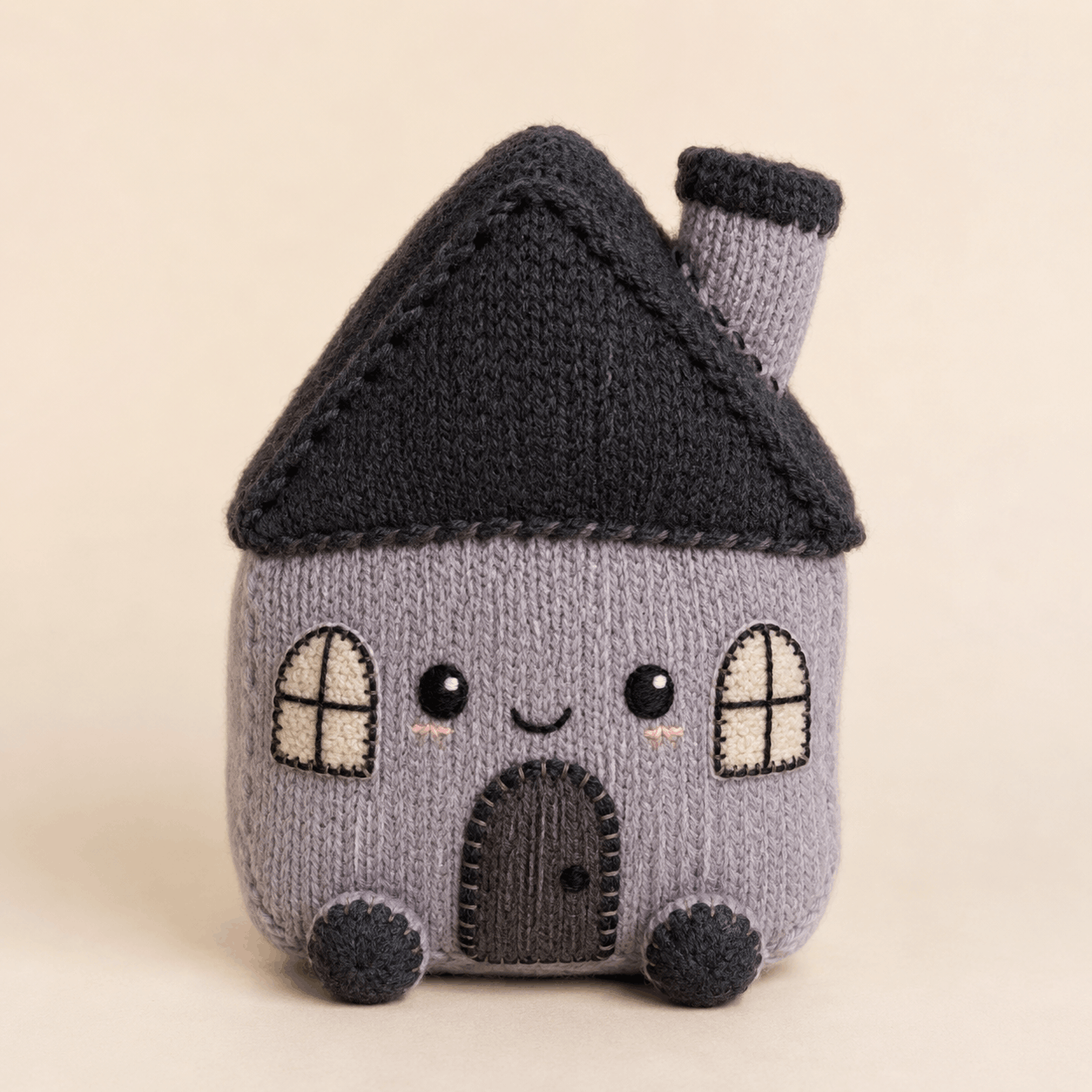
Misty is a softly stuffed house plush with a lavender-gray body, steep charcoal roof, warm cream arched windows, a dark front door, padded feet and a simple embroidered face. This haunted house knitting pattern is worked entirely flat on straight needles, so there is no circular knitting to manage. The project combines stockinette panels with shaped roof pieces, appliqués, seaming and embroidery, making it best suited to a confident beginner or intermediate knitter. Below you can preview the construction, materials, techniques and project-specific finishing tips before using the complete pattern PDF near the bottom of the page.
About This Haunted House Knitting Pattern
The design is a decorative knitted plush shaped like a small gabled house. Its body forms a softly rounded rectangular box, while the tall charcoal roof creates the main silhouette. A lavender-gray chimney with a charcoal cuff rises from the house-left roof slope.
Two cream arched windows frame a centred deep-gray door. Black outlines and pane bars add definition, while the face uses embroidered oval eyes, pink cheeks and a shallow smile. The padded feet sit low on the front and angle slightly outward. The haunted house knitting pattern keeps the back plain so the roof shape and body proportions remain clear from every side.
Skill Level and Finished Size
Craft: Knitting
Project type: Stuffed decorative house plush
Skill level: Confident beginner / intermediate
Construction: Worked flat on straight needles, then seamed and assembled
Terminology: Standard knitting terminology
Finished height: About 28.5–29 cm / 11.25–11.5 in
Width across roof: About 20–21 cm / 8–8.25 in
Body depth: About 11.5–12.5 cm / 4.5–5 in
Roof rise: About 14 cm / 5.5 in
The shaped gables, front-feature placement and final roof alignment need the most care. Because the haunted house knitting pattern uses separate body and roof sections, careful pinning before sewing helps keep the finished house balanced.
Materials and Tools You Will Need
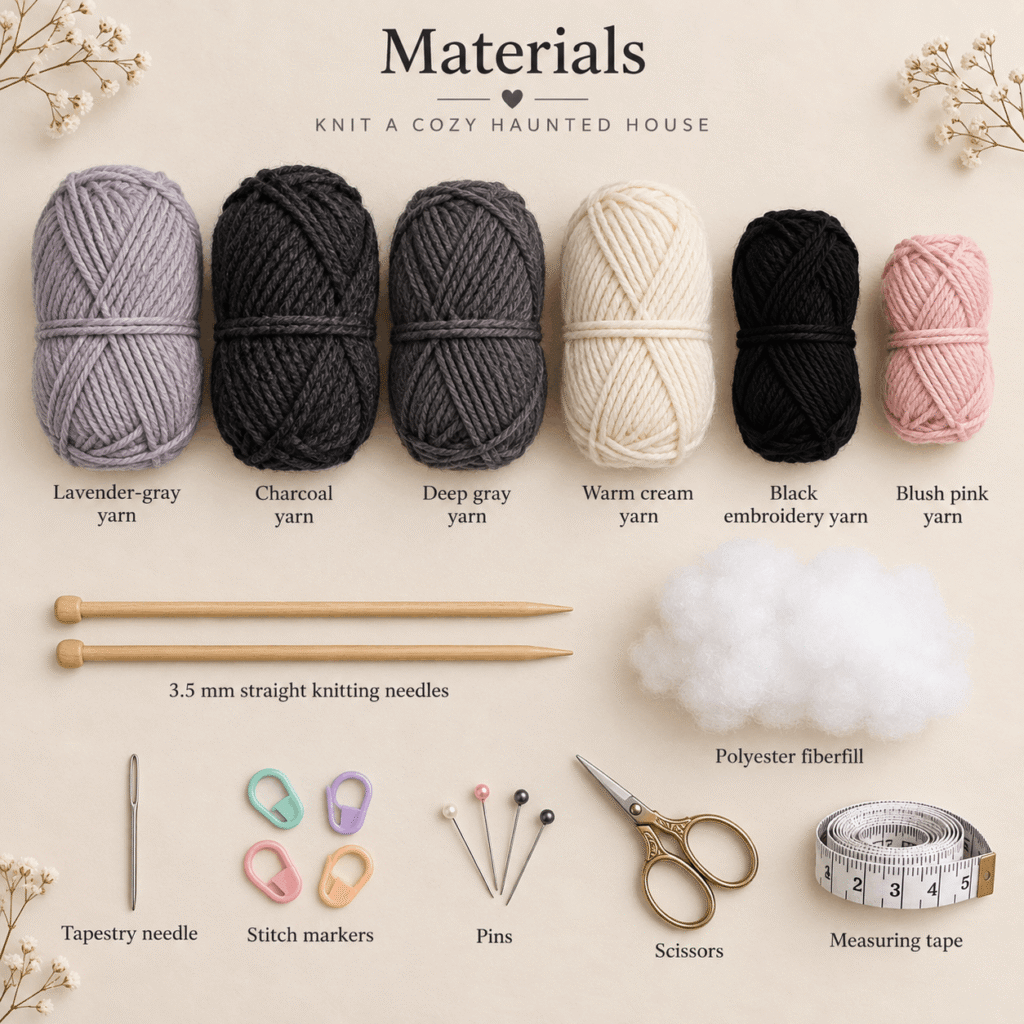
Use smooth DK or light worsted yarn. The body requires about 100 g / 240 m of lavender-gray, while the charcoal roof uses about 70 g / 170 m. You will also need roughly 15 g / 35 m each of deep gray for the door and warm cream for the windows.
Small amounts of black yarn or embroidery thread form the eyes, mouth, window outlines, pane bars and door details, with a scrap of blush pink for the cheeks. Work with 3.5 mm straight knitting needles, or the size needed for gauge, and allow about 100–120 g of polyester fiberfill. You will also need a tapestry needle, pins, scissors, stitch markers and measuring tape.
For this haunted house knitting pattern, the specified stockinette gauge is 22 stitches × 30 rows over 10 × 10 cm / 4 × 4 in for both body and roof fabrics.
Stitches and Techniques Used
Most of the project is stockinette stitch, with knit rows on the right side and purl rows on the wrong side. Shaping uses kfb increases plus k2tog, ssk and p2tog decreases.
Vertical stockinette seams are joined with mattress stitch, while whip stitch is used for several edge joins and the front appliqués. Black embroidery adds window bars, outlines, door planks, the French-knot doorknob and facial details. These familiar techniques keep the haunted house knitting pattern accessible while still giving the house a detailed finish.
How Misty the Little Haunted House Is Constructed
The house starts with six lavender-gray body panels: front, back, two sides, top and bottom. Before assembly, the two windows and door are sewn to the flat front panel and the face is embroidered, allowing the tails to be secured neatly on the wrong side.
The body is then seamed into a soft box and stuffed firmly enough to stand. The roof is built separately from two steep gables and two slope panels. The chimney is attached while the underside of the roof is still accessible.
A light layer of stuffing is added inside the roof before it is centred and sewn to the body. Decorative doubled-yarn stitching finishes the gable seams, gable bases, ridge and lower side eaves. The two padded feet are attached last.
Helpful Tips for Making This Project
Pin the windows, door and face before sewing permanently. The windows should be level and the eyes should sit evenly on either side of centre front.
Check the roof gauge separately from the body gauge. Two yarns of the same stated weight can still knit at different tensions.
Keep the removable front-edge marker on each slope panel so the roof pieces are not accidentally reversed during assembly.
Stuff the body gradually, pushing small amounts into the corners first. Keep the bottom centre relatively flat so the house does not rock.
Keep the roof stuffing light. The haunted house knitting pattern depends on a crisp gabled profile, and too much stuffing can round the slopes and soften the ridge.
When adding decorative roof stitches, use shallow bites and avoid pulling tightly so the seams remain raised without puckering.
Troubleshooting Common Problems
Why Does My Haunted House Knitting Pattern Roof Sit Crooked?
Check that the front and back gable bases are centred and that all four roof corners are pinned before sewing. If one eave section is pulling sideways, unpick only that area, recentre the roof, repin and resew.
Why Is the Body Rocking Instead of Sitting Flat?
Too much stuffing in the lower corners can round the base. Remove a little fiberfill from those corners and redistribute it into the side walls, then shape the bottom gently against a flat surface.
Why Are My Windows or Door Curling?
Stockinette appliqués naturally curl. Pin them flat and use small, evenly spaced whip stitches around the outer edge. If needed, lightly damp-block the flat appliqué before attachment.
Why Does the Roof Look Too Large or Too Small?
Recheck the charcoal roof gauge separately from the body gauge. The haunted house knitting pattern allows you to change needle size for the roof yarn alone if its tension differs noticeably from the body fabric.
Care Instructions for the Finished Project
The pattern does not specify a laundering method, so follow the care guidance for the yarns you choose rather than assuming machine washing is suitable. Do not press the stuffed body or roof with a hot iron. A flat window or door piece may be lightly damp-blocked before assembly if it needs relaxing.
Check the roof seams, chimney, appliqués and feet occasionally and gently reshape the stuffing if the plush becomes compressed.
Leave a Reply