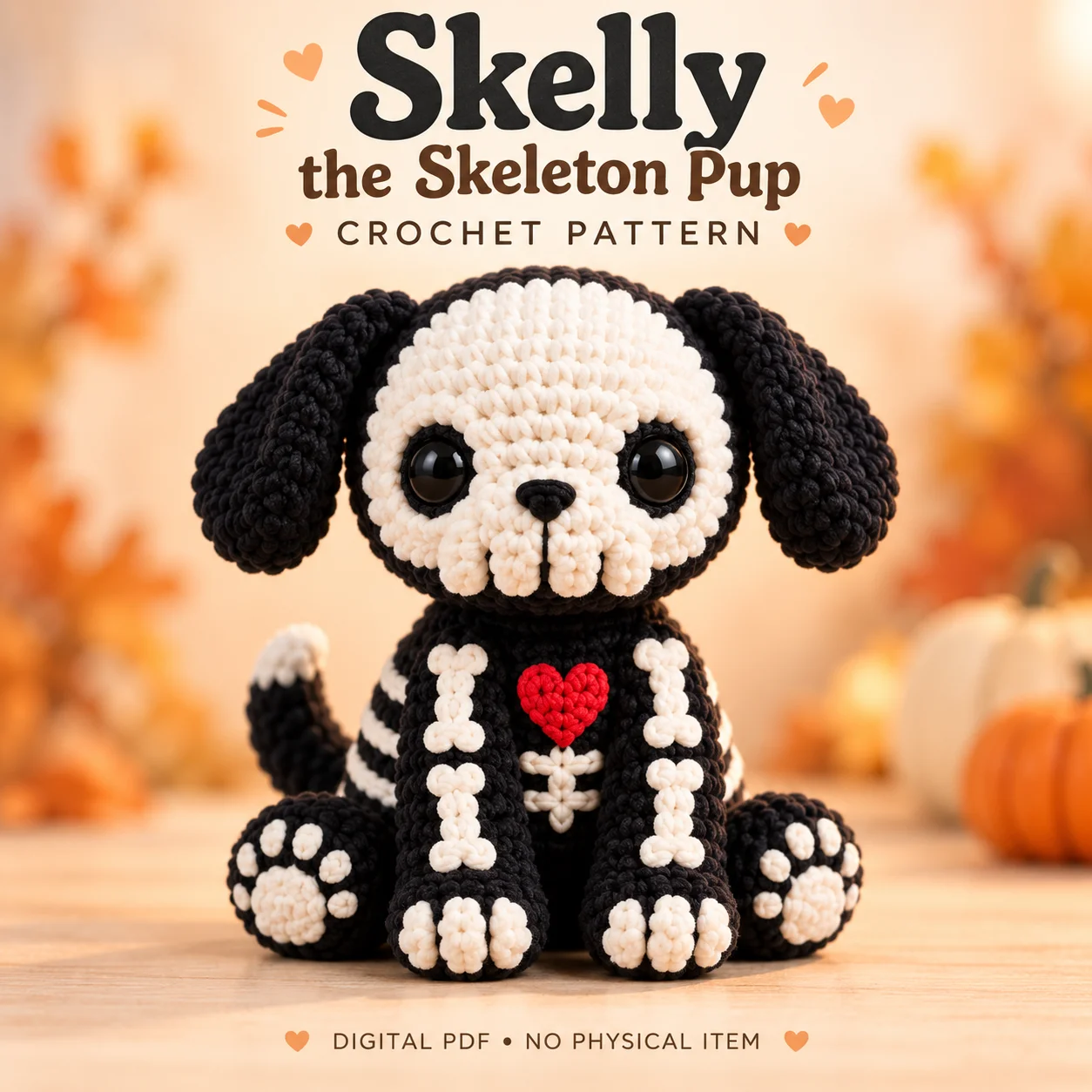
Skelly is a black seated puppy with cream skull panels, white skeleton details and a red heart on the chest. This crochet skeleton dog pattern uses bulky plush or chenille yarn for a soft, chunky silhouette. The supplied corrected PDF is written for intermediate makers using standard US terminology. Floppy ears frame the face, while a sculpted cream muzzle has four rounded lower lobes. The front and hind paws use different white pad layouts, making the finishing map especially important. Read the skull-panel eye installation and skeleton placement notes before assembly so the contrasting details follow the written version rather than generic dog anatomy.
Features of this crochet skeleton dog pattern
The black head has separate cream panels on the front and back, each surrounded by a visible dark border. Complete black oval eye-socket rings surround the front eyes. A triangular black nose sits above a short vertical mouth line and the four-lobed muzzle. Two long forelegs carry paired white bone cords. Beneath the red heart, a short sternum crosses two horizontal bars. Three rib pairs and two separate spine bones decorate the back, while the upward-curved black tail ends in cream.
Preserve the PDF’s distinctions between flat, lightly padded and firmly stuffed pieces.
Skills and stitch methods
Main shapes use continuous spiral rounds with standard yarn-over single crochet; a consistent yarn-under alternative is permitted. Flat skull panels remain unfilled, and decorative chain-and-slip-stitch cords are tacked to the completed stuffed surfaces. Three shallow sculpting channels divide the muzzle’s lower edge into four lobes. The heart uses mixed-height stitches in a magic ring. Keep count markers separate from physical front and back guides, especially when placing the heart, chest motif, paired back ribs and distinct paw-pad arrangements.
Before beginning this crochet skeleton dog pattern, identify which sections are flat and which are stuffed. Read each section heading before continuing, and check the stitch totals at the end of shaping rounds. Counting early is easier than finding a missing increase beneath several completed rounds.
Yarn, tools and filling
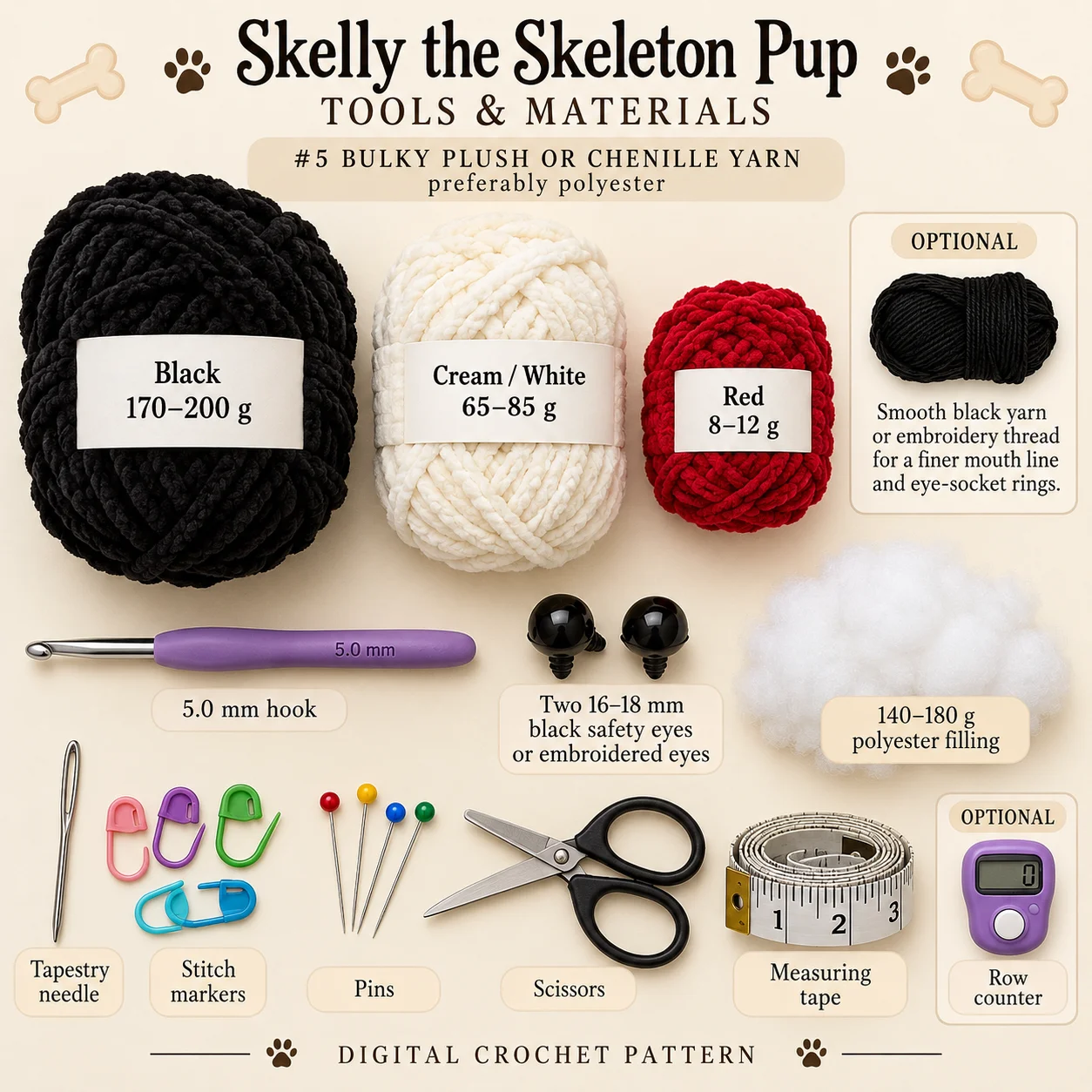
Use #5 bulky plush or chenille yarn, preferably polyester. The approximate supplies listed in the PDF are:
Black 170–200 g; cream/white 65–85 g; red 8–12 g. Optional smooth black yarn or embroidery thread for a finer mouth line and eye-socket rings. 5.0 mm hook; two 16–18 mm black safety eyes or embroidered eyes; 140–180 g polyester filling; tapestry needle, stitch markers, pins, scissors and measuring tape. Optional row counter.
Quantities vary with substitutes. Use pins and separate placement markers during assembly.
Gauge and finished proportions
The practical target is approximately fourteen single crochet stitches and thirteen spiral rounds over 10 cm with a 5.0 mm hook. Measure a firm round swatch or tube without stretching it. Category 5 bulky plush or polyester chenille is recommended. The approximate dimensions is 29–32 cm, with an ear-to-ear width of 26–29 cm. These are digital targets. Substituting another weight changes the scale, and the large head needs even filling without visible gaps between the plush stitches.
For this crochet skeleton dog pattern, compare the fabric and proportions together. A swatch with visible gaps needs attention before stuffing, while a much denser substitute can change the size of every paired component. Recheck the main shapes before attaching the smaller details.
Construction and assembly order
Stuff and close the black head base before attaching either skull panel. Temporarily pin the front cream panel to check the eye centers, then fit the hardware through that panel only. Secure its washers behind the unpinned panel before returning it to the head and sewing the perimeter. The embroidered alternative is added after the panel is attached. Lightly fill the muzzle during sewing, add the triangular nose and form its three shallow channels before the short central mouth line.
Keep the black body’s twenty-four-stitch neck open until it is sewn evenly against the closed head. Add broad side hind legs, the two front limbs and the lightly filled upward-curved tail. Attach the heart and skeleton decorations after the body has its final shape. Each forepaw has three elongated toe pads with no center pad. Each hind paw has one round center pad and six smaller pads in a horseshoe. Preserve the black gaps between separate foreleg and back-spine bones.
The crochet skeleton dog pattern is easier to assemble when all paired pieces are laid out together. Keep the PDF open at its placement notes, pin before sewing and pause to compare front, side and back views. Small corrections at this stage prevent larger changes after the seams are secured.
Practical tips for neat details
- Fit hardware eyes through the front skull panel before sewing it down.
- Preserve an even black border around both cream head panels.
- Make three muzzle channels to form four rounded lower lobes.
- Use three toe pads on each forepaw without a large center pad.
- Add one center pad and six smaller pads to each hind paw.
When working from the crochet skeleton dog pattern, leave the recommended sewing tails and keep the attachment order visible beside your work. Avoid tightening a seam so strongly that it dents the stuffed shape. If a piece rotates while sewing, stop, re-pin it and check the reference markers before continuing.
Troubleshooting
Why does this project have rib cords lifting away?
Pin the cords against the final filled body and follow its rounded surface. Add small tacks at the deepest parts of each curve, using closer spacing where a cord changes direction. The PDF recommends regular anchors rather than tightening the whole cord. Compare the mirrored rib heights before securing the tails, and keep the two back-spine bones separate with a visible black gap.
Why are the skull-panel eyes uneven?
Check the eye posts while the front panel is temporarily pinned to the fully stuffed, closed head. Reposition the posts through the panel before locking the washers. Once the centers are level, remove the panel carefully, fit its washers and return it to the same marked position. Embroidered eyes can instead be adjusted at their marked locations before final stitching.
Why does the seated head lean?
Compare the complete twenty-four-stitch neck attachment around the underside of the head. An uneven join can pull one side lower even when the seam is secure. The PDF permits one hidden reinforcing stitch on the low side after checking the alignment. Keep the lower body base broad and flat, with moderate upper filling, rather than tightening a neck groove.
Finishing and care
Inspect the skull-panel edges, eye-socket rings, heart and every bone-cord anchor. Confirm the two paw layouts and the white tail tip from front, side and back views. Remove pins and temporary guides, then bury remaining ends. Choose cleaning methods from the actual chenille and filling labels. Use the embroidered-eye alternative when detachable components are unsuitable for the recipient, following applicable local requirements. The PDF describes digital checking without a physical test-crochet sample.
Before calling your crochet skeleton dog pattern project complete, inspect the hidden joins as well as the visible face. Secure loose ends using the PDF’s finishing method and confirm that all small details are firmly attached. The design dimensions are estimates; record your own finished measurements if you plan another version with the same yarn.
Download the complete PDF pattern
This PDF contains the complete crochet pattern for Skelly the Skeleton Pup. Digital download only; no physical item will be shipped.
Related projects: Luna the Bat, Frankie the Friendly Frankenstein.
Browse the crochet pattern collection for more project overviews.
Leave a Reply