
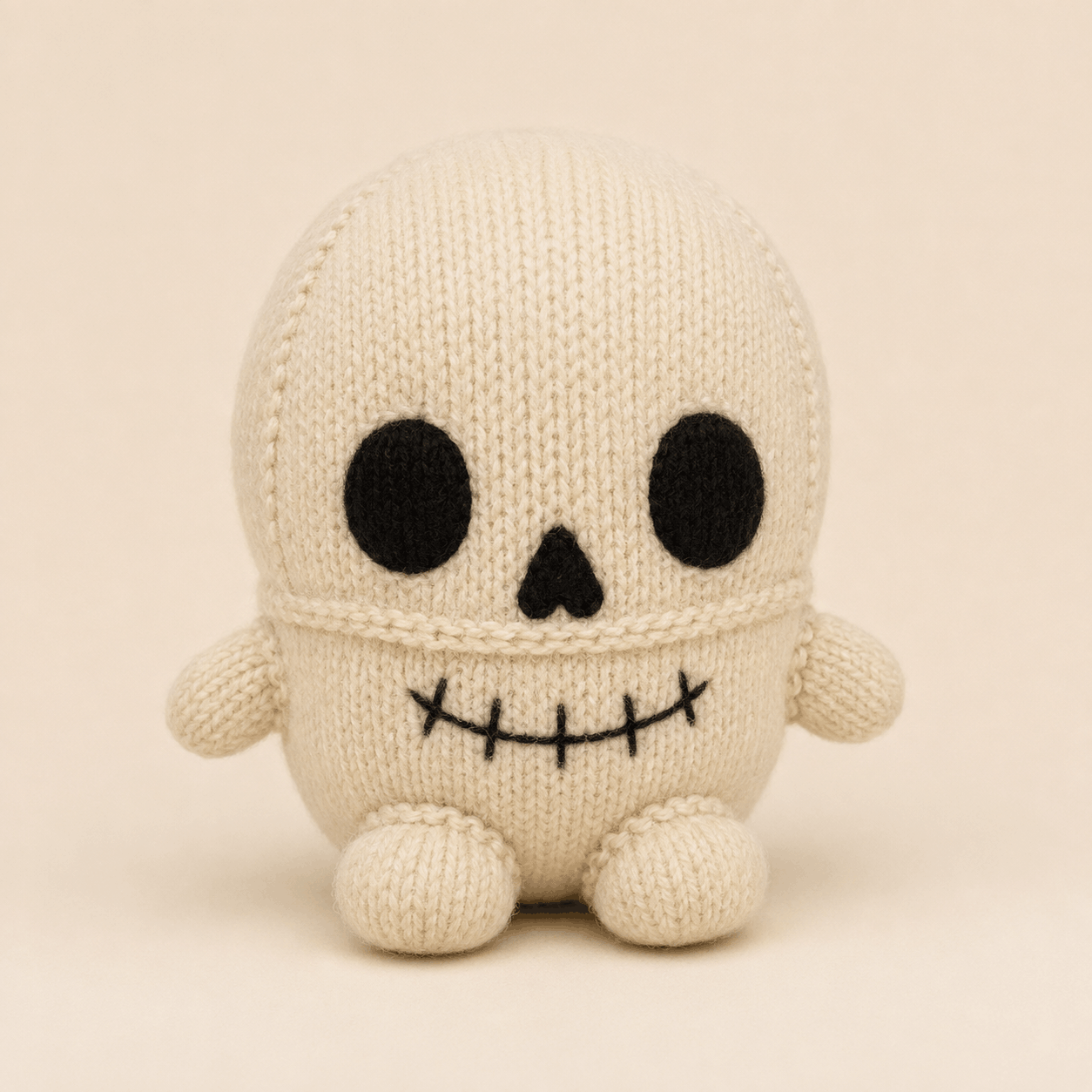
This skull plush knitting pattern makes Skelly, a softly rounded cream plush with a tall domed head, compact lower jaw, black oval eye patches, a small pointed nose, a stitched toothy smile, tiny side arms and plump front feet. Every knitted piece is worked flat on straight needles, so there is no circular knitting to manage. The pattern is rated Confident Beginner / Intermediate and uses stockinette shaping, simple appliqués, mattress stitch and careful stuffing. This overview covers the materials, sizing, techniques, construction, placement and common fixes, while the complete row-by-row instructions remain in the PDF near the bottom.
About This Skull Plush Knitting Pattern
Skelly uses warm ivory or cream for the body and limbs, with black for the eyes, nose and mouth. The body is knitted as one shaped piece instead of separate head and torso sections. A narrow knitted cord wraps around the transition between the head and lower jaw, creating the raised skull ridge.
The eye patches and nose are smooth stockinette appliqués. Below them, the shallow embroidered smile has seven short vertical tooth stitches. Because the face is added while the body is still flat, this skull plush knitting pattern gives you easy access to the wrong side for securing yarn ends before stuffing.
Skill Level and Finished Size
The project uses standard knitting terminology and is worked entirely flat. The stated skill level is Confident Beginner / Intermediate. The main points that require care are the repeated shaping rows, keeping the face centred as the stitch count changes, and attaching the limbs symmetrically.
- Craft: Knitting
- Construction: Flat on straight needles, then seamed
- Gauge: 22 sts × 30 rows = 10 × 10 cm / 4 × 4 in in stockinette
- Overall height: Approximately 24–26 cm / 9.5–10.25 in
- Body width: Approximately 17–18 cm / 6.75–7 in
- Body depth: Approximately 13–14 cm / 5–5.5 in
- Overall width including arms: Approximately 22–24 cm / 8.75–9.5 in
- Eye patches: Approximately 3.5–4 cm wide × 5 cm high / 1.4–1.6 × 2 in
- Arms: Approximately 3.5–4 cm / 1.4–1.6 in long
- Feet: Approximately 6 × 4.5 cm / 2.25 × 1.75 in
Finished size may vary with yarn, needle size, tension and stuffing.
Materials and Tools You Will Need
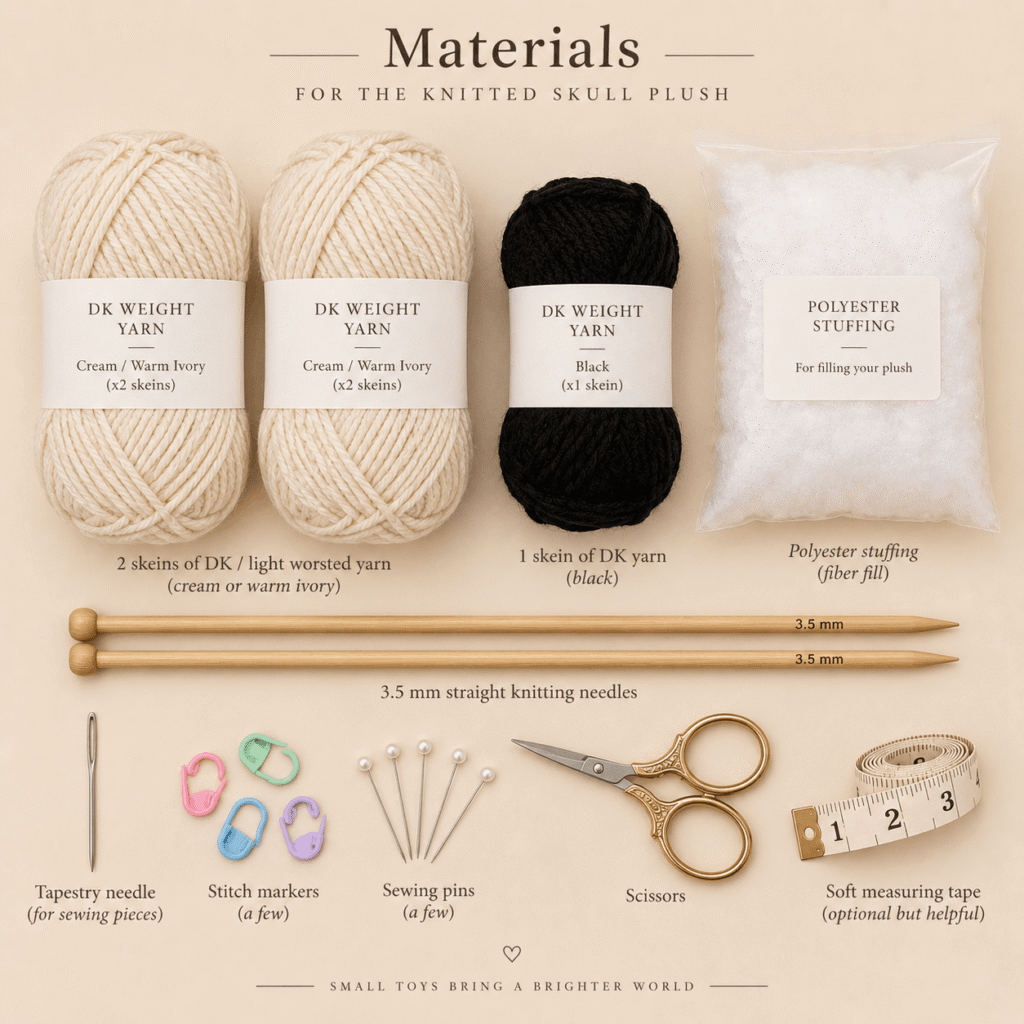
The skull plush knitting pattern uses smooth DK/light worsted yarn, approximately 220–250 m per 100 g. The pattern calls for about 130–150 g of cream or warm ivory for the body, arms, feet and ridge cord, plus about 8–12 g of black for the face pieces and embroidery.
You will also need 3.5 mm / US 4 straight needles, polyester stuffing, a tapestry needle, stitch markers or contrasting yarn, pins, scissors and a measuring tape. Smooth yarn suits this design well because the stockinette surface and appliqué edges remain clearly visible.
Stitches and Techniques Used
The knitting techniques include casting on, binding off, knit and purl stitches, stockinette, kfb, M1L, M1R, k2tog, ssk and p2tog. The body uses symmetrical shaping, while the eyes, nose, arms and feet are smaller flat pieces.
For finishing, the pattern uses mattress stitch for the centre-back seam, whip stitch for the black appliqués, backstitch for the mouth, flattened two-layer attachment for the limbs, and small couching stitches for the ridge cord. These finishing steps are straightforward, but neat placement matters because the design is highly symmetrical.
How Skelly Is Constructed
The main body is knitted first from the base through the lower jaw, widened head and rounded crown. Before the centre-back edges are joined, the eye patches and nose are sewn in place and the mouth is embroidered.
The centre-back seam is then partly closed, the base is gathered, and the body is stuffed through a temporary opening. After the body and crown are closed, the narrow ridge cord is attached around the head-to-jaw transition. The two feet and two lightly stuffed arms are sewn on last. This sequence keeps the face accessible and makes the skull plush knitting pattern easier to finish cleanly.
Helpful Tips for Making Skelly
Mark centre front before positioning the face. The body has both 104-stitch and 112-stitch sections, so the numerical midpoint changes even though the visible centre line remains constant.
Pin both eye patches at the same time and compare them from directly in front. Their centres sit about 10 stitches to either side of centre front, so measuring is more reliable than judging one eye at a time.
Keep the fabric dense enough to hide stuffing, and add stuffing in small tufts. Keep the lower base slightly flatter while building the head dome gradually.
For the arms and feet, flatten the open edge and capture both layers in every sewing stitch. Keep the arm seams approximately horizontal so the arms project outward.
Finally, pin the ridge cord level around the body before sewing it down. A straight ridge is a strong visual feature of this skull plush knitting pattern.
Troubleshooting Common Problems
Why Does My Skull Plush Knitting Pattern Look Uneven After Assembly?
Check the centre-back seam, stuffing and mirrored placement first. A twisted mattress-stitch seam can rotate the body, while uneven stuffing can make one side of the dome look fuller. The skull plush knitting pattern uses measured centre-front placement for the eyes, arms and feet, so rechecking those reference points is more accurate than adjusting pieces by eye.
Why Is the Skull Dome Too Pointed or Too Flat?
For a pointed crown, move stuffing away from the very top and into the upper side walls. If the dome looks flat, add small tufts beneath the crown and smooth them outward. The crown gather should close the opening without creating a hard peak.
Why Do the Eye Patches or Nose Lift?
Add a few small whip stitches through the outer edges, especially around the eye curves and nose corners. Pull only enough to hold the appliqué flat; excessive tension can pucker the cream stockinette.
Why Does Skelly Lean?
Check the foot placement and lower-body stuffing. The feet should sit low on the front with the toes angled slightly outward, while the base should remain a little flatter rather than becoming a firm round ball.
Care Instructions for the Finished Project
The pattern does not specify a particular fibre beyond DK/light worsted yarn, so follow the yarn manufacturer’s care label. Spot-cleaning is a cautious choice for routine care. If the yarn can be washed, avoid twisting or wringing, reshape the plush while damp and let it air-dry completely away from direct heat. Check the seams, appliqué edges, ridge cord and limb attachments occasionally for loose yarn.
Leave a Reply