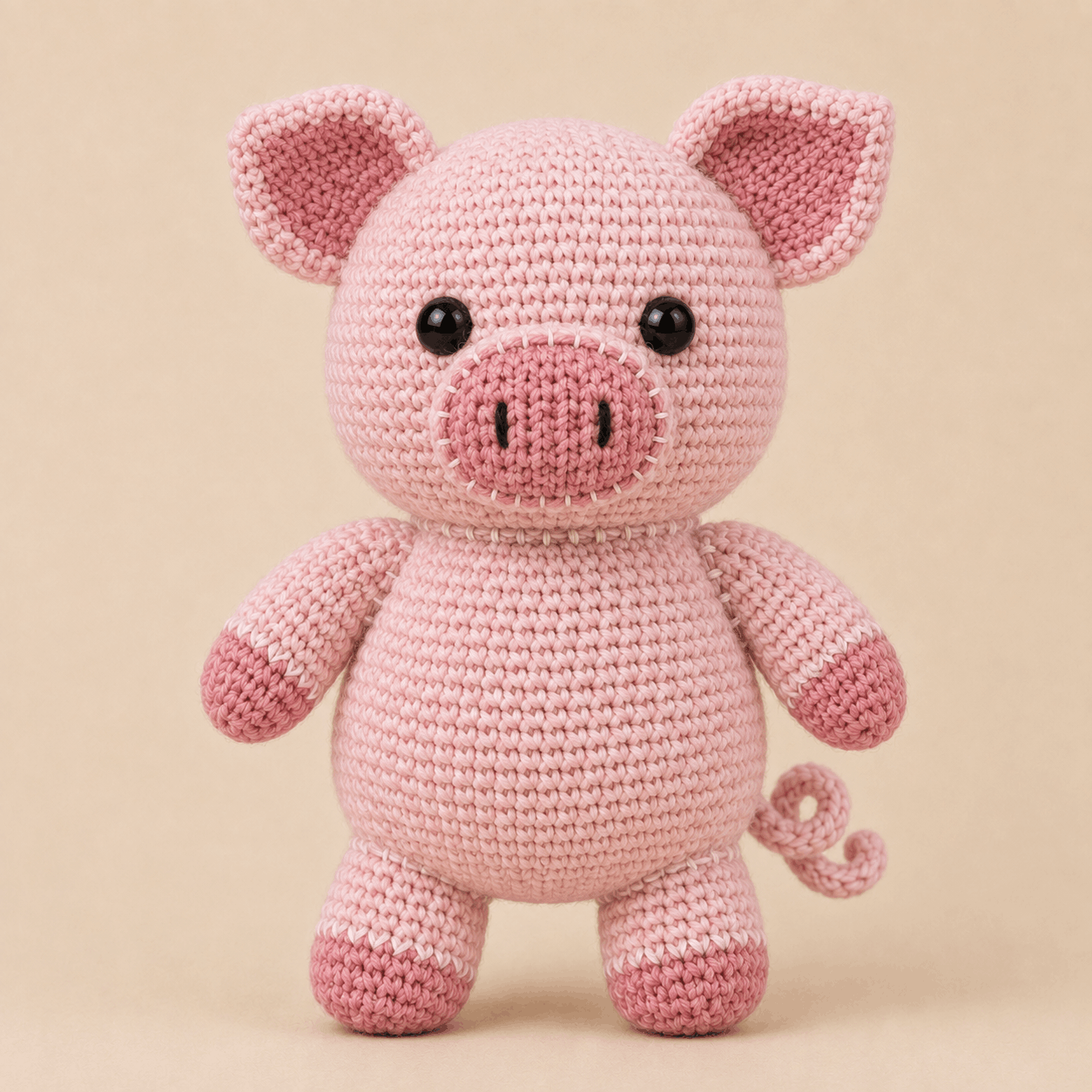
The crochet pig pattern for Rosie the Curly-Tail Pig makes a standing amigurumi with a large rounded head, pear-shaped body, cupped two-layer ears, padded oval snout, contrast hooves and a corkscrew tail. It uses mostly continuous single-crochet spirals, with flat rows for the ears and an oval worked around a foundation chain for the snout. The PDF rates the project Confident Beginner to Intermediate and uses US crochet terminology. This overview covers the supplies, techniques, construction, sizing and finishing points worth understanding before you begin, while the complete round-by-round and row-by-row instructions remain in the downloadable PDF near the bottom.
About This Crochet Pig Pattern
Rosie is a standing stuffed pig worked mainly in light blush pink, with dusty rose on the snout, inner ears and hoof ends. Warm cream yarn adds decorative stitches around the snout edge, hoof colour changes and neck seam.
The design gets much of its character from construction rather than complicated stitch patterns. The head is deliberately large and rounded, while the body has a softer pear shape. Each ear combines an outer and inner layer and is pinched at the base to form a shallow cup. The snout is lightly padded during attachment, and the tail is an unstuffed crocheted strip that naturally coils into a relaxed corkscrew.
Because this crochet pig pattern is assembled from several separate components, careful pinning and placement are as important as the basic crochet.
Skill Level, Construction and Finished Size
Craft: Crochet
Project type: Standing amigurumi plushie
Skill level: Confident Beginner to Intermediate
Terminology: US crochet terminology
Construction: Mostly continuous spiral rounds; ears worked flat; snout worked as a flat oval
Finished height: approximately 34–36 cm / 13.4–14.2 in
Finished width across arms: approximately 21–23 cm / 8.25–9 in
Head: approximately 14–15 cm wide and 15–16 cm high
Body: approximately 12–13 cm wide and 13–14 cm high
Snout: approximately 7–8 cm wide and 4.5–5 cm high
No making-time estimate is given in the PDF. The parts requiring the most care are stitch counting, marker placement and matching paired features before sewing.
Materials and Tools You Will Need
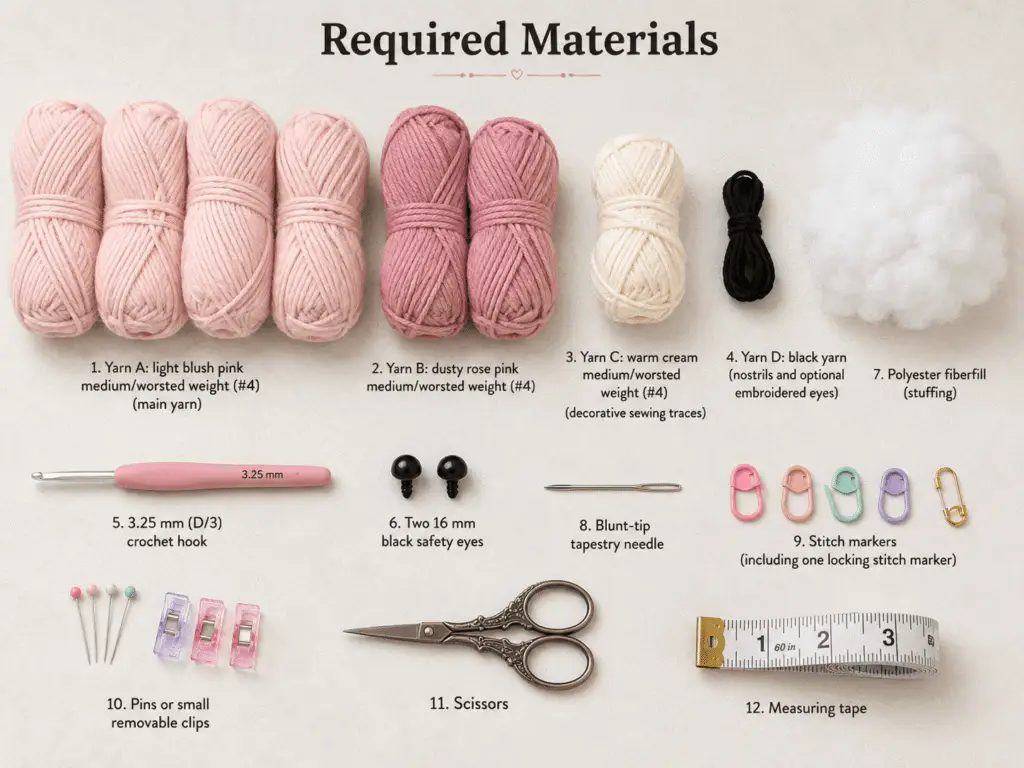
The main fabric uses medium/worsted-weight #4 yarn. The PDF specifies approximately 220–260 g / 400–475 m of light blush pink, 45–60 g / 80–110 m of dusty rose, and 8–12 g / 15–25 m of warm cream for decorative stitching. A small amount of black yarn is used for nostrils and can also be used for embroidered eyes.
You will also need a 3.25 mm (D/3) crochet hook, approximately 200–250 g of polyester fiberfill, a blunt tapestry needle, stitch markers, pins or clips, scissors and a measuring tape. Use two 16 mm black safety eyes or embroidered eyes.
The stated gauge is 20 single crochet stitches × 22 rounds per 10 cm / 4 in. Firm fabric is especially important for this crochet pig pattern, since loose stitches can expose the stuffing.
Stitches and Techniques Used
The project uses standard amigurumi skills: magic ring, chains, single crochet, increases, invisible decreases, continuous spirals, colour changes and fastening off. The ears are worked flat in rows, while the snout is formed around both sides of a foundation chain.
Assembly uses whip stitching and careful placement. The nostrils are short satin-stitch bars, and cream surface stitches finish the snout, hooves and neck seam. Makers using the crochet pig pattern should therefore be comfortable with crochet shaping and basic hand sewing.
How Rosie Is Constructed
The head is worked from the crown downward. Eye placement is handled while the inside remains accessible, then the head is stuffed and the final opening gathered closed.
The snout is made separately, embroidered with nostrils and sewn to the face with a very small amount of stuffing underneath. Each ear has a larger outer piece and smaller inner panel; the layers are joined and the base is pinched before attachment.
The body starts at the bottom centre and works upward to an open neck. Arms and legs are separate. Arm openings are flattened into short horizontal shoulder seams, while leg openings stay circular.
The body rim is sewn one-to-one around the corresponding head round. Legs, arms and tail follow, then the cream decorative stitches and final shaping. Reviewing this order before starting the crochet pig pattern helps prevent overstuffing areas that still need flexibility for assembly.
Helpful Tips for Making Rosie
Keep a locking marker in the first stitch of every spiral round. The PDF uses that stitch as the counting reference for centre-front, centre-back and side-axis placement.
Pin both members of a pair before sewing either permanently. This matters particularly for the ears and legs, where a small height or angle difference is easy to notice.
Stuff gradually rather than forcing in large clumps. The head should stay rounded through the sides and cheeks, and the upper body should remain slightly softer near the neck so the opening can flex while it is sewn to the head.
Leave the top of each arm flexible as directed. The unstuffed upper rounds allow the opening to flatten into the intended shoulder seam.
Before completing the crochet pig pattern, set Rosie on a flat surface and check the front, sides and back. Both hooves should make even contact and the body should not lean.
Troubleshooting Common Problems
Why does this project Rock or Lean?
Check the leg placement before changing the stuffing. The two circular leg openings should be mirrored around the body centre front, and both hooves should sit on the same surface. If placement is correct, adjust a small amount of stuffing through the affected leg opening and resew it securely.
Why Is Stuffing Showing Between the Stitches?
The fabric may be too loose or overfilled. The PDF recommends firm, dense tension and suggests moving down a hook size when the fabric is loose. Add fiberfill in smaller pieces instead of pressing large clumps against the stitches.
Why Do the Ears or Snout Look Uneven?
Use the marked centre lines and stitch coordinates rather than judging only by eye. Match the ear-base pinches and angles, and keep the snout horizontal and centred beneath the eyes before sewing.
Why Is the Tail Too Open?
The finished tail should relax into approximately 1.5–2 curls. Shape it gently by hand first. If necessary, the pattern allows a tiny matching-yarn tack between adjacent coils on the back.
Care Instructions for the Finished Project
The PDF does not provide a washing method, so follow the care instructions for your chosen yarn. Spot-cleaning is the cautious option where practical. If Rosie becomes damp, reshape the pieces and allow the plushie to air-dry completely away from direct heat. Avoid twisting or wringing the stuffed fabric.
Inspect sewn features occasionally. The pattern notes that safety eyes and other small or rigid components may not be suitable for projects intended for children under three years. Embroidered eyes are an alternative.
Leave a Reply