
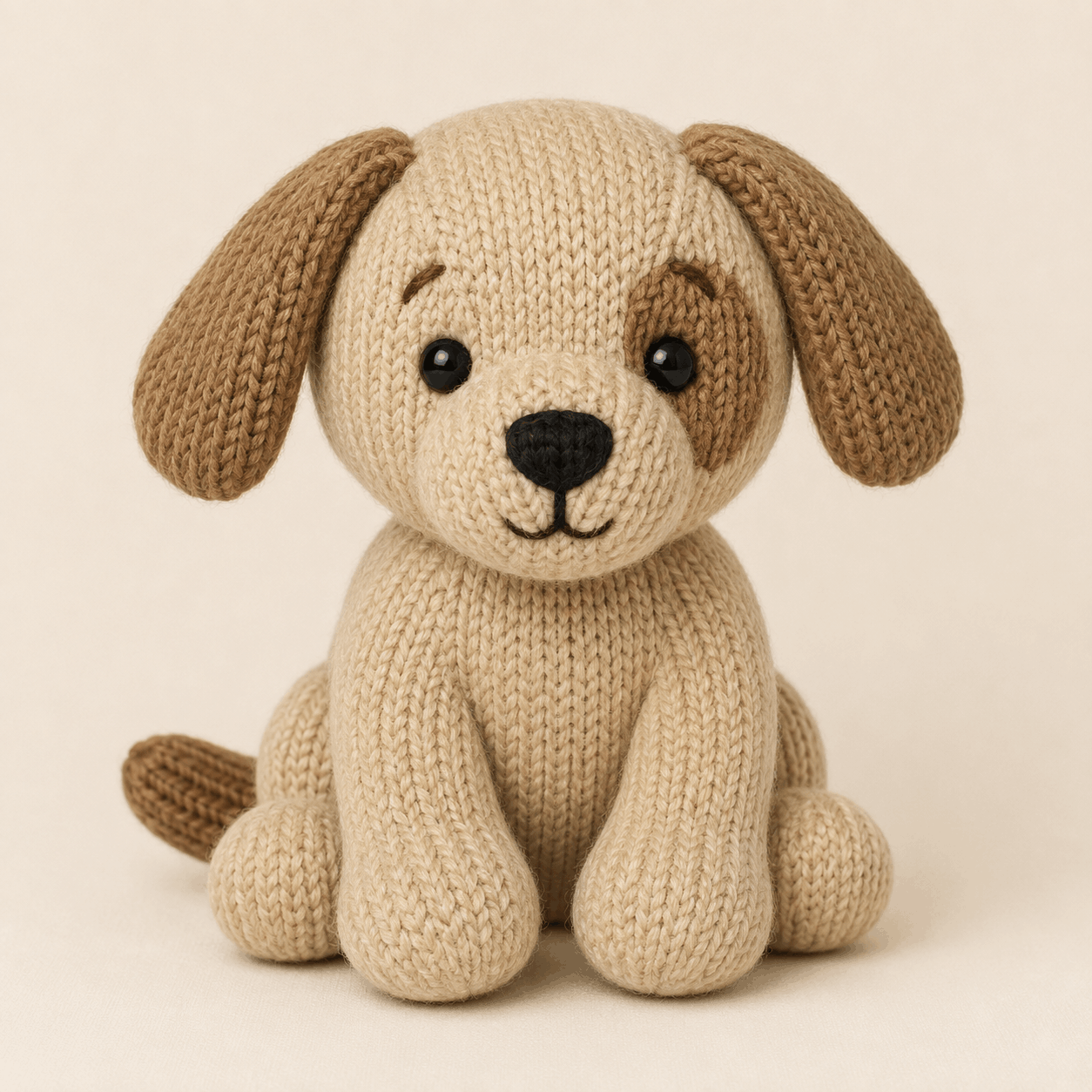
Biscuit is a softly stuffed seated puppy with a rounded cream head, floppy caramel ears, a matching tan eye patch, a rounded muzzle, and a small tail. This patch-eyed puppy knitting pattern combines knitting in the round with one small flat-knit detail, making it most suitable for confident beginners who are ready to work small circumferences and assemble shaped toy pieces. The finished puppy has long front legs, compact hind feet, and a balanced seated pose. Below, you can review the main materials, techniques, construction, and project-specific tips before downloading the complete free PDF near the bottom.
About This Patch-Eyed Puppy Knitting Pattern
Biscuit is a knitted stuffed-animal project made from separate pieces that are shaped, stuffed, and sewn together. Warm cream forms the head, body, muzzle, and legs, while caramel tan is used for the floppy ears, tail, and the patch around the puppy-left eye.
The head and body are worked in the round for smooth stockinette fabric. The eye patch is knitted flat, and the ears are knitted as tubes but left completely unstuffed before being flattened and attached. The lightly stuffed muzzle gives the face a softly rounded profile.
Skill Level, Making Time and Finished Size
- Craft: Knitting
- Project type: Stuffed puppy plushie
- Skill level: Confident Beginner to Intermediate
- Construction: Mainly worked in the round, with a flat-knit eye patch and sewn assembly
- Needle method: Magic Loop or double-pointed needles
- Terminology: Standard knitting abbreviations as defined in the PDF
- Finished seated height: about 24–26 cm / 9.5–10.25 in
- Overall width across ears: about 24–26 cm / 9.5–10.25 in
- Head: about 13 cm wide and 12.5–14 cm high
- Body: about 11–12 cm high and 10–11 cm wide
- Estimated making time: not stated in the PDF
The facial placement, flattened attachment seams, and final neck join deserve the most care because they strongly affect Biscuit’s expression and posture.
Materials and Tools You Will Need
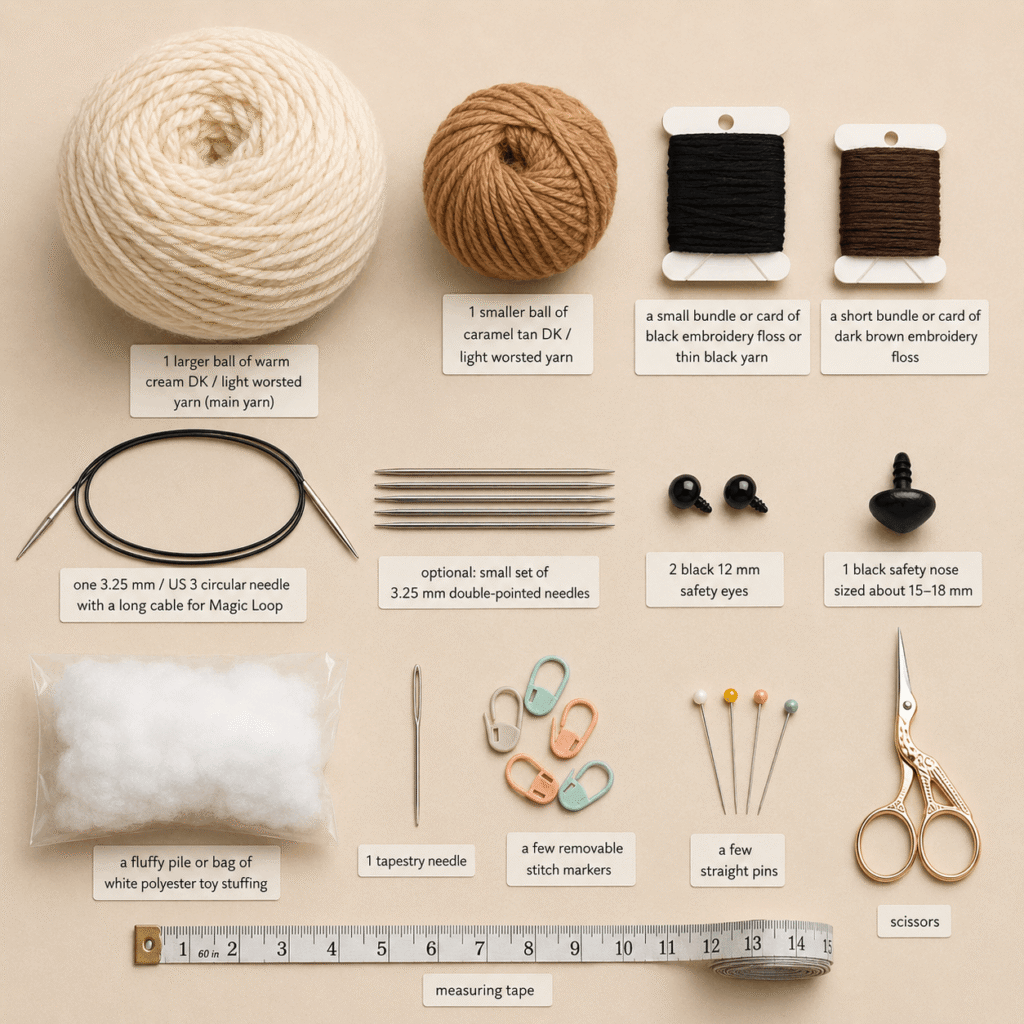
The patch-eyed puppy knitting pattern uses DK or light worsted yarn. The PDF specifies about 125–140 g / 300–350 m of warm cream and about 40–50 g / 95–120 m of caramel tan. You will also need a small amount of black embroidery floss or thin yarn, plus dark brown embroidery floss for the eyebrows.
Use 3.25 mm / US 3 needles, either a long circular needle for Magic Loop or double-pointed needles. The pattern lists two 12 mm safety eyes, a 15–18 mm safety nose, about 120–160 g of polyester toy stuffing, a tapestry needle, removable markers, pins, scissors, and measuring tape. Embroidered eyes and nose can be substituted.
Gauge is 23 stitches by 32 rounds over 10 cm / 4 in in stockinette worked in the round. A dense fabric helps keep stuffing from showing.
Stitches and Techniques Used
This project uses casting on, knit and purl stitches, stockinette, kfb increases, k2tog and ssk decreases, binding off, working in the round, flat knitting, seaming, stuffing, and facial embroidery.
The circular pieces are knitted every round, with a beginning-of-round marker treated as centre back on the head and body. The point opposite it becomes centre front, giving you a consistent reference for later placement. The eye patch is the main flat-knit section and is shaped into a small vertical oval before sewing.
For this patch-eyed puppy knitting pattern, the most important technical habit is keeping careful track of orientation. Correct centre-front, centre-back, and left/right references make the face and limbs much easier to align.
How Biscuit Is Constructed
The puppy is built from a head, eye patch, muzzle, body, two front legs, two hind legs, two ears, and one tail. The head is made first and kept open at the neck so the patch and eyes can be installed before final stuffing.
The muzzle is worked separately, fitted with the nose and embroidered mouth, lightly stuffed, and sewn to the face. The caramel ears are flattened without stuffing and attached at matching angles.
The body is made separately. The front paws are stuffed more firmly than the upper legs, while the hind legs are shaped to support the seated position. The tail is lightly stuffed and kept flexible near the base. Assembly finishes by joining the head and body with their centre lines aligned.
Helpful Tips for Making This Project
Mark centre front as soon as the head and body are large enough to handle easily. The patch-eyed puppy knitting pattern uses those reference points repeatedly for the face and body attachments.
Keep the upper ends of the legs soft. They are designed to flatten into short horizontal attachment seams; overstuffing them can make the limbs rotate outward.
Pin the eye patch before installing the safety eyes. The puppy-left eye passes through both the patch and the head fabric, so patch placement needs to be settled first.
Compare both ears and both hind legs before sewing permanently. Matching height and angle help the ears hang evenly and the feet reach the same level.
Finally, stuff the muzzle lightly. Too much filling can distort the lower face instead of creating the intended soft rounded shape.
Troubleshooting Common Problems
Why Does the Patch-Eyed Puppy Knitting Pattern Project Rock Instead of Sitting Flat?
Uneven lower-body stuffing or mismatched hind-leg placement can make the puppy rock. Redistribute stuffing toward the lower sides, then check that both hind feet reach the same level and that the fuller toe ends point forward before resewing.
Why Are the Arms Pointing Outward?
The front legs depend on short horizontal top seams. If the upper legs are overstuffed or the attachment line becomes vertical, the arms may flare sideways. Remove a little stuffing near the top and resew the flattened opening horizontally.
Why Is the Eye Patch Puckering?
Lightly dampen and press the patch flat before attachment. Sew with small edge stitches and avoid pulling the yarn so tightly that the curved head fabric puckers.
Why Is the Head Leaning?
Check that the centre-front and centre-back lines of the head and body match. If needed, open a short section of the neck seam, adjust the stuffing, and resew the join evenly.
Care Instructions for the Finished Project
Spot-cleaning is the safest general approach unless the yarn manufacturer gives different instructions. Use cool or lukewarm water, avoid twisting or wringing, reshape gently while damp, and air-dry completely away from direct heat.
Inspect the neck seam, limbs, ears, tail, and facial features if the plushie is handled often. The PDF notes that safety eyes, a safety nose, and other small rigid parts may not be suitable for children under three years old; embroidered eyes and an embroidered nose are alternatives.
Leave a Reply