
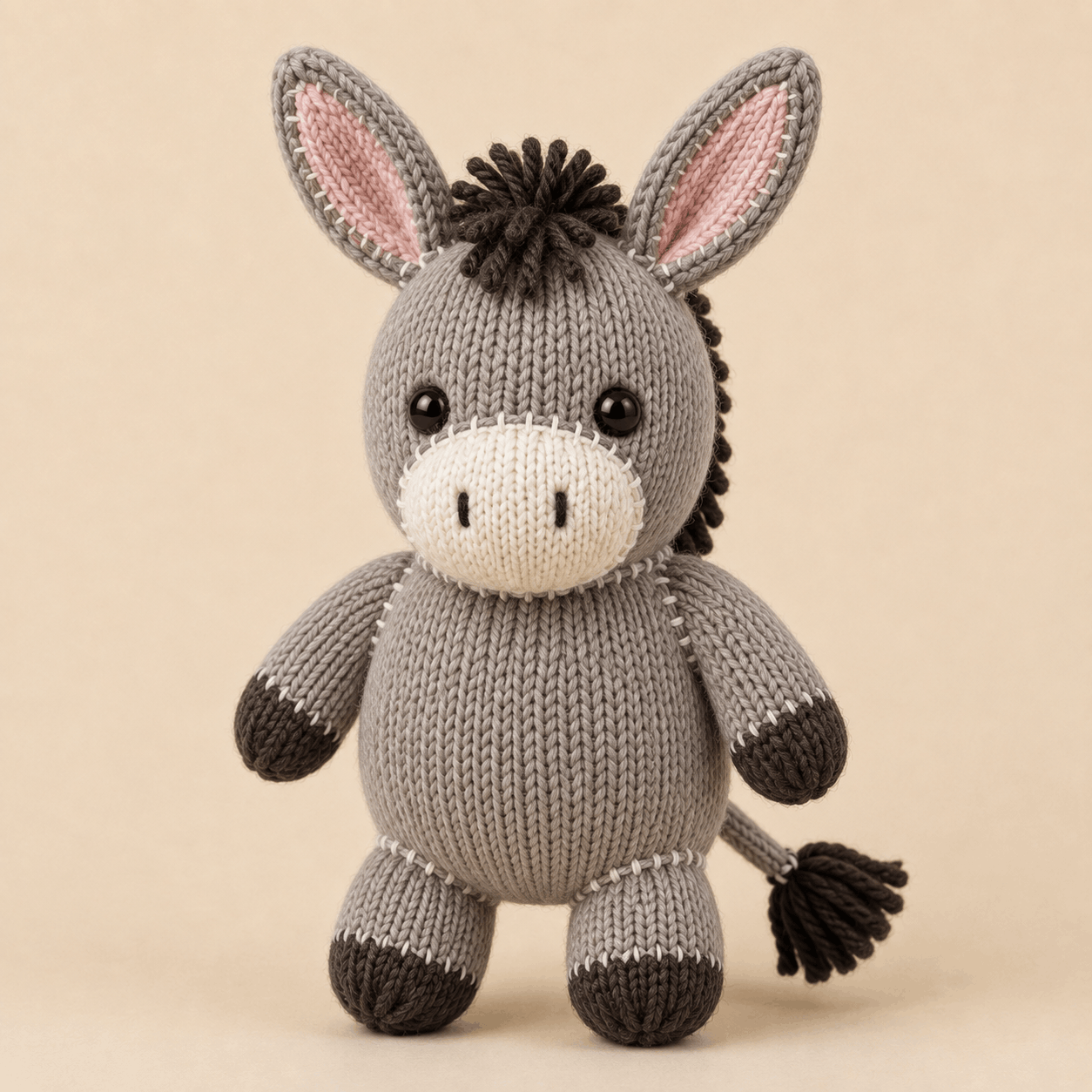
Milo the Little Donkey is a soft knitted plush with a rounded gray body, long upright ears, a cream muzzle, dark brown hooves, a looped mane and a tassel-tipped tail. This donkey knitting pattern is designed for confident beginners to intermediate knitters who are comfortable with small-circumference knitting, basic shaping and sewn assembly. Most pieces are worked in the round, while the muzzle, inner ears and mane base are worked flat. This guide summarizes the materials, techniques, construction and finishing points so you can decide whether the project suits your skills. The complete row-by-row and round-by-round instructions are available in the PDF near the bottom.
About This Donkey Knitting Pattern
Milo has a softly rounded toy shape with a large head, compact body and short limbs. Gray is the main colour, with dark brown for the hooves, mane and tassel, cream for the muzzle and visible decorative seam stitches, and soft pink for the inner ears.
The details make this donkey knitting pattern especially distinctive. The ears are flattened gray tubes with separate pink panels. The cream muzzle is a shaped oval that is lightly stuffed during attachment. A narrow loop-stitch strip creates the mane, while a gray I-cord forms the tail and ends in a full dark-brown tassel. Cream contrast stitches finish the neck, limb joins, hoof transitions and muzzle edge.
Skill Level, Construction and Finished Size
Craft: Knitting
Project type: Stuffed donkey plushie
Skill level: Confident beginner to intermediate
Construction: Mainly in the round, with flat pieces for the muzzle, inner ears and mane base
Finished height: Approximately 33–35 cm / 13–13.75 in from hoof base to ear tip
Finished width: Approximately 18–20 cm / 7–7.75 in across the arms
Body depth: Approximately 9–10 cm / 3.5–4 in
The PDF also gives measurements for the head, ears, muzzle, arms, legs and tail. Finished size may vary with yarn, needles, tension and stuffing. No making-time estimate is stated. Placement and assembly require the most care because the pattern uses centre-front and centre-back references plus counted stitch and round guides.
Materials and Tools You Will Need
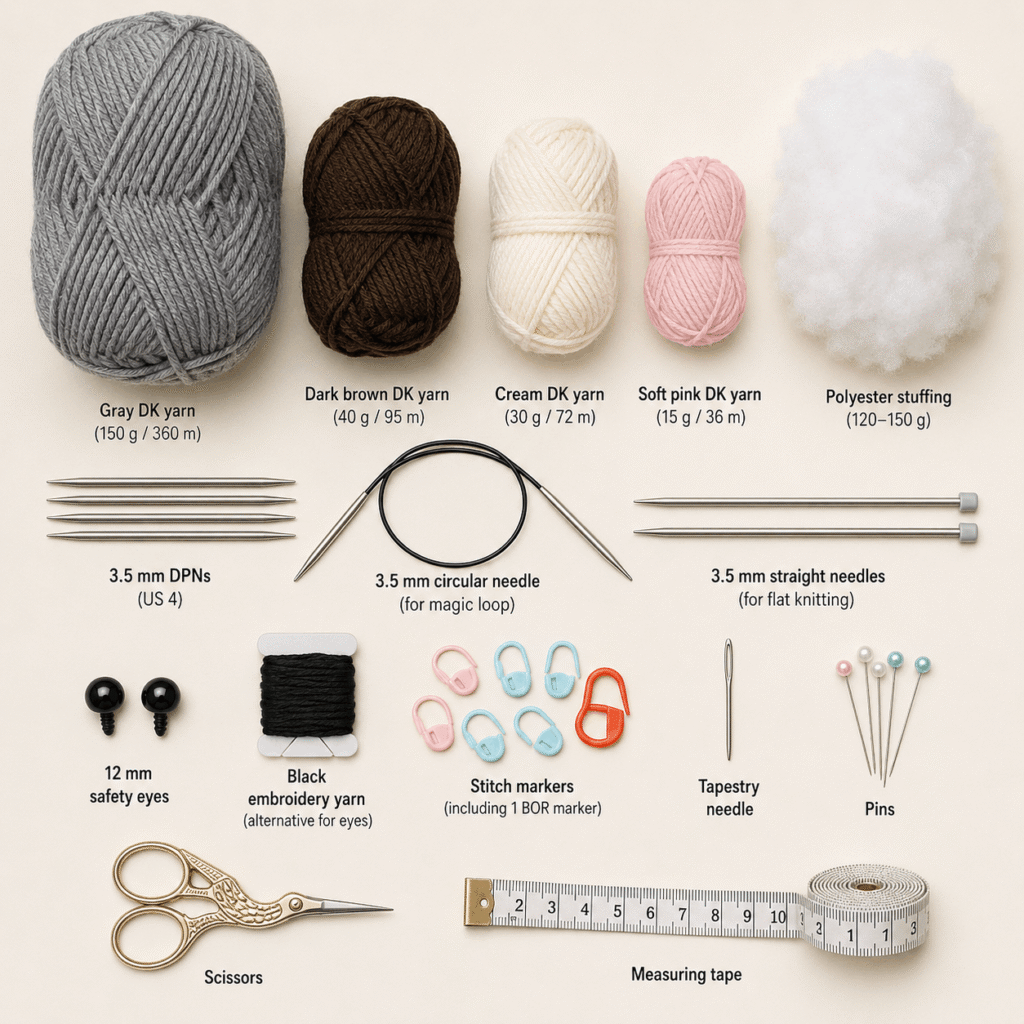
This donkey knitting pattern uses smooth DK/light worsted yarn with 3.5 mm (US 4) needles. The listed quantities are approximately 150 g gray, 40 g dark brown, 30 g cream and 15 g soft pink. You will need DPNs or a long circular needle for magic loop, plus 3.5 mm needles for the flat pieces.
Other supplies include approximately 120–150 g polyester toy stuffing, stitch markers, tapestry needle, pins, scissors and measuring tape. The face uses two 12 mm black safety eyes, with embroidered eyes as an alternative. The pattern calls for firm stockinette fabric so stuffing does not show through when gently stretched.
Stitches and Techniques Used
You should be comfortable casting on, binding off, knitting, purling, working in the round and working flat. Shaping uses kfb and pfb increases plus k2tog, p2tog and ssk decreases.
The mane introduces a loop stitch worked on right-side rows. The tail uses a five-stitch I-cord, so the donkey knitting pattern also includes a simple tubular-cord technique. Finishing uses whip stitch, mattress- or ladder-style sewing, backstitch, satin-style embroidery and visible running or whip stitches.
The stockinette sections are repetitive, but keep the beginning-of-round position consistent, match paired pieces carefully and form the mane loops evenly.
How Milo the Little Donkey Is Constructed
The head and body are knitted separately in gray with open neck edges. Both are shaped in the round, stuffed through those openings and sewn together. Safety eyes are installed while the head is still accessible.
The cream muzzle is worked flat and lightly stuffed against the face while being sewn on. The outer ears are unstuffed gray tubes that are flattened before separate pink inner-ear panels are attached. Arms and legs are knitted in the round, changed to dark brown for the hoof sections, stuffed and flattened at their open attachment edges.
The mane is a flat loop-stitch strip sewn over the crown and down the centre back of the head. The tail is an unstuffed I-cord with a dark-brown tassel. Structural seams are completed before the visible cream contrast stitches.
Helpful Tips for Making This Project
Keep the beginning-of-round marker in place. On the head and body it also marks centre back, which is important when using the placement maps later.
Pin mirrored pieces before sewing. Comparing the eyes, ears, arms and legs together makes small height or angle differences easier to spot.
Follow the stuffing guidance by section: keep the neck and limb tops softer so the flattened attachment seams sit neatly.
For this donkey knitting pattern, neat ear finishing matters: preserve an even gray border around each pink panel. The cream whip stitches are meant to be visible, but they should pass only through the front gray layer.
Keep mane loops clear of the sewing thread by stitching only through the narrow knitted base. Before burying the last yarn ends, stand Milo on a flat surface and check that both hooves face forward and the leg seams are level.
Troubleshooting Common Problems
Why Does My Donkey Knitting Pattern Look Uneven After Assembly?
If the head leans, check the centre-front and centre-back alignment at the neck seam. Uneven stuffing or tighter sewing on one side can pull the head off centre. Open a short section, redistribute the stuffing and resew with even tension.
Why Are the Ears or Eyes at Different Heights?
Compare both round height and horizontal stitch position before securing the eyes. The ear bases should also mirror one another. If one ear leans after attachment, the PDF recommends a hidden anchoring stitch at the back of the base rather than tightening the whole seam.
Why Is Stuffing Showing Through the Fabric?
The stated gauge is 24 stitches by 32 rounds per 10 cm / 4 in in round stockinette, with a similarly firm target for flat stockinette. Remove a little stuffing first if the fabric is stretching. For a future piece, use a smaller needle if the knitted fabric itself is too loose.
Why Do the Feet Turn Sideways?
Rotate each flattened upper leg opening until the hoof faces forward before fully tightening the seam. Keep both leg seams horizontal and matched. Correct leg placement is important to the standing balance of this donkey knitting pattern.
Care Instructions for the Finished Project
Spot-cleaning is a cautious choice, and the yarn manufacturer’s care instructions should take priority. If washing is suitable for the yarn, use cool or lukewarm water, avoid wringing, reshape while damp and air-dry away from direct heat.
Inspect seams and attached details from time to time. The PDF notes that safety eyes and other small or rigid components may not be suitable for children under three years old; embroidered eyes can be used instead.
Leave a Reply