
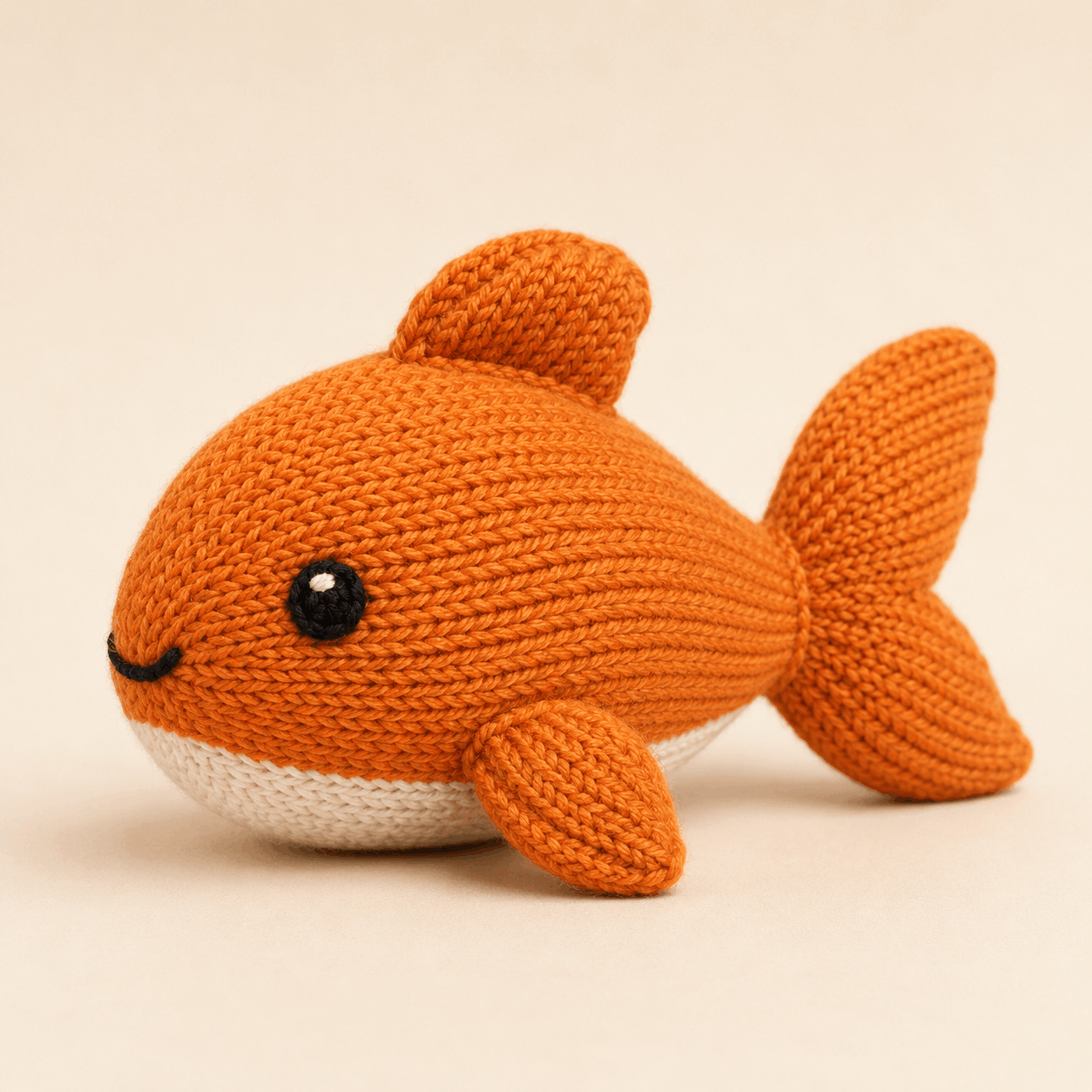
Clementine is a softly rounded orange fish plushie with a cream underside, black eyes, a stitched smile, slim side fins, a small dorsal fin and a forked two-lobed tail. This knitted fish pattern combines circular stockinette for the body with flat-knitted pieces for the belly, fins and tail, giving knitters practice with both methods in one compact project. The pattern is rated Confident Beginner / Intermediate and suits makers who are comfortable with small circumferences, basic increases and decreases, and simple seaming. The complete row-by-row and round-by-round instructions are available in the PDF near the bottom.
About This Knitted Fish Pattern
Clementine has a plump oval body that tapers from a rounded nose toward a narrower tail root. Most of the fish is orange, while a shaped cream belly panel runs along the underside. The side fins sit low near the cream-belly margins and angle slightly down and back, while the dorsal fin is centred along the top. Two narrow tail lobes form the fork at the rear.
The body is worked as one stuffed piece. The belly and fins are separate flat-knit components, so the design avoids complicated colourwork. The face uses two 12 mm safety eyes or embroidered alternatives, plus a shallow black stitched smile.
Skill Level, Making Time and Finished Size
- Craft: Knitting
- Project type: Stuffed fish plushie
- Skill level: Confident Beginner / Intermediate
- Construction: Body worked in the round; belly, fins and tail pieces worked flat
- Terminology: Standard knitting terminology
- Overall length: Approximately 24.5–25.5 cm / 9.5–10 in
- Body length: Approximately 19 cm / 7.5 in before the tail
- Body width/height: Approximately 10.5–11.5 cm / 4.25–4.5 in
- Side fins: Approximately 4.5–5 cm / 1.75–2 in long
- Dorsal fin: Approximately 4 cm / 1.5–1.6 in high
- Tail lobes: Approximately 7.5–8 cm / 3–3.25 in each
- Making time: Not specified
The most careful parts of this knitted fish pattern are keeping the body orientation markers clear, installing the eyes before the tail taper closes access, and mirroring the side fins.
Materials and Tools You Will Need
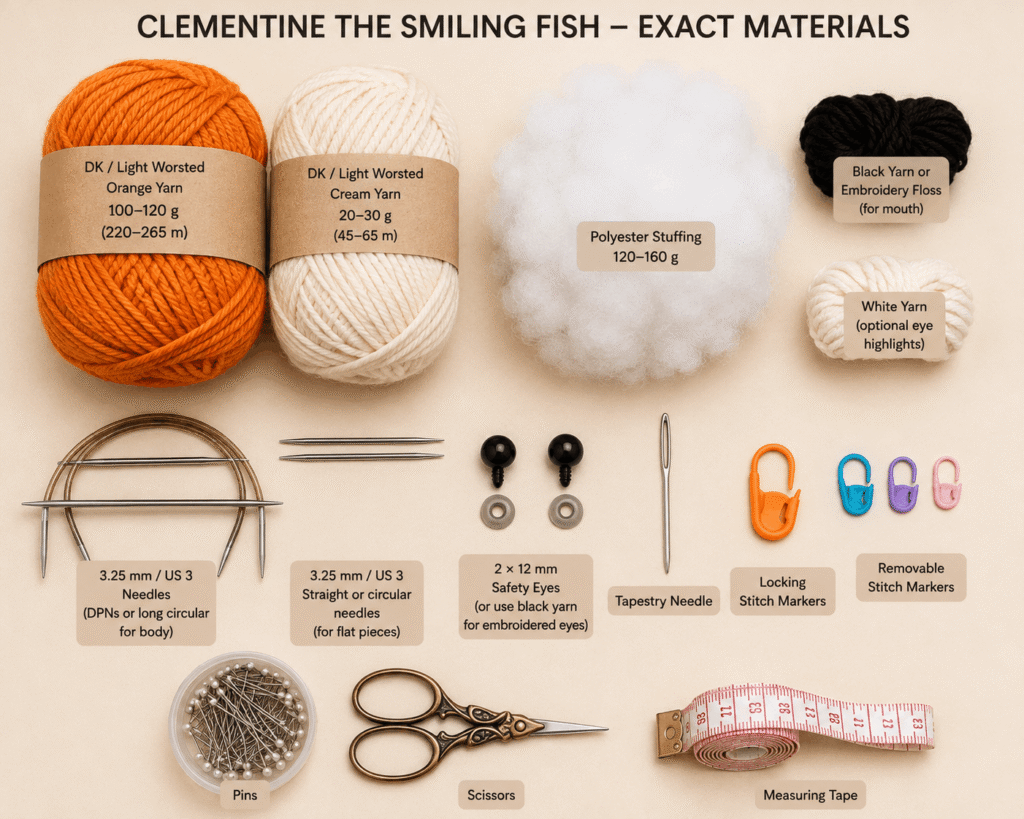
Use DK / light worsted yarn: approximately 100–120 g / 220–265 m of orange and 20–30 g / 45–65 m of cream. Small amounts of black yarn or embroidery floss are used for the mouth, with optional white yarn for eye highlights.
The pattern uses 3.25 mm / US 3 needles. Choose DPNs or a long circular needle for Magic Loop on the body, plus straight or circular needles for the flat pieces. You will also need two 12 mm safety eyes or black yarn for embroidered eyes, approximately 120–160 g of stuffing, a tapestry needle, locking markers, pins, scissors and a measuring tape.
Gauge is 22 stitches by 30 rows/rounds over 10 cm / 4 in in stockinette. Aim for a firm fabric so stuffing does not show.
Stitches and Techniques Used
This knitted fish pattern uses casting on, knit and purl stitches, knitting in the round, flat stockinette, kfb increases, k2tog and ssk decreases, binding off, stuffing, mattress stitch or small whip stitch, surface sewing and simple embroidery.
The body begins at the nose, expands gradually to a 72-stitch middle section, then tapers toward the tail root. The belly, fins and tail pieces are worked flat with right-side knit rows and wrong-side purl rows.
The first body rounds can be fiddly because the circumference is very small. Once the body expands, the knitting becomes much easier to handle.
How Clementine the Smiling Fish Is Constructed
Start with the orange body and work from nose to tail root. The nose cast-on opening is gathered closed with its tail, and removable markers are added for eye and placement guides. Safety eyes are secured before the decreasing tail section limits access to the inside.
After stuffing and closing the body, knit one flat cream belly panel. Four side-fin halves are joined in pairs to make two lightly stuffed fins. The dorsal fin uses two halves, and four tail-lobe halves become two flexible lobes.
Pin the belly first, finish the face, then attach the dorsal fin, side fins and tail. The knitted fish pattern includes stitch and round references to help keep the features aligned.
Helpful Tips for Making This Project
Keep the beginning-of-round marker at the centre underside. It is the main guide for centring the belly and keeping the fish symmetrical.
Use the removable placement markers carefully. The eyes sit on the lateral axes, while the side-fin roots are lower near the cream-belly margins, so those positions should not be confused.
Stuff gradually. Keep the middle full and the last section near the tail root slightly softer. This helps preserve the rounded body and narrower rear.
Pin both side fins before sewing either one, and check the tail fork from the side, top and rear. Comparing both sides before sewing is much easier than correcting a finished seam.
Troubleshooting Common Problems
Why Does My Knitted Fish Pattern Look Uneven After Assembly?
Check that the cream belly is centred on the underside, the dorsal fin follows the top-centre line, and both side fins use matching attachment spans. If one fin points differently, repin both pieces and compare them from the front and side before sewing again.
Why Is Stuffing Showing Through the Stockinette?
The pattern calls for firm stockinette. Remove a little stuffing first. If the fabric is still too open, a smaller needle may help. Overstuffing can stretch the stitches and make gaps more visible.
Why Does the Tail Fork Look Too Closed?
The two lobes should angle away from each other. Open the fork and add a small anchoring stitch at the inner base of each lobe if needed. Keeping the lobes lightly stuffed also prevents them from becoming heavy.
Care Instructions for the Finished Fish
The pattern does not specify a particular washing method, so follow the care instructions for the yarn you choose. Check the sewn fins, tail lobes and other attachments periodically if the plushie is handled often.
Safety eyes are small rigid components and may not be suitable for projects intended for children under three years. The pattern includes embroidered eyes as an alternative.
Leave a Reply