
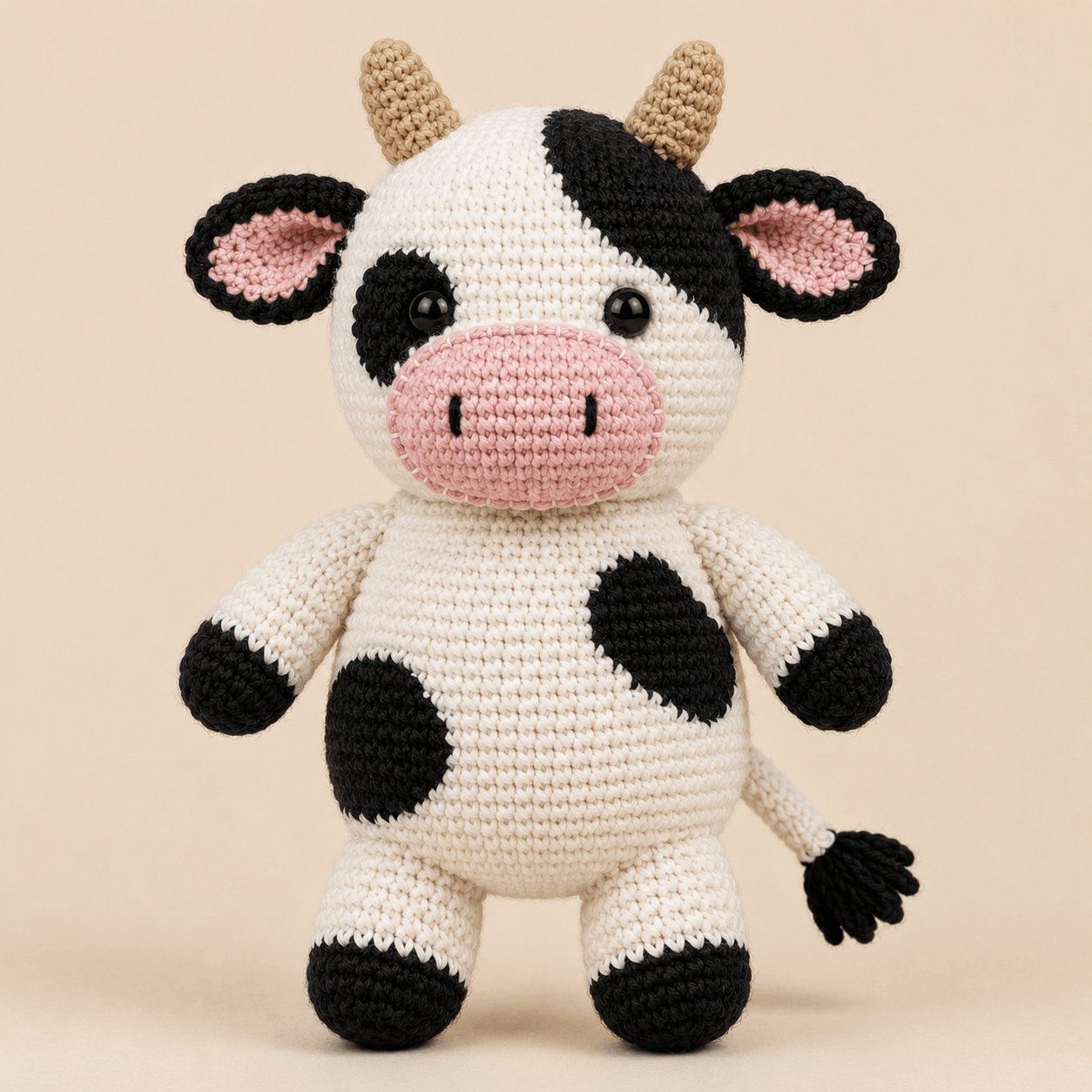
Mabel the Meadow Cow is a standing amigurumi with a rounded cream head and body, irregular black patches, a wide pink muzzle, black-and-pink ears, tan horns and black hooves. This crochet cow pattern is worked mostly in continuous spiral rounds and combines familiar amigurumi shaping with careful feature placement. It is rated Confident Beginner to Intermediate, making it best suited to crocheters who already understand single crochet, increases and decreases. This overview covers the supplies, techniques, construction and trouble spots, while the full instructions remain in the PDF near the bottom.
About the Mabel Crochet Cow Pattern
Mabel is a stuffed standing cow rather than a flat decoration or keychain. The cream base is broken up by asymmetrical black markings, including a large forehead patch, a smaller eye patch and four body spots. A broad pink oval muzzle with embroidered nostrils gives the face its strongest visual feature.
The ears have pink inner panels sewn to black outer pieces and are pinched slightly at the base for shape. Two tan horns rise above them, and the narrow cream tail finishes with a black yarn tuft. These details give the crochet cow pattern its distinctive look without complicated stitch textures.
Skill Level, Construction and Finished Size
Craft: Crochet
Project type: Standing amigurumi cow plushie
Skill level: Confident Beginner to Intermediate
Construction: Mostly continuous spiral rounds, with oval pieces and flat spot motifs
Terminology: US crochet terminology
Hook: 3.0 mm
The cow measures approximately 31–33 cm / 12.25–13 in high including the horns and 23–25 cm / 9–9.75 in from ear to ear. The head is about 11–12 cm wide, the body about 10–11 cm wide, and the muzzle about 8–8.5 cm wide.
The PDF does not provide an estimated making time. The most careful stages are facial placement, ear and horn symmetry, and leg positioning so the cow stands evenly.
Materials and Tools You Will Need
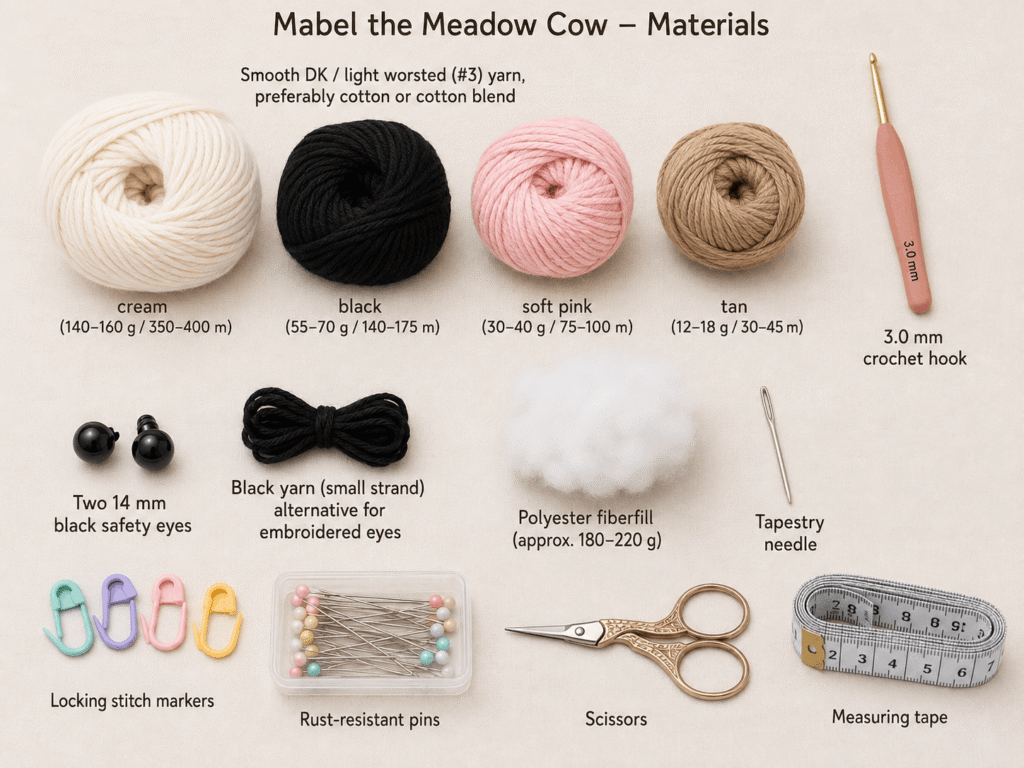
The crochet cow pattern uses DK / light worsted (#3) smooth yarn, preferably cotton or a cotton blend. The listed amounts are approximately 140–160 g cream, 55–70 g black, 30–40 g soft pink and 12–18 g tan.
Other supplies include a 3.0 mm crochet hook, approximately 180–220 g polyester fiberfill, a tapestry needle, locking stitch markers, rust-resistant pins, scissors and a measuring tape. For the eyes, use either two 14 mm black safety eyes or black yarn for the embroidered option.
Smooth yarn helps because the spots and sewn joins are easier to position when stitches remain visible.
Stitches and Techniques Used
The main techniques are a magic ring, chain stitches, single crochet, increases, invisible decreases and fastening off. Most three-dimensional pieces are worked in continuous spirals, so a marker is moved to the first stitch of every round.
The muzzle and ears are made by crocheting around both sides of a foundation chain to form oval shapes. The black patches are flat spiral motifs made in several sizes. You will also change colour at the hooves, flatten limb openings, whip stitch components together and use satin stitch for the nostrils and optional embroidered eyes.
The crochet cow pattern does not depend on advanced decorative stitches, but consistent counting and tidy assembly are important.
How Mabel Is Constructed
The head is crocheted from the crown downward and left open at the neck. Before that opening becomes inaccessible, the black head patches are sewn in place and either the safety eyes are installed or the embroidered-eye positions are marked. The pink muzzle is made separately and lightly stuffed while being attached.
The body is worked from the center underside upward. Four black spots are sewn onto it before the head is joined. Both head and body finish with matching 30-stitch neck openings, allowing a stitch-to-stitch join with center front and center back aligned.
Arms and legs begin with black hoof sections before changing to cream. Their upper edges are flattened for sewing. The two-layer ears, lightly stuffed horns and unstuffed tail are all prepared separately. This assembly-focused construction is why the crochet cow pattern benefits from careful pinning before any permanent seam is made.
Helpful Tips for Making This Project
Keep the beginning-of-round marker accurate. After the orientation rounds, that line becomes center back for the head and body, while the point opposite it is center front. Those references guide later placement.
Check the stated gauge of approximately 22 sc × 24 rounds = 10 × 10 cm / 4 × 4 in. If stuffing shows through, the PDF suggests a smaller hook or firmer tension.
Do not shape every black spot identically. Some are gently stretched into ovals while others stay rounder, creating the intended irregular cow markings.
Use different stuffing levels where directed. The head and body are firm, the muzzle is lightly stuffed, the hoof ends are firmer than the upper limbs, and the tail stays unstuffed.
Finally, pin the legs and stand Mabel on a flat surface before sewing. Small adjustments are much easier at this stage than after the seams are complete.
Troubleshooting Common Problems
Why Does This Crochet Cow Pattern Project Lean After Assembly?
A lean can come from leg placement or an uneven neck join. Before attaching the legs permanently, make sure both broad black hooves face forward and sit evenly. If the head leans after joining, the PDF recommends reopening a short section on the compressed side, redistributing the neck stuffing and resewing with the center lines aligned.
Why Is Stuffing Showing Through the Fabric?
Visible filling usually means the fabric is stretched too far. Recheck gauge and avoid overstuffing. For a new piece, use a slightly smaller hook or tighter tension if needed. On an existing piece, reduce stuffing pressure and move filling away from stretched areas.
Why Do the Spots or Muzzle Pucker?
The flat motifs should rest on the surface rather than pull the body inward. If a spot puckers, remove a few sewing stitches, flatten it and resew with shallower bites. If the muzzle sits crooked, repin the affected area using the midpoint between the eyes as a centering reference.
Why Do the Eyes, Ears or Horns Look Uneven?
The crochet cow pattern gives placement references based on rounds and center lines. Check the eyes before securing safety-eye backs, match the two ear bases at the same height, and compare horn angles from both the front and top before finishing their seams.
Care Instructions for the Finished Project
The PDF does not specify a complete washing method, so follow the care instructions for the yarn used. Spot cleaning is the cautious choice when practical. Avoid twisting or wringing the stuffed piece, reshape while damp if necessary, and air-dry fully away from direct heat.
Check sewn components and facial details periodically if the cow is handled often. Safety eyes and other small or rigid parts may present a choking hazard and may be unsuitable for children under three. The pattern includes an embroidered-eye option, although changing the eye type alone does not establish that the whole finished toy is child-safe.
Leave a Reply