
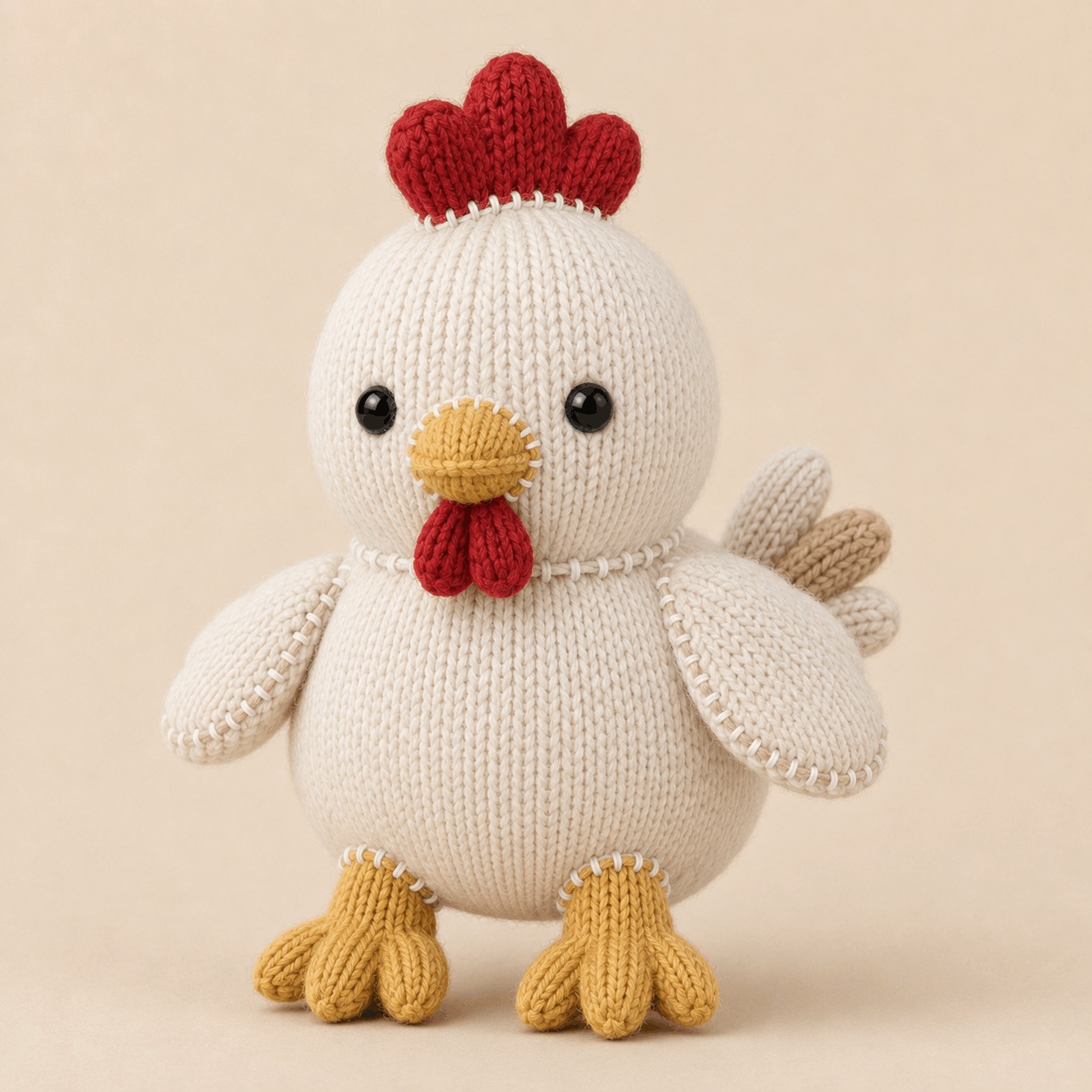
Clara the Cozy Hen is a softly stuffed knitted bird with a rounded ivory head and body, mustard-yellow beak and three-toed feet, a deep-red comb and wattles, padded side wings, and a layered fan tail. This hen knitting pattern is designed for a confident beginner who is comfortable with basic shaping, knitting in the round, flat stockinette, and sewn assembly. Most of Clara is worked in continuous rounds, while the wings are made from paired flat panels and lightly padded before attachment. This overview covers the materials, techniques, construction, finishing tips, and common problems to watch for before you use the complete PDF near the bottom.
About This Hen Knitting Pattern
Clara has a plump upright shape with a large rounded head, full body, three-lobed comb, two wattles, oval beak, and five-feather fan tail. Ivory forms most of the toy, while mustard yellow, deep red, warm taupe, and soft white add contrast. Each wing is made from two flat stockinette panels, and the visible soft-white overcast stitching around selected joins is an intentional part of the finished look.
Skill Level, Making Time and Finished Size
Craft: Knitting
Project type: Stuffed hen soft toy
Skill level: Confident Beginner
Construction: Mainly continuous rounds, with flat double-layer wings
Terminology: Standard knitting terminology
Finished height: Approximately 28–30 cm / 11–11.75 in
Finished width across wings: Approximately 20–22 cm / 7.9–8.7 in
Estimated making time: Not stated in the PDF
The head is about 12–12.5 cm wide, the body about 14 cm wide, and each wing about 9–9.5 cm long. The PDF also gives measurements for the feet, comb, beak, and tail fan. The parts needing the most care are dense gauge, matched wings, and symmetrical placement, all of which affect the finished hen knitting pattern.
Materials and Tools You Will Need
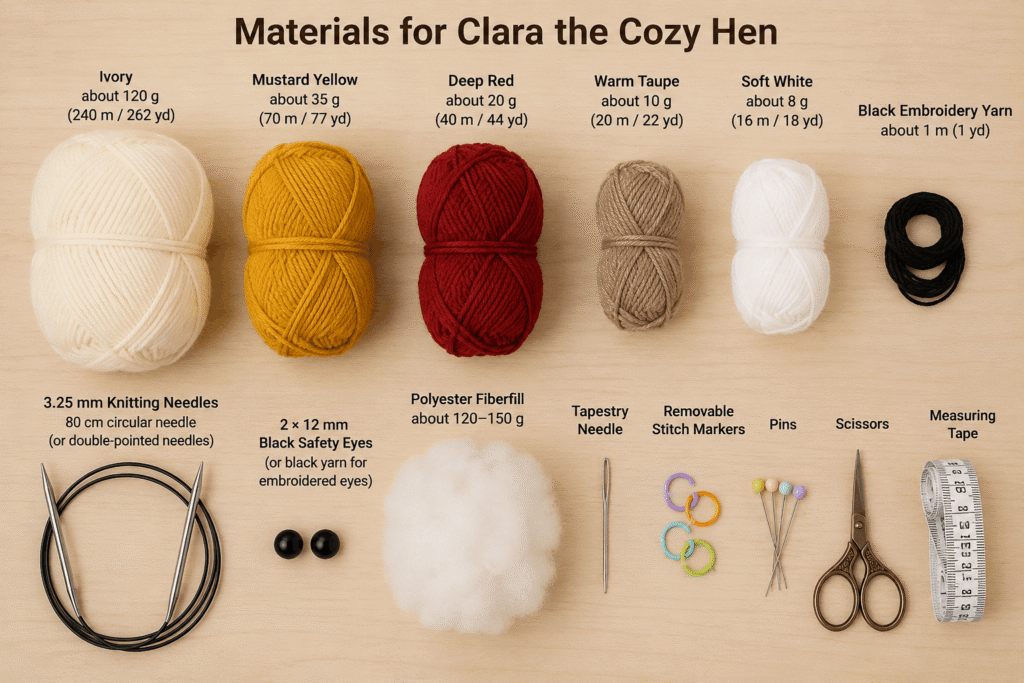
The project uses smooth worsted/Aran weight (#4) yarn with good stitch definition. Approximate yarn amounts are 120 g ivory, 35 g mustard yellow, 20 g deep red, 10 g warm taupe, and 8 g soft white. A small amount of black embroidery yarn or stranded cotton can be used for the beak division line.
The pattern calls for 3.25 mm knitting needles. You can use an 80 cm circular needle for magic loop or double-pointed needles for small circumferences, and the same size can be used for the flat wing panels.
You will also need two 12 mm black safety eyes or black yarn for embroidered eyes, about 120–150 g polyester fiberfill, a tapestry needle, removable stitch markers, pins, scissors, and a measuring tape. Smooth yarn is especially suitable for this hen knitting pattern because the stockinette fabric and visible decorative stitching are important parts of the design.
Stitches and Techniques Used
The pattern uses casting on, binding off, knit and purl stitches, knit-front-and-back increases, k2tog and ssk decreases, continuous rounds, and flat stockinette. Finishing includes ladder-style seaming, whip stitch, visible overcast stitching, simple embroidery, stuffing, and sewn assembly.
Most shaping is repetitive. The wing panels need extra attention because the shaping stays away from the outer edge to preserve a clean seam line.
How Clara the Cozy Hen Is Constructed
The body and head are knitted separately in the round and finish with matching neck openings. The eyes are positioned while the inside of the head is still accessible, then the head is stuffed and joined to the body with a ladder seam.
Four flat wing panels are knitted and paired to make two wings. The feet are assembled from separate ankles, longer center toes, and shorter side toes. The beak, two wattles, and three comb lobes are also made separately.
The tail contains five feathers in three lengths: three ivory and two taupe. They are lightly stuffed, flattened, and overlapped at center back to create the fan. Following the assembly order in the hen knitting pattern helps keep important seams and placement points accessible.
Helpful Tips for Making This Project
Keep the body and head fabric firm enough to hide stuffing. The stated in-the-round gauge is 22 stitches by 28 rounds over 10 cm; if the fabric is loose, the PDF recommends using a smaller needle.
Keep the beginning-of-round marker at center back on the head and body so center front, side placement, and tail alignment remain easy to track.
Match the wing panels before sewing, and use light stuffing in the smaller pieces so the wings, toes, comb lobes, beak, and tail feathers keep their intended shapes.
Pin all major pieces before sewing permanently. The hen knitting pattern includes precise guidance for the eyes, beak, wings, feet, comb, and tail, so checking the toy from several angles before tightening stitches will help preserve symmetry.
Keep the tail feather bases overlapped rather than spread apart. The gathered tips are meant to rise upward and outward toward the neck.
Troubleshooting Common Problems
Why Does My Hen Knitting Pattern Project Lean or Rock?
If Clara rocks instead of standing steadily, check the lower body stuffing first. Too much stuffing can round the base. Remove a little if needed, press the bottom gently against a flat surface, and confirm that both feet are attached at the same height with all toes touching the surface.
Why Is Stuffing Showing Through the Stockinette?
Visible fiberfill usually means the fabric is too loose or the piece is overfilled. Remove some stuffing first. If the problem continues on another piece, use a smaller needle with the same yarn weight. Dense stockinette is important in this hen knitting pattern because the smooth fabric shows gaps easily.
Why Does One Wing Sit Higher?
The wing shoulder edges should be attached at matching heights. If one wing is uneven, remove that attachment, repin both wings, and compare from the front and top before resewing. The free portion of each wing should angle downward and slightly forward.
Why Does the Tail Fan Droop?
The tail feathers should be lightly stuffed and flattened. If they sag, remove excess filling and add a few hidden anchor stitches through the lower feather bases. Keeping those bases compact and overlapped also helps the fan hold its shape.
Care Instructions for the Finished Project
Spot-clean Clara when possible and follow the yarn manufacturer’s care instructions. If a deeper clean is needed, use cool or lukewarm water, avoid wringing, reshape while damp, and air-dry away from direct heat.
Inspect the sewn pieces occasionally. The hen knitting pattern uses safety eyes unless you choose embroidered eyes instead. Small or rigid components may be unsuitable for children under three years old; the PDF suggests embroidered eyes as an alternative.
Leave a Reply