
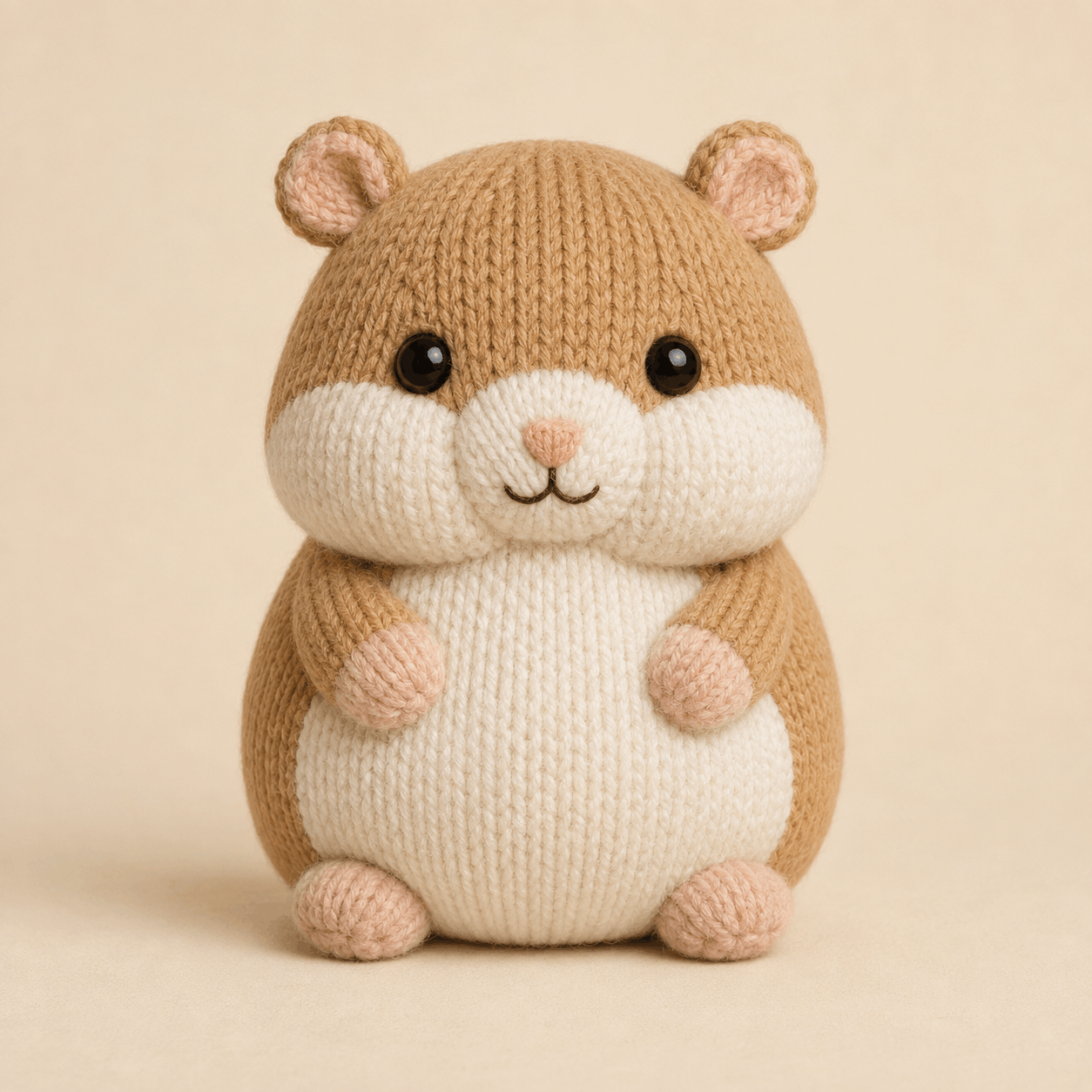
This hamster knitting pattern makes Hazel, a softly rounded knitted plushie with a tan head and body, broad cream cheek pads, a cream belly, peach paws, tiny rounded ears and a small tail at the back. The project combines circular stockinette knitting with a few small flat-knit panels, so it offers a useful mix of shaping, colour placement and assembly without relying on complicated stitch patterns. It is rated Confident Beginner to Intermediate. In this overview, you can see the materials, main techniques, construction order and project-specific finishing points before using the complete PDF near the bottom of the page.
About This Hamster Knitting Pattern
Hazel is designed as a seated stuffed animal with a large rounded head, full cheeks and a compact body. The cream face area is built from two separate cheek pads plus a small muzzle, while the cream belly is added as a flat panel over the tan body. Peach is reserved for the paw tips, feet, tail, inner ears and embroidered nose, which keeps the colour palette simple and easy to track.
The proportions are intentionally soft and rounded rather than realistic. The broad cheek area is the most distinctive feature, followed by the small ears, short arms and low oval feet. Because the face and belly are applied separately, neat pinning and centre-line alignment matter as much as the knitting itself.
Skill Level, Construction and Finished Size
- Craft: Knitting
- Project type: Stuffed hamster plushie
- Skill level: Confident Beginner to Intermediate
- Construction: Mostly knitted in the round, with flat-knit cheek pads, muzzle, belly panel and inner-ear patches
- Needle setup: DPNs or a long circular needle for Magic Loop
- Finished height: Approximately 25–27 cm / 9.75–10.5 in, including ears
- Finished width: Approximately 16–18 cm / 6.25–7 in
- Body depth: Approximately 12–14 cm / 4.75–5.5 in
- Estimated making time: Not specified in the pattern
The parts that deserve the most attention are the face placement, belly alignment and final head-to-body join. The pattern uses centre-front and centre-back references so these areas can be checked before they are permanently sewn.
Materials and Tools You Will Need
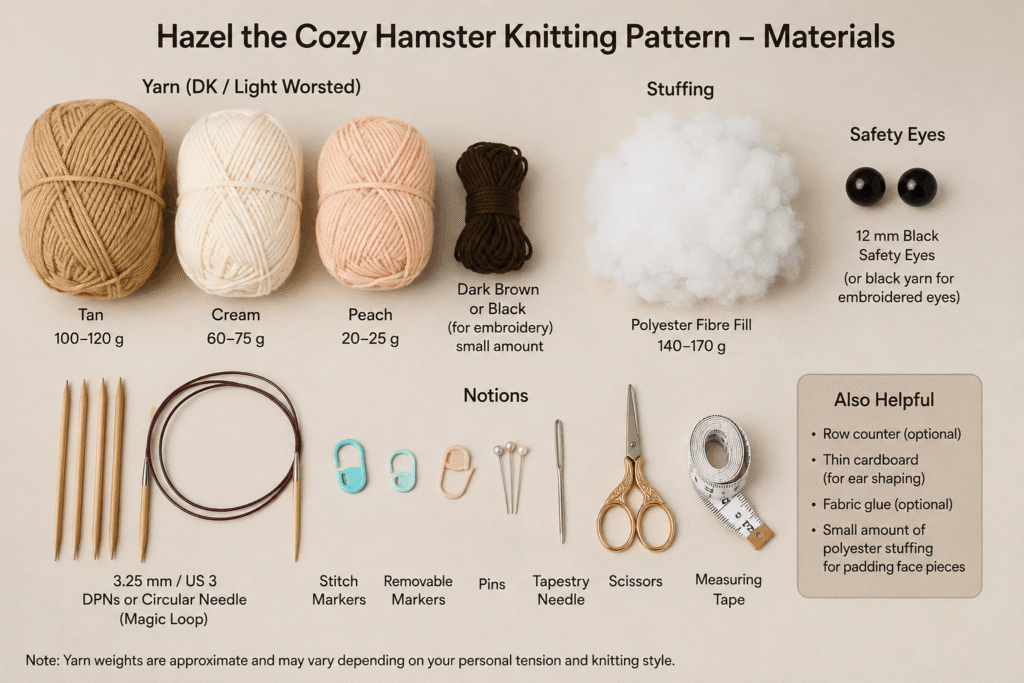
For this hamster knitting pattern, the main yarn is DK or light worsted weight with smooth stitch definition. The pattern calls for approximately 100–120 g of tan, 60–75 g of cream and 20–25 g of peach, plus a small amount of dark brown or black thread or fine yarn for facial embroidery.
You will also need 3.25 mm / US 3 needles suitable for small circumferences, approximately 140–170 g of polyester fibre fill, two 12 mm black safety eyes or black yarn for embroidered eyes, a tapestry needle, stitch markers, removable markers or contrast yarn, pins, scissors and a measuring tape.
Using smooth yarns of similar thickness helps the cream face pieces, belly and peach details remain in proportion with the tan sections. A firm stockinette fabric is also important because the plushie is stuffed and the filling should not show through the stitches.
Stitches and Techniques Used
The knitting itself uses standard stockinette with straightforward shaping. Makers should be comfortable casting on, knitting and purling, increasing with kfb and pfb, decreasing with k2tog, ssk and p2tog, binding off, and working small pieces in the round.
Assembly adds another layer of technique. The cheek pads, muzzle and belly are attached with small whip stitches, while the head-to-body join uses mattress stitch or small ladder-style stitches. The ears and arms are attached through flattened openings, so the sewing needle must catch both layers before entering the body or head.
Gauge is 23 stitches by 32 rounds over 10 cm / 4 in when worked in the round, with the same 23 stitches by 32 rows for flat stockinette.
How Hazel the Cozy Hamster Is Constructed
The hamster knitting pattern begins with the head, worked from the crown toward the lower pole. The safety eyes are installed before the final lower shaping is completed. Two cream cheek pads and a cream muzzle are knitted flat, lightly padded during sewing and centred around the face markers.
Next come the tan ears with peach inner-ear patches. The body is knitted from the base upward, stuffed firmly through the lower half and more moderately near the neck. A flat cream belly panel is then pinned on centre front and sewn down before the limbs are attached.
The arms start with peach paw tips and change to tan, while the feet and tail are peach. Once those pieces are positioned, the completed head is aligned with the body at matching 24-stitch contact rings and sewn evenly around the join.
Helpful Tips for Making Hazel
A few small habits make this hamster knitting pattern easier to assemble accurately. Keep the beginning-of-round marker at centre back on both the head and body, and retain an exposed centre-front reference while positioning the applied pieces.
Pin every visible component before sewing. Check the hamster from the front, both sides, top and back, because a piece that appears centred from one angle can still sit too far forward or backward from another.
Add stuffing gradually. The head should be firm but slightly softer near the lower pole, while the upper body remains moderately stuffed so the head can settle naturally into position.
Keep each arm’s shoulder seam short and approximately horizontal. A long vertical attachment line can rotate the arm and make it project sideways instead of hanging downward and slightly inward.
When a placement marker would sit underneath a sewn-on panel, transfer the reference to an exposed position before removing the original marker.
Troubleshooting Common Problems
Why Does My Hamster Knitting Pattern Look Uneven After Assembly?
Start by checking the centre-front and centre-back references. If the face, belly or head looks skewed, compare both sides before removing the temporary markers. The pattern uses mirrored cheek placement and matched body references so one side can be repinned without changing the opposite side.
Why Is Stuffing Showing Through the Fabric?
The knitted fabric should be dense enough to contain the fibre fill. If gaps appear, reduce the stuffing in that area or work with firmer tension or a slightly smaller needle. Also compare the tan, cream and peach yarns at the stated gauge so one colour does not produce noticeably looser fabric.
Why Do the Arms or Feet Point the Wrong Way?
For the arms, check that the flattened shoulder opening is sewn along a short, approximately horizontal line. For the feet, keep each piece as a low oval with its long axis running left to right. Repositioning these attachment areas can correct a sideways arm or outward-turning foot.
Care Instructions for the Finished Hamster
The finished toy from this hamster knitting pattern does not have a laundering method specified in the PDF, so follow the care instructions for the yarn and stuffing you choose. For light surface marks, gentle spot cleaning is a conservative option that reduces the risk of distorting the shaping. Reshape the face and body after cleaning and allow the plushie to dry completely away from direct heat.
If safety eyes are used, inspect them and the surrounding fabric periodically. Small rigid components may not be suitable for projects intended for children under three years; embroidered eyes are the alternative included in the pattern.
Leave a Reply