
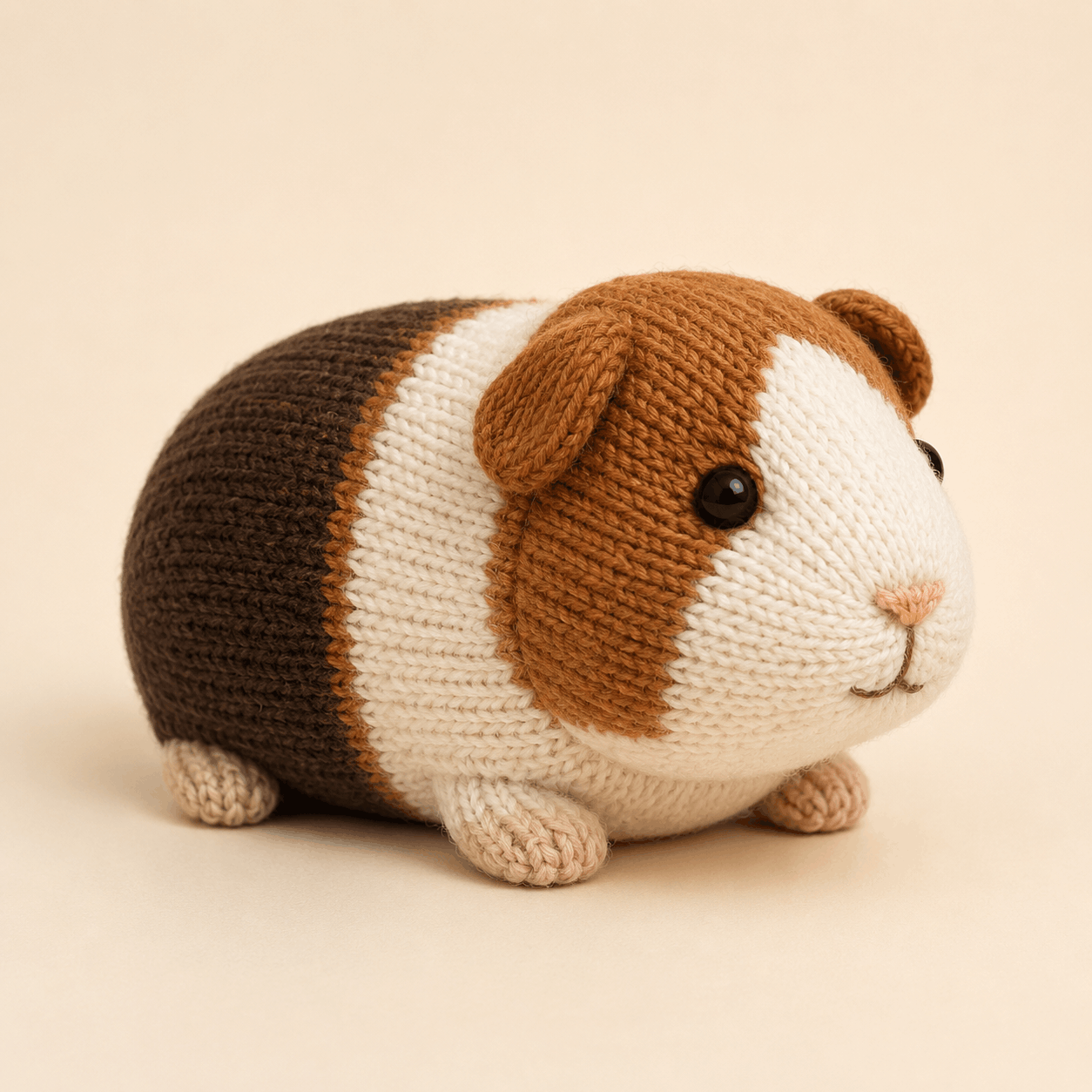
This guinea pig knitting pattern makes Hazel, a plump tricolor plushie with a cream muzzle and underside, cinnamon face patches, a dark chocolate rear, drooping ears, blush-beige feet, black eyes, and simple embroidery. The project combines knitting in the round with two mirrored flat panels, making it suitable for a confident beginner who is ready to practise shaping, colour placement, stuffing, and assembly. This overview covers the materials, techniques, construction, and common finishing problems, while the complete round-by-round instructions and placement maps are available in the PDF near the bottom.
About This Guinea Pig Knitting Pattern
Hazel has a low, rounded stuffed-animal shape rather than a tall toy body. The main stockinette body is worked from the nose toward the rear. Cream forms the muzzle, lower face, underside, and shoulder band, while dark chocolate brown forms the rear. Two cinnamon panels are sewn over the upper head to create the cheek and crown markings while leaving a tapered cream blaze at centre front.
The ears are flattened and unstuffed so they droop naturally. Four small feet support the body close to the surface, and the face uses either 12 mm safety eyes or embroidered eyes, plus a peach nose and dark brown mouth. This guinea pig knitting pattern depends more on careful placement and finishing than on complicated stitch patterns.
Skill Level, Construction and Finished Size
- Craft: knitting; project type: stuffed guinea pig plushie; skill level: Confident Beginner / Easy Intermediate; construction: body, ears, and feet in the round with two mirrored face panels worked flat; finished length: about 24–25 cm / 9.5–9.75 in; body height: about 13–14 cm / 5–5.5 in; body width: about 14–15 cm / 5.5–6 in; ear size: about 3.5 × 4 cm / 1.4 × 1.6 in; foot size: about 3.5 cm / 1.4 in long and 2.5–3 cm / 1–1.2 in wide.
The parts that need the most care are the mirrored cinnamon panels, the straight cream blaze between them, and the foot placement that keeps the body balanced. Finished size can vary with yarn, needle size, tension, and stuffing.
Materials and Tools You Will Need
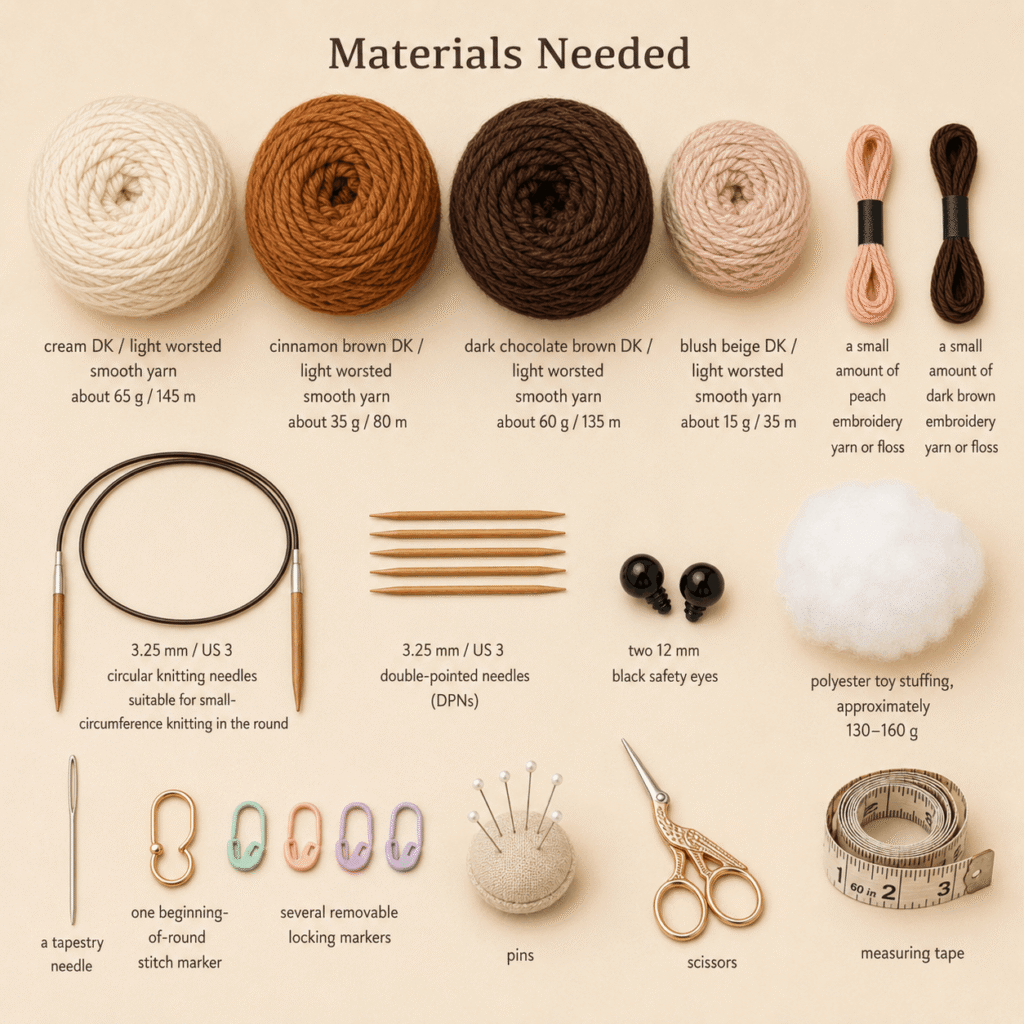
For this guinea pig knitting pattern, use DK/light worsted smooth yarn in approximately 65 g / 145 m cream, 35 g / 80 m cinnamon brown, 60 g / 135 m dark chocolate brown, and 15 g / 35 m blush beige. Small amounts of peach and dark brown embroidery yarn finish the face.
The pattern uses 3.25 mm / US 3 needles suitable for Magic Loop or DPNs, 130–160 g polyester toy stuffing, a tapestry needle, a beginning-of-round marker, removable markers, pins, scissors, measuring tape, and either two 12 mm safety eyes or black yarn for embroidered eyes. Gauge is 24 stitches × 32 rounds per 10 × 10 cm / 4 × 4 in for the circular pieces, with the same stitch and row gauge for the flat face panels. Firm fabric helps keep stuffing from showing.
Stitches and Techniques Used
The knitting uses casting on, knit and purl stitches, stockinette, kfb increases, k2tog and ssk decreases, knitting in the round, flat knitting, and binding off. Finishing includes gathered closures, surface whip stitching, flattened two-layer attachments, stuffing, and simple embroidery.
Gauge consistency matters across all four yarn colours so the structural pieces stay proportional. It is also worth labelling the two face panels as soon as they are finished, because their shaping is mirrored and their inner edges create the centre blaze.
How Hazel Is Constructed
The guinea pig knitting pattern starts at the nose and expands into the cream body. After the head and shoulder area, the yarn changes to dark chocolate brown for the rear, which is decreased toward the back closure.
Before the body is fully closed, the mirrored cinnamon face panels are sewn over the cream upper head. The eyes are installed through both the panels and underlying body fabric, then the body is stuffed gradually with the underside kept slightly flatter than the sides.
The ears are knitted separately, closed at the tip, flattened, and attached unstuffed. Each foot is worked from toe to attachment edge; the toe opening is gathered closed before light stuffing, while the attachment edge stays soft and flat. Nose and mouth embroidery are added during finishing.
Helpful Tips for Making Hazel
Keep the beginning-of-round position centred on the underside. The pattern uses retained fabric markers to preserve the front and rear foot centre lines after the body is closed, so leave those markers in place until the feet are sewn.
Pin the cinnamon panels directly onto the curved head before sewing. Their correct mirrored orientation keeps the cream blaze straight and symmetrical. For this guinea pig knitting pattern, add stuffing in small pieces and keep the nose slightly softer than the sides and rear. Press the underside into a broad, low curve before placing the feet.
Pin both ears and all four feet before making permanent seams. Compare the toy from the front, sides, top, and underside. When attaching flattened ears or feet, each sewing stitch should catch both layers of the knitted piece.
Troubleshooting Common Problems
Why Does My Guinea Pig Knitting Pattern Look Too Round?
Too much stuffing underneath can make Hazel spherical instead of long and low. Move some filling toward the sides and rear, then press the belly into a slightly flatter curve. Also check row and round gauge, because a mismatch can change the body length even when the stitch count is correct.
Why Are the Cinnamon Face Panels Rippling?
The panel seam may be too tight, or the panel may have been pinned on a flat surface instead of the curved head. Loosen the problem area, repin it on the stuffed body, keep the cream blaze straight, and resew with small flexible whip stitches.
Why Do the Feet Splay or Miss the Surface?
Use the retained underside markers and pin all four feet together before sewing. The toes should angle slightly forward rather than outward. Keep each attachment line short and catch both flattened layers. If one foot still sits high, adjust its pinned position slightly before securing it.
Care Instructions for the Finished Project
Spot-clean when possible and follow the care instructions for the yarn you use. Avoid twisting or wringing, reshape the plushie gently while damp, and air-dry it fully away from direct heat. Check the ear and foot seams from time to time if the toy is handled frequently.
Safety eyes and other rigid small parts may not be suitable for children under three years old. The pattern provides embroidered eyes as an alternative.
Leave a Reply