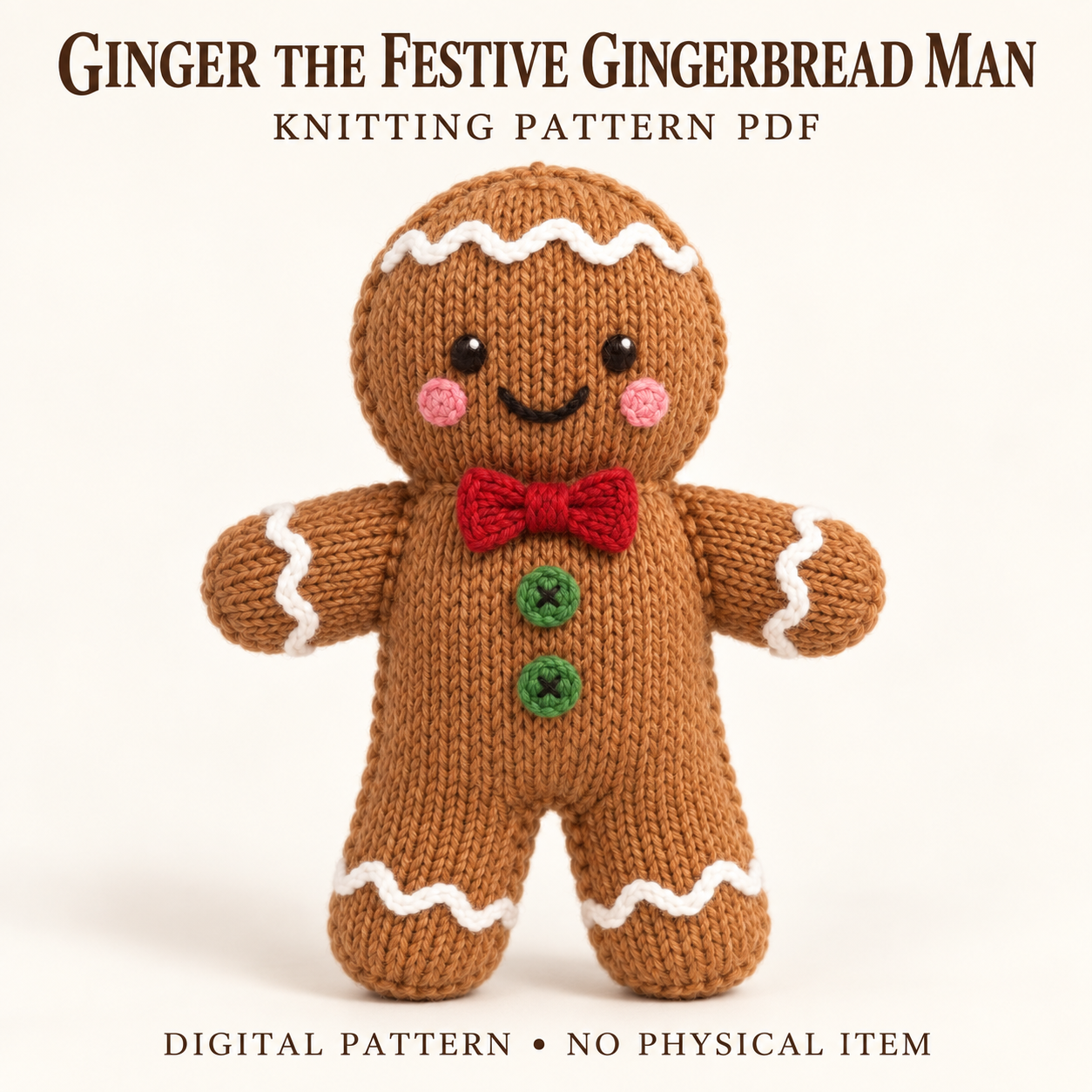
This gingerbread man knitting pattern creates Ginger, a rounded brown character decorated with white icing, a red bow tie, pink cheeks, and two green knitted buttons. The oversized head and compact body give the design its cheerful proportions, while wavy I-cord bands bring the gingerbread theme to the head, wrists, and ankles. The main pieces use circular knitting, with smaller flat details added during finishing. Ginger is a useful project for knitters who enjoy combining shaped toy parts with embroidered expressions and sewn decorations. This guide covers the supplies, construction approach, and assembly decisions described in the PDF. Use the complete pattern for the full stitch counts and round-by-round shaping instructions.
Details in this gingerbread man knitting pattern
Ginger’s icing comprises five separate bands: one around the head above the eyes, plus a band at each wrist and ankle. Their waves are formed during attachment, rather than knitted directly into the brown fabric.
The green buttons are yarn appliqués with black X details, not plastic buttons. Two pink cheek discs and a black smile complete the face. A red bow sits beneath the chin, and the back stays plain apart from the icing bands that continue around the relevant parts. The restrained set of decorations makes symmetrical placement especially noticeable.
Skill level, gauge, and planned size
The PDF places the project at confident-beginner to intermediate level. Circular knitting, increases, decreases, joining live leg stitches, and toy assembly form the main skill set. Smaller details introduce flat knitting and I-cord.
The gingerbread man knitting pattern uses a firm gauge of 19 stitches and 27 rounds per 10 cm. Its approximate height target is approximately 30–32 cm, with an 11.5–12.5 cm head diameter and a 25–27 cm arm span. The PDF explicitly treats the dimensions as approximate rather than measurements from a physically tested prototype. Yarn choice, gauge, and stuffing can therefore affect the final proportions.
Yarn colours and essential supplies
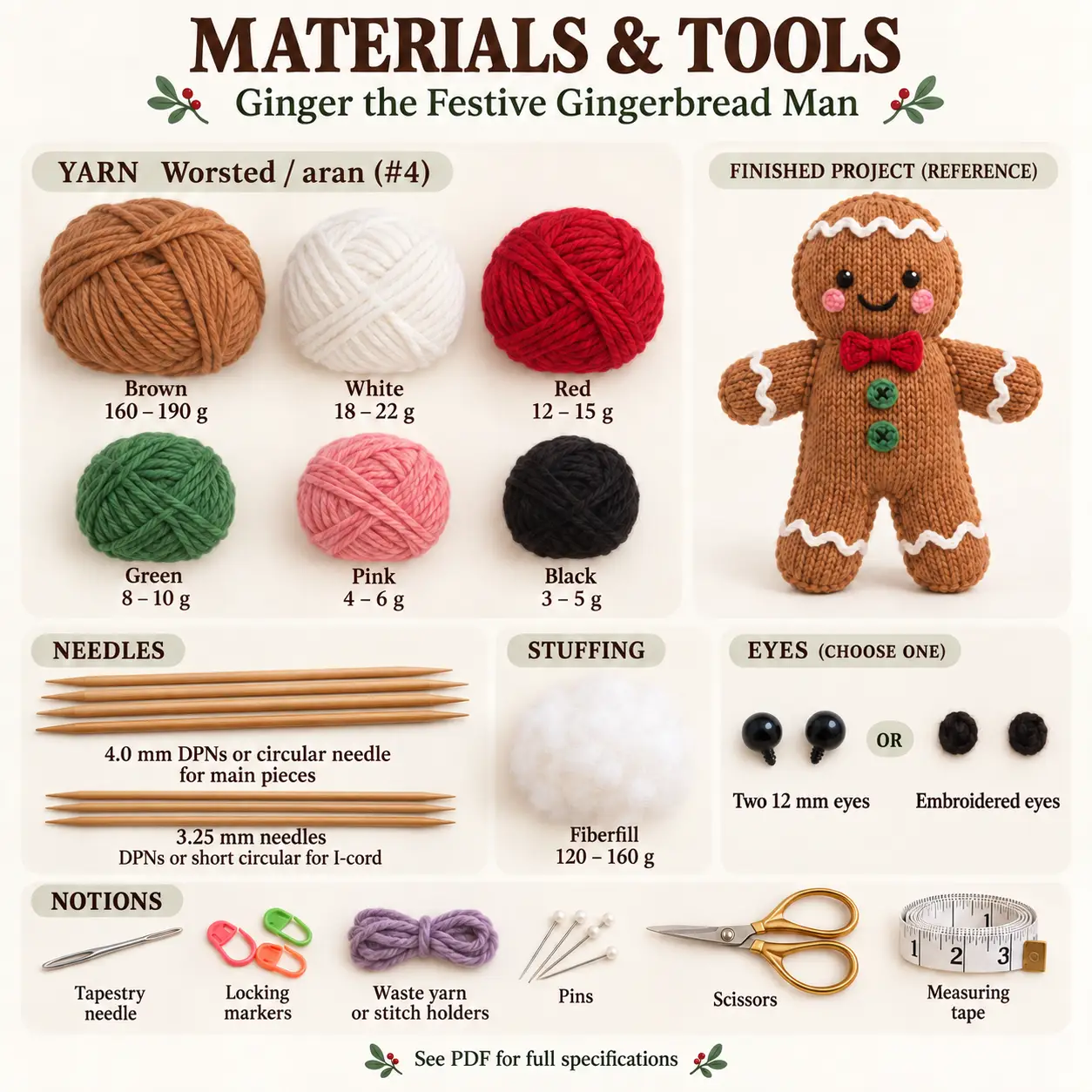
Choose smooth medium-weight worsted or aran yarn, such as acrylic or a wool blend. The PDF lists:
- Gingerbread brown: 160–190 g.
- White: 18–22 g.
- Red: 12–15 g.
- Green: 8–10 g.
- Pink: 4–6 g.
- Black: 3–5 g.
Use 4 mm double-pointed needles or a circular needle for the main pieces. The smaller details use 3.25 mm needles; I-cord requires double-pointed needles or a short circular needle. Prepare 120–160 g of fiberfill and either two 12 mm eyes or embroidered eyes.
A tapestry needle, locking markers, waste yarn or holders, pins, scissors, and a measuring tape support the finishing work. Organising these supplies before starting the gingerbread man knitting pattern helps keep small appliqués and temporary markers easy to identify.
Techniques that shape the character
The legs begin separately and remain live until they are joined with cast-on crotch bridges. The torso then grows from that joined base. The head is a separate piece worked from the crown toward its neck edge, while the arms run from the hands toward the shoulders.
For the gingerbread man knitting pattern, physical centre-front and centre-back guides stay at the bridge midpoints. They should not move simply because the beginning of round changes during shaping. These fixed references help align the face, bow, buttons, and head connection later.
The bow uses two flat wings and a centre band. Button and cheek discs stay unstuffed, as do the bow pieces.
Building the body and adding decorations
Complete the joined legs and body, then work the separate head and arms. If using fitted eyes, install them before the head’s final shaping and closure make the inside inaccessible. Align the physical front and back guides when joining the head to the body.
Attach the arms before arranging the decorative details. Sew the icing around the stuffed forms, placing its wave anchors carefully. Add the pink cheeks and embroidered expression, then secure the bow beneath the chin and the two buttons along the front. Finish their black X details and remove temporary guides.
Check the character from several angles before the final sewing passes. The head’s neck edge and the body’s upper edge both have 48 stitches in the PDF, providing a useful alignment reference.
Stuffing and icing placement tips
Give the feet firmer filling, use medium filling at the crotch, and keep the torso moderately firm with a slightly softer neck. Fill the head evenly, and leave the arm shoulders soft enough to attach naturally. Add small amounts gradually so the outer fabric stays smooth.
The gingerbread man knitting pattern relies on couching to hold its white I-cord waves in position. Space the anchors evenly around the stuffed form, keeping the head band above the eyes. Do not pull the cord so tightly that it flattens the head or draws the wrists inward.
Secure the bow’s centre band before deciding whether its tips need small positioning tacks. This helps preserve the bow’s shape while keeping it centred.
Troubleshooting shaping and finishing
Why is the icing uneven on my gingerbread man knitting pattern project?
Unequal anchor spacing can create waves of different sizes. Re-pin the cord around the stuffed piece, then adjust the couching points so the peaks and dips repeat more consistently. Assess the whole band before securing the last section.
How can I close a small crotch-corner gap?
Use the joining tail to close the tiny opening at a bridge corner. Keep the surrounding fabric relaxed while sewing; excessive tension can distort the joined legs. Recheck the front and back guide positions once the gap is closed.
Why does the head appear rotated?
Compare the head’s front with the body’s physical centre-front guide, rather than relying only on a round-start marker. Re-pin the neck attachment to restore alignment before sewing it securely. The facial decorations should follow that same front reference.
Care for the completed knitted character
Use the yarn label as the starting point for care. Gentle surface cleaning protects the many sewn details from unnecessary handling. Avoid wringing the toy or tugging the icing, bow, and appliqués when wet.
Dry Ginger thoroughly away from direct heat, maintaining the rounded shapes. Check decorative attachments and the eye finish during ordinary use. The embroidered-eye option avoids fitted eye components, but all small details still need secure finishing appropriate to the intended recipient. The PDF does not provide a universal washing method or a formal product-safety certification.
Download Ginger’s complete pattern PDF
The gingerbread man knitting pattern PDF provides the full instructions for the joined body, separate head and arms, icing, appliqués, and assembly. Keep it beside your knitting for the exact stitch counts and shaping sequence.
DIGITAL DOWNLOAD ONLY — NO PHYSICAL ITEM WILL BE SHIPPED.
Leave a Reply