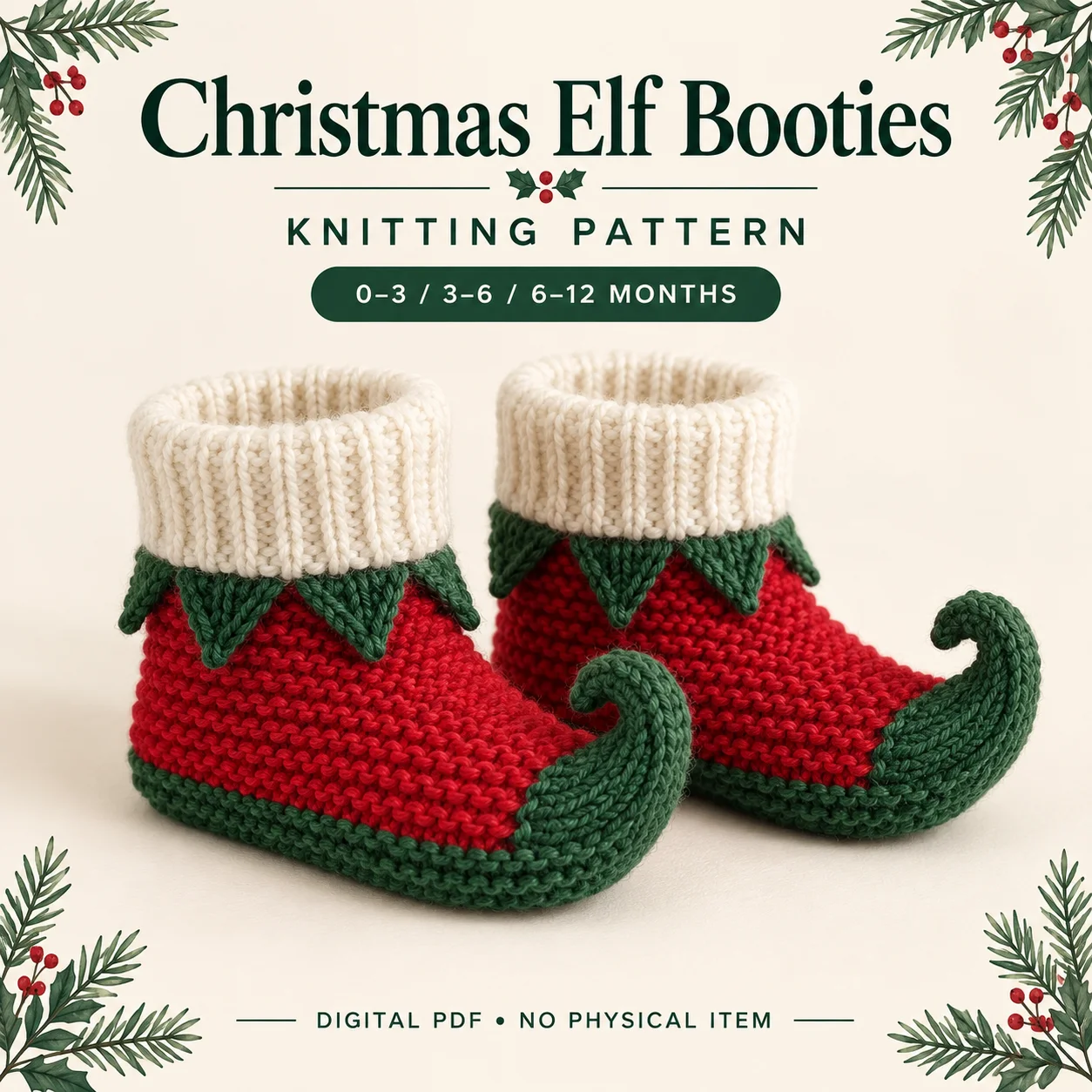
This elf booties knitting pattern creates a pair of decorative infant Christmas booties with ivory cuffs, scarlet upper feet and forest-green soles and curled toes. The pieces are knitted flat, with a turned garter sole and sewn heel closure. These decorative booties are not intended for walking or unattended sleep. The PDF brings together the materials list, gauge guidance, construction instructions and finishing checks, so you can plan the project before casting on. Use the written counts and diagrams together, and keep the selected size or row schedule visible while working. This article explains the design and preparation; the downloadable document supplies the complete instructions. Check gauge and the size measurements before beginning.
DIGITAL DOWNLOAD ONLY — NO PHYSICAL ITEM WILL BE SHIPPED.
Design features of the elf booties knitting pattern
The white cuffs use true one-by-one ribbing, followed by red ankles and a red garter instep and sidewall. Green forms the outsole. Four small green collar points decorate each cuff junction. Each curled toe uses two shaped green panels, joined without stuffing and tacked upward and back. Optional gold dots are embroidered with soft yarn. The document excludes detachable bells, beads and hard ornaments.
The preview is an illustrative rendering of the intended project. For exact color locations, stitch counts and relative placement, use the PDF’s counted instructions. A decorative image cannot establish gauge or confirm the behavior of a particular yarn.
Skill level and techniques to prepare
The PDF rates this project Intermediate. Useful techniques include flat ribbing on an odd stitch count, stockinette, holding side stitches, garter instep knitting, edge pickups, turned sole rows, decrease shaping, backstitch heel joining and sewing small knitted components. Read through the finishing sequence before beginning, especially where a later step depends on held stitches or a marked fabric edge.
Practice an unfamiliar technique on spare yarn first. When preparing the elf booties knitting pattern, separate learning a technique from checking the project counts, so an uncertain method does not obscure which row or stitch group you are working.
Yarn colors and tools
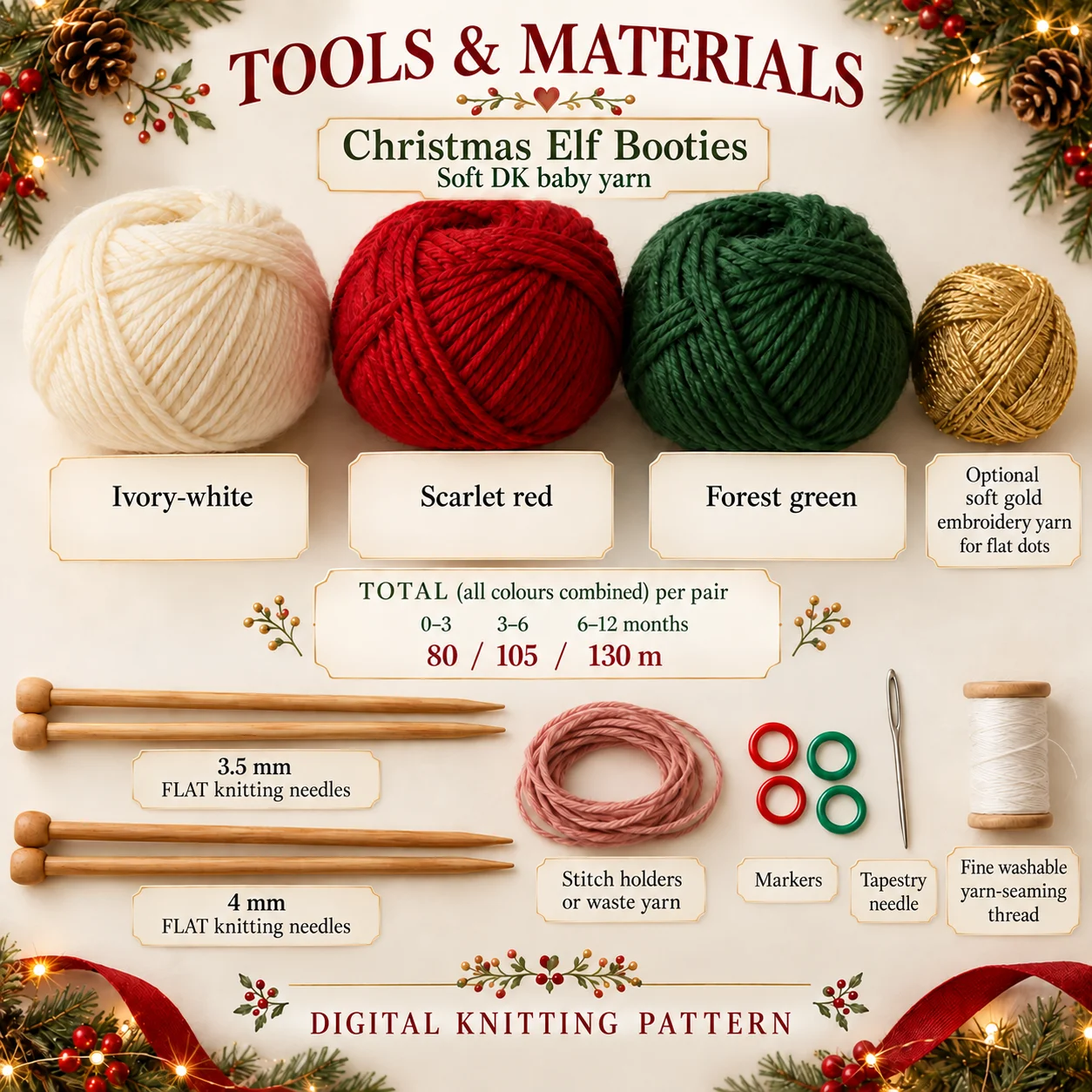
Ivory-white, scarlet red and forest green: 80 / 105 / 130 m TOTAL per pair for 0–3 / 3–6 / 6–12 months. Optional soft gold embroidery yarn for flat dots. No bells or beads.
Equipment: 3.5 mm and 4 mm FLAT knitting needles; stitch holders or waste yarn, markers, tapestry needle and fine washable yarn-seaming thread.
These allowances should guide preparation, not be presented as measured consumption. Keep each accent color labelled and compare the fiber-care requirements before combining yarns. The tools and materials image accompanies the elf booties knitting pattern as a quick reference, while the PDF remains the detailed supply source.
Gauge and calculated measurements
The target is 22 stitches and 30 rows per 10 cm in blocked stockinette, plus approximately 32 garter rows per 10 cm on 4 mm needles. These are provisional fabric targets; sample the actual fabrics and check their blocked response.
The size labels are 0–3, 3–6 and 6–12 months. Reference foot lengths are 8.2, 9.2 and 10.4 cm. Calculated sole targets are 8.8, 10 and 11.3 cm, excluding the decorative curl. Cuff cast-ons are 27, 31 and 35 stitches, with central instep groups of 13, 15 and 17. Measure the intended foot and inspect the actual heel and opening rather than assuming an age label confirms fit.
Wash or block a swatch as permitted by the yarn label, dry it flat and measure a central ten-centimeter area. Use the actual blocked gauge when assessing dimensions. Too many stitches per ten centimeters generally requires larger needles; too few requires smaller needles. Re-swatch after changing needles. The elf booties knitting pattern measurements are provisional calculations, so blocking should not be used to disguise a significant gauge mismatch.
Construction and finishing sequence
Work two booties with matching counts. Begin with twelve white rib rows, then the size-specific red ankle rows. Hold the outer groups while knitting the central red instep for fourteen, sixteen or eighteen garter rows. Pick up one stitch per two instep-edge rows to reach 41, 47 or 53 stitches. Knit the red sidewall, then change to green for the turned sole. Each sole row consumes one side stitch; after 28, 32 or 36 rows, all side stitches are used and the central 13, 15 or 17 stitches remain.
Keep a row record as you work and pause at the stitch-count checkpoints. Read the selected instruction line independently instead of mixing values from different sizes. For the elf booties knitting pattern, the written construction sequence provides the reliable order of operations; use its counts rather than reconstructing the garment from the promotional image.
Counted decoration and practical tips
Bind off the central green sole edge, fold it at its single center stitch and backstitch the matching halves with the wrong side outward. Connect the vertical back-ankle seam to that heel junction. Check the heel and sole join before sewing the decorative toe. For each toe, sew two tapered panels along both long edges and the three-stitch tip, leaving only the cast-on base open. Attach that entire base above the sole at the red forefoot, then tack the tip upward and back. Inspect both heels before adding decoration.
Useful checks while working:
- Follow the alternating cuff rows for the odd stitch count.
- Check both instep pickups against the size table.
- Record every sole turn and side stitch consumed.
- Inspect the folded heel geometry on the actual fabric.
- Secure toe components and omit attachments that create risk.
Before putting the elf booties knitting pattern away between sessions, record the last completed row and the next action. A simple note makes it easier to resume at the correct point without repeatedly recounting the whole piece.
Troubleshooting
Why does my elf booties knitting pattern project develop instep holes?
Check that each instep edge supplied one pickup per two rows and that the held side groups were included in the correct orientation. The PDF allows small remaining gaps to be closed with duplicate stitch. Do not add uncontrolled pickups to conceal a counting mistake.
Why are the soles uneven?
Count the turned sole rows and confirm that the left and right side groups were consumed alternately. Both booties need the selected total of 28, 32 or 36 sole rows, with no side stitches remaining.
Why does the heel junction fail to align?
Check the folded bound-off sole edge and its center stitch before joining the ankle seam. The source specifically warns against sewing to an imaginary separate horizontal heel edge. Its provisional geometry must be inspected on the knitted pieces.
Care and final inspection
Hand wash according to the baby yarn’s requirements and dry flat. Inspect cuffs, heel junctions, collar points and curled-toe attachments before use. These decorative booties have no verified walking grip and are not for walking or unattended sleep. Keep small parts and attachments secure and supervise use.
Check the finished project against the original stitch counts, row counts and placement notes. Inspect the edges and all secured yarn ends before use. The elf booties knitting pattern should be assessed using your actual fabric and wearer needs, with the source’s provisional sizing notice kept in mind.
Download the digital PDF
The document includes a project overview, supplies, abbreviations, construction guidance, counted decoration or color schedule, and finishing advice. Read it alongside the diagrams and keep the gauge information available while working. It is a digital knitting guide for making the project yourself.
For general foot measurements, consult the Craft Yarn Council foot size chart. These are reference measurements, not proof of fit for this bootie pattern; measure the intended wearer, check the PDF’s provisional sizing notes, and compare the finished sole after knitting.
Leave a Reply