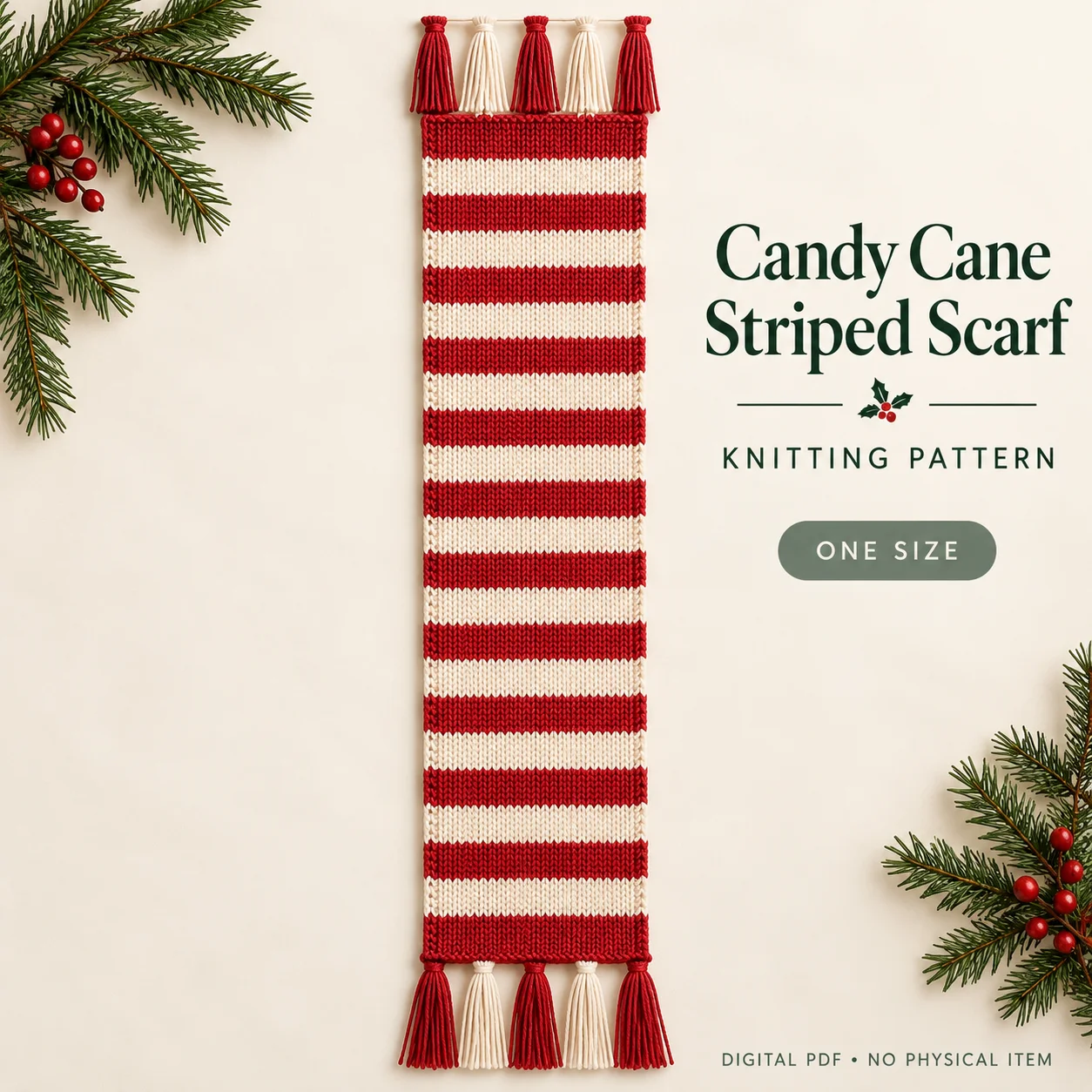
This candy cane scarf knitting pattern creates a red-and-ivory scarf with a smooth knitted center and narrow garter borders. Twenty-one real yarn-color bands create the stripes, while five solid-color fringe bundles finish each end. The one-size design is worked flat on straight needles, with a counted row schedule that keeps the first and last bands red. The PDF brings together the materials list, gauge guidance, construction instructions and finishing checks, so you can plan the project before casting on. Use the written counts and diagrams together, and keep the selected size or row schedule visible while working. This article explains the design and preparation; the downloadable document supplies the complete instructions. The pattern includes measurements and yarn guidance; your finished fit will depend on gauge and finishing.
DIGITAL DOWNLOAD ONLY — NO PHYSICAL ITEM WILL BE SHIPPED.
Design features of the candy cane scarf knitting pattern
The scarf keeps twenty stitches throughout: three garter stitches at each long edge and fourteen stockinette stitches in the middle. Eleven red bands alternate with ten ivory bands. The two red end bands each contain twenty rows; the nineteen internal bands contain twelve or thirteen rows according to the PDF table. The fringe at each short edge alternates red, ivory, red, ivory and red. Decoration is created by changing the working yarn, not by stitching a chart over finished fabric.
The preview is an illustrative rendering of the intended project. For exact color locations, stitch counts and relative placement, use the PDF’s counted instructions. A decorative image cannot establish gauge or confirm the behavior of a particular yarn.
Skill level and techniques to prepare
The PDF rates this project Beginner+. Useful techniques include casting on, knitting, purling, following right-side and wrong-side rows, joining a new stripe color, binding off, weaving yarn ends and making folded fringe. Read through the finishing sequence before beginning, especially where a later step depends on held stitches or a marked fabric edge.
Practice an unfamiliar technique on spare yarn first. When preparing the candy cane scarf knitting pattern, separate learning a technique from checking the project counts, so an uncertain method does not obscure which row or stitch group you are working.
Yarn colors and tools
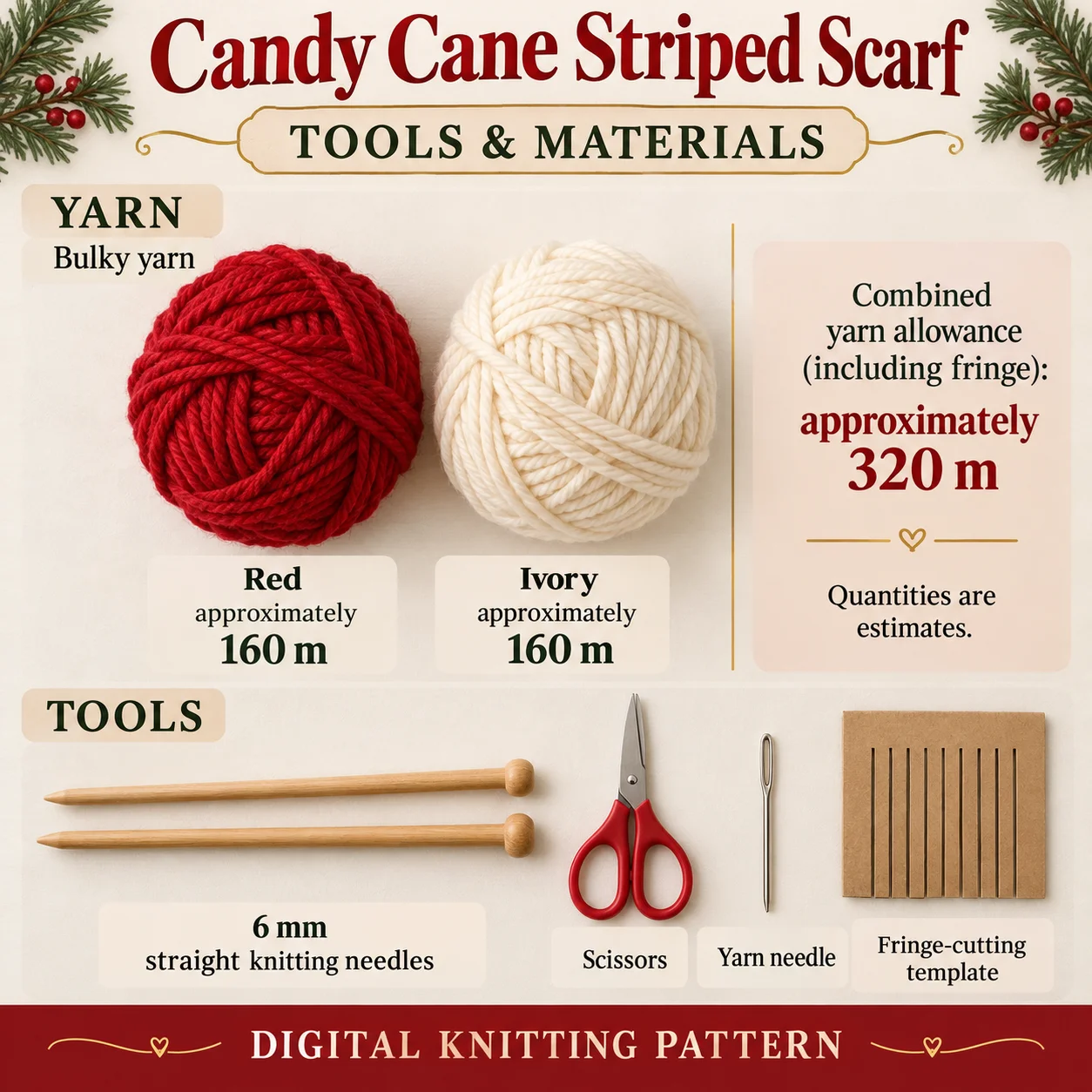
Red approximately 160 m; ivory approximately 160 m, including fringe. Quantities are estimates.
Equipment: 6 mm straight knitting needles, scissors, yarn needle and fringe-cutting template.
These allowances should guide preparation, not be presented as measured consumption. Keep each accent color labelled and compare the fiber-care requirements before combining yarns. The tools and materials image accompanies the candy cane scarf knitting pattern as a quick reference, while the PDF remains the detailed supply source.
Gauge, sizing and finished measurements
The target is 14 stitches and 20 rows per 10 cm in blocked stabilized-stockinette fabric on 6 mm needles. Make the swatch with the specified three-stitch garter borders and smooth central fabric, rather than using an all-garter sample.
The one-size finished-size guidelines are 14.3 cm in blocked width and 140 cm in knitted length. Fringe adds approximately 11 cm at each end, or 22 cm overall. The document allows optional length adaptation, but its supplied twenty-one-band table totals 280 rows. Changing that table requires a separate length plan and revised yarn allowance.
Wash or block a swatch as permitted by the yarn label, dry it flat and measure a central ten-centimeter area. Use the actual blocked gauge when assessing dimensions. Too many stitches per ten centimeters generally requires larger needles; too few requires smaller needles. Re-swatch after changing needles. Check your blocked gauge before choosing a size; blocking should not be used to disguise a significant gauge mismatch.
Construction and finishing sequence
Cast on twenty stitches in red. Right-side rows knit all twenty; wrong-side rows knit three, purl fourteen and knit the final three. Follow all twenty-one inclusive row ranges in sequence, keeping the border the same color as its current stripe. The last ivory band finishes at row 260; the final red band occupies rows 261 through 280. Bind off knitwise in red. Weave the color-change ends into matching-color wrong-side stitches and block before attaching the fringe.
Keep a row record as you work and pause at the stitch-count checkpoints. Read the selected instruction line independently instead of mixing values from different sizes. For the candy cane scarf knitting pattern, the written construction sequence provides the reliable order of operations; use its counts rather than reconstructing the garment from the promotional image.
Counted decoration and practical tips
Join each new color at its listed row with a twelve-centimeter weaving tail. Do not carry the resting yarn up the side. For each fringe bundle, cut eight same-color strands to 24 cm, fold them and attach them to the short edge. The fold creates sixteen hanging ends per bundle. Five bundles belong at each end near stitch positions 2, 6, 10, 14 and 18. Both ends together require 48 red and 32 ivory cut strands; trim the attached fringe to approximately 11 cm.
Useful checks while working:
- Count worked rows rather than garter ridges.
- Keep all twenty stitches after every color change.
- Knit the first and last three stitches on both row sides.
- Prepare single-color fringe bundles before attaching them.
- Trim both fringe ends only after the fabric is dry.
Before putting the candy cane scarf knitting pattern away between sessions, record the last completed row and the next action. A simple note makes it easier to resume at the correct point without repeatedly recounting the whole piece.
Troubleshooting
Why do the stripe lengths differ?
The internal bands intentionally contain either twelve or thirteen rows, while the two red end bands contain twenty. Check actual rows against the inclusive row-range table. Counting edge ridges instead of worked rows gives a different result and can lengthen the scarf.
Why are the long borders uneven?
Check that all three edge stitches are knitted on both right-side and wrong-side rows. On wrong-side rows, purl only the central fourteen stitches. Keep border tension consistent when joining new yarn.
Why is the fringe uneven?
Check for five bundles at each end and eight same-color cut strands in each bundle. Match the red, ivory, red, ivory, red order across both ends. Attach all bundles before trimming them to a shared length.
Care and final inspection
Hand wash as appropriate to the yarn and lay the scarf flat to dry. Fringe can tangle during machine washing. Weave stripe ends horizontally through matching-color wrong-side stitches, reverse direction and trim only when secure.
Check the finished project against the original stitch counts, row counts and placement notes. Inspect the edges and all secured yarn ends before use. Compare the pattern dimensions with the intended wearer and check the finished fit before use.
Download the digital PDF
The document includes a project overview, supplies, abbreviations, construction guidance, counted decoration or color schedule, and finishing advice. Read it alongside the diagrams and keep the gauge information available while working. It is a digital knitting guide for making the project yourself.
Leave a Reply