
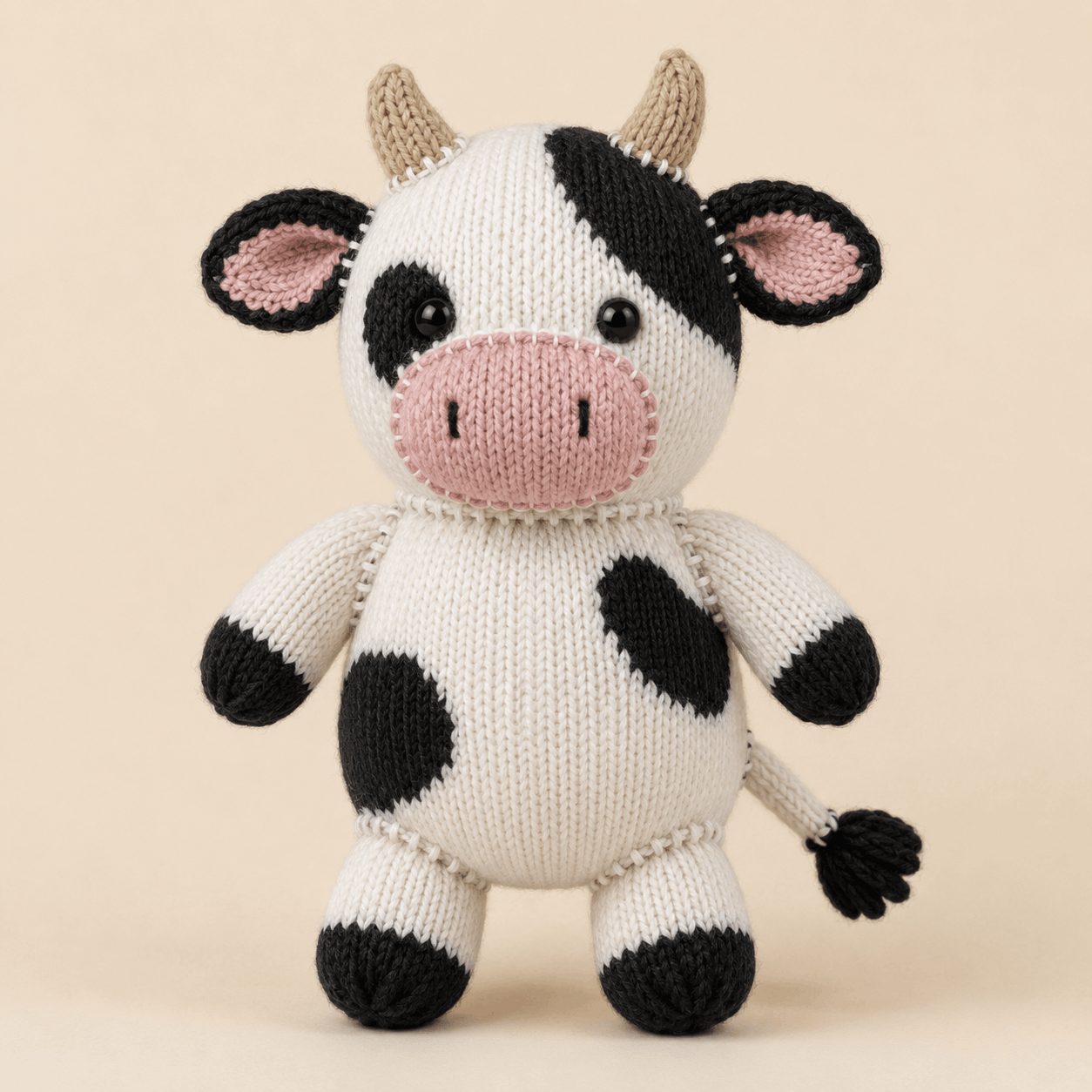
The patchwork cow knitting pattern for Mabel creates a plump standing cow with a cream body, asymmetrical black markings, a dusty-pink muzzle, pink inner ears, black hoof tips, tan horns, and a slim tail with a black tuft. Most of the plushie is knitted in the round, while the muzzle and ear panels are worked flat and the tail uses I-cord. Rated Confident Beginner to Intermediate, it suits knitters who know basic shaping and want to practise duplicate stitch, careful placement, stuffing, and assembly. This overview explains the project without reproducing the full instructions, which remain in the downloadable PDF near the bottom.
About This Patchwork Cow Knitting Pattern
Mabel is a standing stuffed cow with a rounded head, softly tapered body, short limbs, broad muzzle, and small upright horns. Her irregular black-and-cream colouring gives the design its patchwork look.
The black markings are added with duplicate stitch while the head and body are still unstuffed, preserving the visible knitted V texture across the patches. Other distinctive details include layered black-and-pink ears, decorative cream joining stitches, and an I-cord tail with a black tassel.
These finishing details make the patchwork cow knitting pattern a good choice for knitters who enjoy adding character through placement and sewing after the main stockinette pieces are complete.
Skill Level, Construction and Finished Size
The PDF rates Mabel as Confident Beginner to Intermediate.
- Craft: Knitting
- Project type: Standing cow plushie
- Construction: Mainly worked in the round, with flat-knitted pieces and an I-cord tail
- Finished height: Approximately 30–32 cm / 11.75–12.5 in including the horns
- Finished width: Approximately 20–22 cm / 7.9–8.7 in from ear tip to ear tip
- Head: About 10–11 cm / 3.9–4.3 in high and wide
- Body: About 12.5–13.5 cm / 4.9–5.3 in high and 10.5–11.5 cm / 4.1–4.5 in wide
- Making time: Not stated in the PDF
The knitting uses familiar shaping, but the duplicate-stitch maps, centre-front orientation, mirrored attachments, and standing balance need more concentration.
Materials and Tools You Will Need
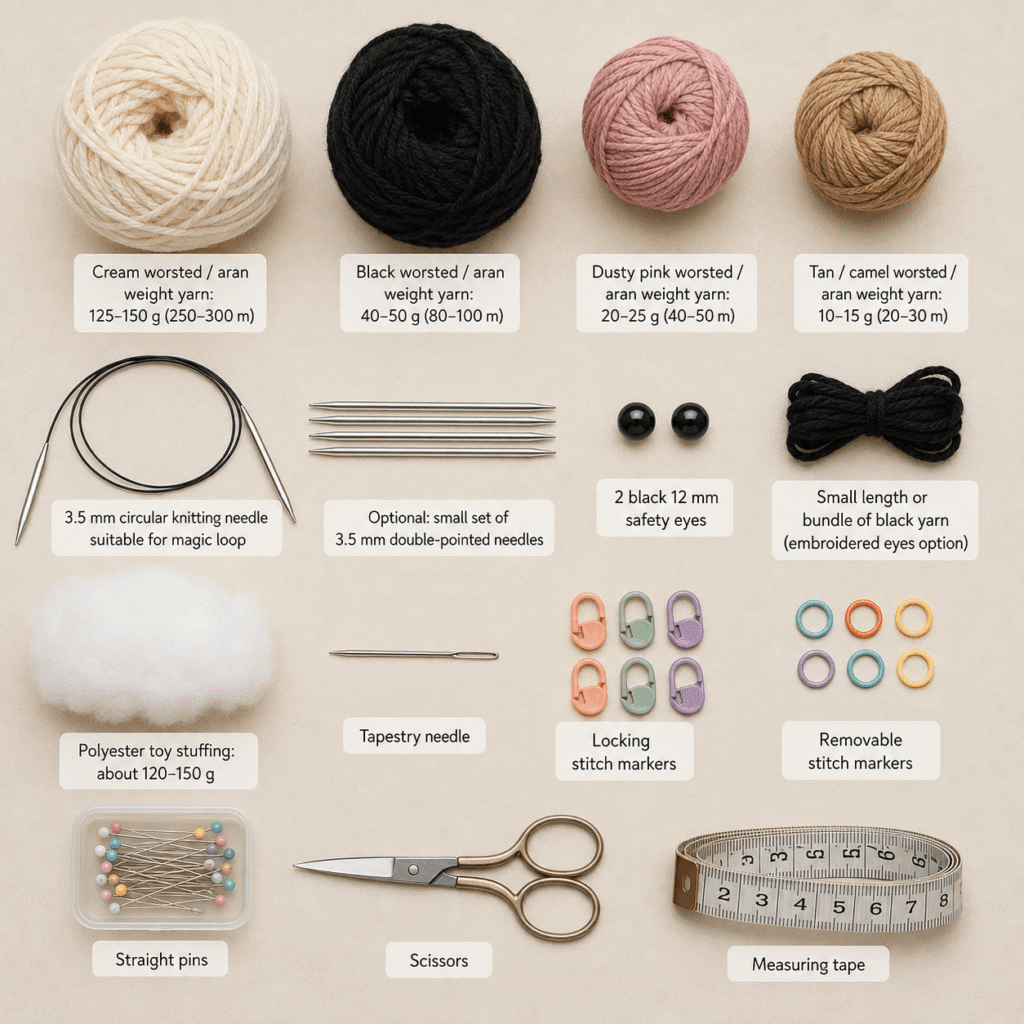
The patchwork cow knitting pattern uses Worsted/Aran weight yarn in cream, black, dusty pink, and tan or camel. The PDF specifies about 125–150 g of cream, 40–50 g of black, 20–25 g of dusty pink, and 10–15 g of tan/camel.
Use 3.5 mm circular needles suitable for magic loop or 3.5 mm double-pointed needles. The same size may be used for the flat pieces.
You will also need about 120–150 g of polyester toy stuffing, a tapestry needle, locking and removable markers, pins, scissors, and a measuring tape. The face can use two 12 mm black safety eyes or embroidered black yarn eyes.
Gauge is 24 stitches × 32 rounds = 10 × 10 cm / 4 × 4 in in stockinette worked in the round. Aim for a dense fabric that contains stuffing without becoming stiff.
Stitches and Techniques Used
Mabel uses casting on, binding off, knit and purl stitches, knitting in the round, kfb increases, k2tog and ssk decreases, and flat stockinette.
Duplicate stitch forms the black patches by covering selected cream knit stitches with black yarn. A four-stitch I-cord creates the tail. Finishing also uses embroidery, stuffing, whip stitching, decorative blanket-style joins, and sewing pieces to counted positions.
The stitches are straightforward; the more demanding part is keeping decorative details symmetrical and following placement references accurately.
How Mabel Is Constructed
The head is knitted from the crown downward. Before its lower opening becomes too small, the black patches are completed and safety eyes are fitted if that option is used. The head is then stuffed and closed. Embroidered eyes are added after stuffing when chosen instead.
The body begins at the open neck and is knitted downward. Its black patches are also added before stuffing, and the lower body closes while the neck remains accessible.
The muzzle, outer and inner ear panels, horns, arms, legs, and tail are made separately. The limbs begin with black hoof sections before changing to cream.
During assembly, the facial details, horns, and ears are finished before the limbs and tail. The body is partly stuffed, attachments are sewn in place, the remaining stuffing is adjusted, and the 32-stitch neck opening is joined one-to-one to the head.
Helpful Tips for the Patchwork Cow Knitting Pattern
Keep a removable marker at centre front when checking patches and facial features. The pattern positions centre front relative to the beginning-of-round marker at centre back, helping prevent left/right mistakes.
Complete duplicate-stitch markings before stuffing so you can secure yarn ends on the wrong side and keep the floats relaxed.
Match the black duplicate-stitch tension to the cream stockinette. Pulling too tightly can pucker the fabric and distort the mapped patches.
Pin the muzzle, ears, horns, arms, and legs before sewing. This patchwork cow knitting pattern gives specific placement references, but checking the cow from several angles helps catch small differences.
Stuff with the intended shape in mind: horns are lightly filled, the muzzle stays softly rounded, and the upper limb sections remain softer for attachment.
Finally, stand the body upright before completing the leg seams so both black hooves face forward and sit at the same height.
Troubleshooting Common Problems
Why Does My Patchwork Cow Knitting Pattern Project Sit Unevenly?
If Mabel leans or one leg sits higher, compare both leg joins. The pattern places them at the same body round with mirrored stitch spans. Repin the higher piece, keep both hooves facing forward, and check the body on a flat surface before resewing. If the base is too rounded, redistribute some stuffing upward and flatten the lower body gently.
Why Are the Black Patches Puckering?
The duplicate-stitch yarn may be too tight. Ease each covered V until it matches the surrounding cream stitches. Similar yarn weight and gauge for black and cream also help the surface remain smooth.
Why Is Stuffing Showing Through?
Check the stated gauge. If the stockinette is too loose, stitches can spread when stuffed. The PDF recommends using a smaller needle or reducing the stuffing until the fabric closes cleanly.
Why Does the Muzzle Look Off-Centre?
Use the marked centre front rather than judging against the irregular black patches. Remove the shifted section of seam, repin the muzzle, check it from the front, and resew once it is level.
Care Instructions for the Finished Cow
The PDF does not specify a washing method or yarn fibre, so follow the care instructions for the yarn you use. As cautious general care, spot-clean when practical, avoid twisting or wringing, reshape while damp, and air-dry fully away from direct heat.
The pattern notes that safety eyes and other small rigid components may not be suitable for projects intended for children under three years old. Embroidered eyes are offered as an alternative. The PDF does not claim formal toy-safety testing.
Leave a Reply